
Story of the Week: Andrew Lloyd Webber’s Experimental Theater Era
Radical new productions of Cats and Phantom play New York this season.
 |
Broadway
|
|
Broadway
|
November 7, 2025
(© Tricia Baron)
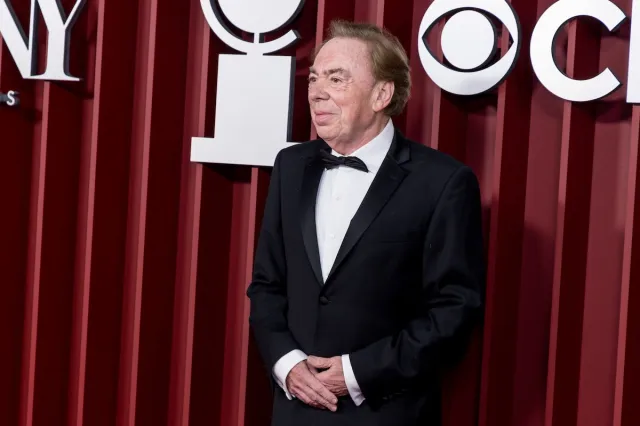
Two years ago, I marked the abrupt closing of Bad Cinderella with an overview of Andrew Lloyd Webber’s remarkable run as the most successful living musical-theater composer, writing, “Those of us under the age of 44 have never known a time in which Lloyd Webber didn’t have a presence on Broadway.”
Evita, Cats, and (most notably) The Phantom of the Opera shaped the tastes of multiple generations of theatergoers by wedding catchy tunes to spectacular stagecraft—but most importantly, by touring relentlessly. A uniform vision (one production of Cats looked much like any other) created a globally recognized brand—the McDonalds of musical theater—earning piles of cash for Lloyd Webber and his investors.
But that uniformity also bred artistic stagnation. I was disappointed by the last Broadway revival of Cats, which was just a remounting of the original. I suspected Lloyd Webber was too set in his ways to ever mess with a product that had proved so financially lucrative. And after Phantom closed, I was certain it would return in a form significantly diminished from the lavish Hal Prince production that lived in the Majestic Theatre from 1988 to 2023. But I was wrong on both counts.
Story of the Week will look at two thrillingly reimagined ALW musicals playing New York this season and what they say about the experimental streak of a composer we think we have all figured out.
(© Oscar Ouk)
What is Masquerade?
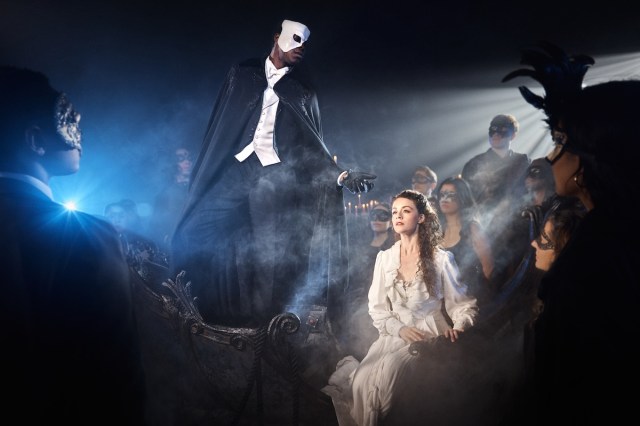
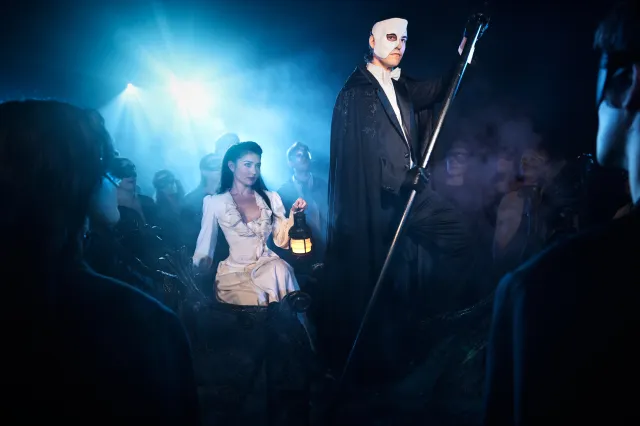
This off-Broadway revival of The Phantom of the Opera takes audiences inside the musical by transforming the old ASCE Society House on West 57th Street (most recently the home of Lee’s Art Shop) into the Paris Opera. We arrive as guests of a masquerade gala but are quickly sucked into the drama surrounding young soprano Christine Daaé and the mysterious “opera ghost” who has been secretly giving her music lessons, which we get to witness as we chase the Phantom and Christine down to his secret lair.
It’s intoxicating to know that you’re participating in camp while still getting goosebumps all the same. That’s certainly how I felt as I clutched my little electric candle and descended the escalator accompanied by the title song, arriving in the basement just in time to witness the phantom steer his gondola past me on an invisible lake shrouded in stage fog. The whole event is like stepping inside a 1980s gothic fantasy, making this the premier court masque of the Trump era. Although with any luck, we’ll get an immersive Evita in the new White House ballroom.
Director Diane Paulus and her team have scrupulously designed every detail, from Emilio Sosa’s magnificently bejeweled costumes to the elegantly scripted handwriting of the Phantom’s threatening letters.
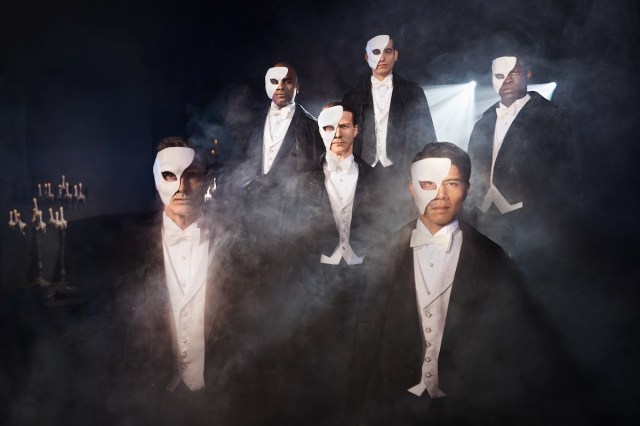
An army of “butlers” in white lace masks usher us through the space with care and precision. There was a woman in a wheelchair in my group, and a dedicated attendant ensured that she arrived on time to every scene, always with a good view of the action. My companion had to visit the bathroom shortly after “Wishing You Were Somehow Here Again” (the show is two hours, no intermission), and a butler not only got him to a conveniently located facility, but he was personally escorted back into the scene by Carlotta (Satomi Hofmann, hilarious). This is a Phantom to experience with all the senses as you feel the actors sweep past you and belt in your face.
(© Oscar Ouk)
Six different actors play the Phantom, and six play Christine as different groups enter the space in stages, replicating the flow of a haunted house while recognizing the realities of a vocally challenging score. I had the pleasure of witnessing Kyle Scatliffe, whose intensity burns through the phantom mask as he makes direct eye contact with every guest. Eryn LeCroy’s powerful voice (as Christine) is still reverberating in my skull. But Maxfield Haynes’s performance as a young phantom will likely haunt me the longest. Silent and hunched in a cage in the corner of a freak show, his outstretched hand has the power to make you feel complicit in unspeakable cruelty. I suspect that’s not a sensation most visitors to the original Broadway production ever felt.
In addition to being an opulent live-in spectacle, Masquerade persuasively makes the case that there is more to discover in Phantom, if only the creative team has the courage to lose sight of the shore. That is certainly something a different team of theatermakers discovered last year with a highly unusual staging of Cats.
What is Cats: The Jellicle Ball?
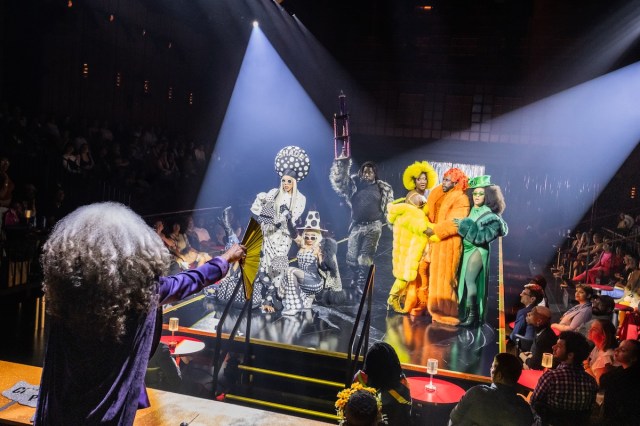
In the summer of 2024 at the new PAC NYC, directors Zhailon Levingston and Bill Rauch presented the world premiere of this new revival of Cats that reframes the dance-tastic feline death ritual as a drag ball, the kind documented by Jennie Livingston in her 1990 documentary Paris Is Burning.
Yes, it’s a musical about singing, dancing cats—but what if those cats were also creatures of the night, scrappy survivors with nine lives and perhaps (in the case of Macavity) sticky paws? This unlikely synthesis proved unexpectedly poignant, but it was also a total delight. In my review, I called it “the most fun I’ve ever had at an Andrew Lloyd Webber musical,” and I’m thrilled that the production will be transferring to Broadway this spring.
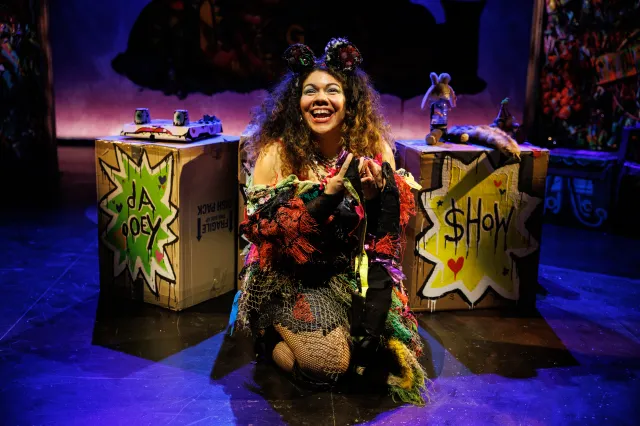
(© Evan Zimmerman)
Unlike Masquerade, the audience remains seated throughout, but the event still feels immersive as we are transported to a converted industrial warehouse in Harlem to witness the ball of the century. Off-Broadway, viewers clacked their fans and cheered on their favorite cats like they were professional wrestlers. Certainly, some of Omari Wiles and Arturo Lyons’s choreography approaches the physical exertion one might witness at a WWE match, if the wrestlers were in heels. I’m eager to see if that same energy follows the production to Broadway, where immersive productions have had less luck.
If it works uptown, it will be in no small part due to the exhilarating performances of the actors transferring with the production, including a commanding André De Shields as Old Deuteronomy, the subtly shady Junior LaBeija as Gus, and the undeniably sexy Sydney James Harcourt as Rum Tum Tugger (the clear winner of the “Butch Queen Realness” category). Even if you think you hate Cats, The Jellicle Ball is likely to change your mind. It certainly changed mine.
Is this happening just in New York?
No. London has a much more vibrant immersive theater scene, and a revival of Starlight Express at Troubadour Wembley Park Theatre has the actors zipping around the audience on roller skates (the show is like Cats, but about trains). I haven’t seen it, but it won seven WhatsOnStage Awards this year, including Best Revival, making it a clear fan favorite.
West End audiences also clamored this summer to see Rachel Zegler in a revival of Evita that had her performing “Don’t Cry for Me Argentina” from the balcony of the London Palladium to the adoring (and non-paying) crowds on Argyll Street below while the punters inside had to make do with live video—a powerful way to convey Eva Peron’s love of the poor and disdain for the elite.

(© Marc Brenner)
That production was helmed by hotshot director Jamie Lloyd, who pulled a similar stunt on Broadway last season with his revival of Sunset Blvd. While the minimalist production mostly took place within the proscenium of the St. James Theatre, the second-act opener and title number featured the entire cast marching up and down 44th Street every night, with live video broadcast back into the theater before the cast made a grand entrance.
All of it suggests that Lloyd Webber is game to reimagine what his legacy musicals might look like, both inside and outside the theater. It’s an exciting development for a composer who has made a fortune on Broadway and therefore might be disinclined to fix what, from a financial perspective, was never broken.
But by allowing directors to dig beneath the surface of these well-known properties, Lloyd Webber is expressing real confidence in their infrastructure—that the house can be renovated without jeopardizing its structural integrity. It’s a flex, one that the composer has certainly earned. I hope it results in more weird and wonderful revivals in the coming years.




Featured In This Story
Related Articles
See all
Latest Reviews
See all

Latest Videos
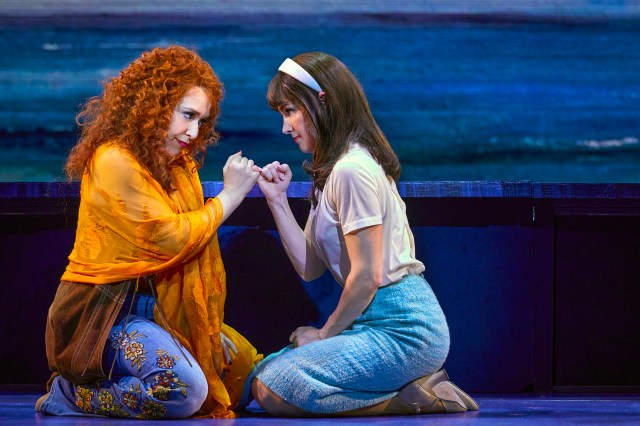
Watch Jessica Vosk and Kelli Barrett Sing a Song From the Upcoming Broadway Musical Beaches
Broadway performances start on March 27 at the Majestic Theatre.