
Review: The Other Place Rises From the Ashes of Antigone
Emma D’Arcy and Tobias Menzies star in Alexander Zeldin’s not-a modernization-of-Sophocles.
 |
New York City
|
|
New York City
|
February 12, 2026
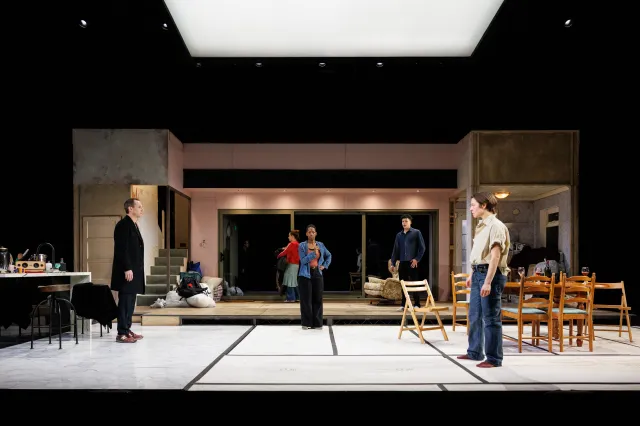
(© Maria Baranova)
The epigraph of Alexander Zeldin’s play The Other Place during its original UK run was “After Antigone,” after being the equivalent of “an homage to” or “inspired by.” That subtitle has all but disappeared from materials related to Zeldin’s under-fed drama, now making its American debut at the Shed after a 2024 run at London’s National Theatre. In fact, the writer-director is taking pains to ensure that no one makes a false equivalency: “The Other Place is not a ‘version’ of Antigone or a retelling of it for a modern audience or anything like that, though perhaps that was the initial provocation,” he writes in a program note.
You can still see the 2,000-year-old Sophoclean bones that Zeldin is playing with, but The Other Place is indeed not Antigone, at least not in the way that Robert Icke’s Oedipus remained Oedipus, albeit in a contemporary setting. Zeldin’s piece is very much trying to assert its independence, but every time he gets the play to stand on its own two feet, a Greek relic wanders in to remind you of its lineage.
Chris (Tobias Menzies) lives with partner Erica (Lorna Brown) and her teenager Leni (Lee Braithwaite) in the house once occupied by his brother, who hanged himself in the backyard a decade earlier. Chris’s niece Issy (Ruby Stokes) also resides with them, and they’re awaiting the arrival of Issy’s sister Annie (Emma D’Arcy), who has spent the past 10 years in a state of mourning. Chris is finally planning to spread his brother’s ashes, but not if Annie has anything to say about it. Chris is Creon, Annie is Antigone, and the brother whom the no-longer-Greek-princess wants to bury is now her father. You get the gist.
The play itself is a protracted study of the ways grief avails itself to different people. Annie puts on her (D’Arcy is nonbinary and uses they/them pronouns; the character does not) Dad’s old clothes almost as soon as she gets in (costumes by Rosanna Vize) and acts as if she’s the only one who’s lost somebody. Issy is there to remind her, in no uncertain terms, that “he was my daddy too.” Chris, for some reason, is only now desperate to move forward, renovating the house from top to bottom in an attempt to erase the past through drywall and sliding lanai doors. Vize’s construction-zone set glows ominously under lighting designer James Farncombe’s overhanging diffuser, the glass windows becoming a two-way mirror.
Zeldin muddies the waters of his not-explicitly-Antigone play with several explicitly-Antigone references, namely the character Terry (Jerry Killick), no longer a blind mystic but a stringy-haired neighbor in cargo shorts and flipflops. Every time he wanders in with a not-quite-prophecy (“You know where this leads, mate. It leads to hell”), our eyes start rolling, though to Killick’s credit, he plays the role to deliciously repugnant perfection.
The thin script eventually drives Chris and Annie into similarly ancient territory (no spoilers!), but it’s a shift that never convinces, at least not with the way that Menzies and D’Arcy have calibrated their relationship for the preceding hour. The dramaturgical seams and the directorial pretention are especially visible: they put a napkin over their head to hide from judgement like they’re eating an ortolan, but judgement finds them anyway, leading to the inevitable.
Ultimately, Zeldin’s sensationalistic conclusion feels hollow: it’s earnestly performed and entirely insubstantial. The Other Place is Antigone-not and Antigone-lite at the same time. But it’s all Greek to me.




source on Google
Featured In This Story

Latest Reviews
See all







Latest Videos
Watch: Ellen Greene Reflects on the Enduring Legacy of Little Shop of Horrors
Frank Oz’s cult classic movie-musical has gotten a new 4K restoration in celebration of its 40th anniversary.