
Interviews
Interview: Playwright David Cale Dives Into The Unknown
Cale’s latest monodrama stars Sean Hayes at Studio Seaview.
 |
Off-Broadway
|
|
Off-Broadway
|
February 20, 2026
Writer and performer David Cale is quick to point out that not all his plays are autobiographical. Harry Clarke, the Billy Crudup vehicle that made him a household name in theater, isn’t. Blue Cowboy, his story about a gay writer who falls for sexuality-grappling cowboy, also isn’t. But We’re Only Alive for a Short Amount of Time, about a family tragedy that has haunted him since his teens? That one is, and elements of the central event and its aftermath have quietly surfaced in most of his work, dating back to his 1986 piece The Redthroats, though it took years for the connection to become clear.
Cale’s latest solo piece, The Unknown, directed by Leigh Silverman at Studio Seaview and starring Sean Hayes, similarly navigates the often murky barriers between art and truth. The monodrama is about a writer haunted—stalked, really—by a mysterious figure, forcing him to confront the blurred lines of fear and obsession.
While not strictly rooted in truth, The Unknown taps into a pivotal moment from early in Cale’s life, turning his own unease into a compelling and suspenseful tour de force that Hayes performs mightily. For once, Cale gets sit down to watch (often from the back of a full house), and what’s not unknown is how much he’s enjoying himself (a lot).
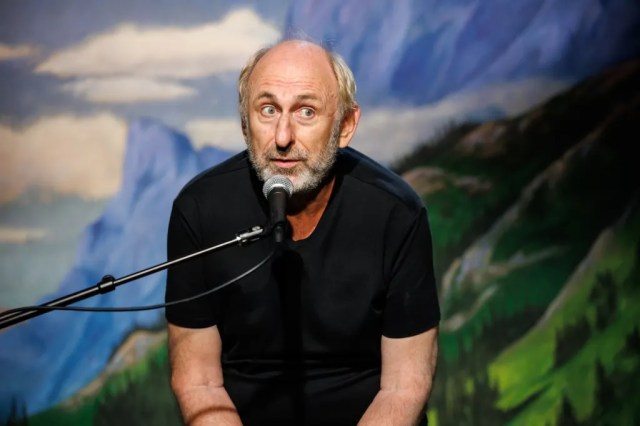
(© Maria Baranova)
This conversation has been condensed and edited for clarity.
You perform your own work most of the time. You don’t perform Harry Clarke and Sandra and The Unknown, which feel connected as thriller mysteries. Were these plays written as vehicles for yourself, or did you always have them in mind for other people?
I always thought somebody else could perform my work, but my friends who really know about this stuff, who I trust, thought they were dependent on me. And then when we got Billy to perform Harry Clarke, it made it realistic for another person to do it. Billy doing it altered the perception of me.
In what way?
I was suddenly being seen as a writer, not as a performance artist-y kind of person, which was good. Plus, it was such a popular show. It went to the West End and was a big hit. I’d been a stagehand on Annie for almost two years when I lived in London [in the 1970s]. So, I’d been a stagehand, which was just a job, and suddenly, my name’s on the marquee as a writer. Harry Clarke was the gift that kept on giving.
How do you decide that Harry Clarke or The Unknown is a play for another actor, whereas Blue Cowboy is a play for the actor David Cale?
Well, Blue Cowboy I did not want to perform. Les Waters [the director] wrote to me and said that he wanted to work with me. He asked if I had anything new and my agent sent him Blue Cowboy on a Wednesday and we had dinner on Friday. I didn’t think for a minute that he would have read it, but he did and he wanted to do it. I didn’t want to be in it because everybody would think it was autobiographical, but Les wasn’t interested in doing it with anybody but me, which was flattering. It was the right move. But I was afraid because it’s a pretty sexual show. It just made me kind of shy. It’s much easier to write it than think you’ll have to do it, but I loved doing it. We’re trying to reopen it. I really love that show. It’s my baby.
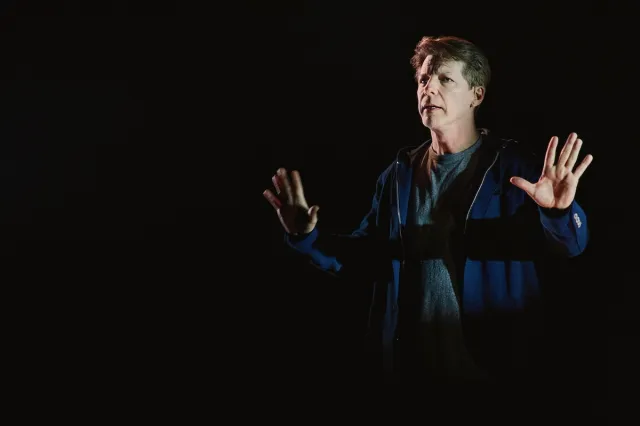
(© Emilio Madrid)
These plays aren’t strictly autobiographical, but there are elements of your life within them. The Unknown is semi-inspired by an experience you had with a stalker.
I was doing a show called Deep in a Dream of You in 1992 at the Goodman, and I couldn’t find a producer in New York. The Knitting Factory, which was basically a jazz club on Houston Street, said they would do it for three nights, two shows a night. I took out big ads in the Village Voice, and on the first day of performances, this person was buzzing my door all night. It was obviously very specific; they aimed for the first performance, which the New York Times was at. I caught the person in the end, and it was horrible. It was really harassing. But it also brought out my craziness. I’m like, “How am I going get back at this person,” once I found out who it was? It definitely opened up a can of worms in me.
Who knew that 30 years later, it would become the seed of this idea?
That’s what I was thinking this morning. I didn’t seek revenge, I just turned lemons into lemonade. Or my revenge is the show. I’ve only ever played people on stage that I like, but one time, there was this kid at school who used to torment me for being gay, and I wrote a monologue about him and played him on stage. It was brutal. That was revenge.
Are you the kind of writer who is a stickler for every comma and exclamation point?
I kind of am. Sean is very rigorous about getting the words right. He came in off book. I’d never seen him hold the script. He was on his feet from day one, which really is an asset, but that is a lot of work. It’s a lot of work and it’s a lot of words. And it’s one thing if he wrote the words. There are so many words and if you trip up, you’ve got to get straight back up again. Sometimes, when you focus on the story, the words go wonky. It’s like a blip. It doesn’t happen the next night. But it happens to me all the time.
Are you as much a stickler for when you’re the performer as when you are for someone else?
Yeah. Although, with We’re Only Alive for a Short Amount of Time, I got script notes with mistakes that I’d made until the last performance at the Public. And, I mean, I lived it. With Blue Cowboy, I was good by my standards, I have to say. I want them to be accurate. They’re very specifically written. But it’s hard when that train is moving. If the audience is doing something unexpected, it’s very easy to trip a little bit. I’ve done much worse than Marjan [in Sandra] or Billy or Sean, for sure, in terms of line accuracy.
I want to tell you that I really loved The Testament of Ann Lee, which is a movie that I think got quite unfairly passed over this Hollywood award season, and especially Amanda Seyfried.
I don’t want to be pretentious about it, but [writer/direcotr] Mona Fastvold is a visionary. Everybody on that film was so lovely. Amanda’s adorable—that’s an understatement. Everybody loves Amanda for very, very good reason. But that movie came out of nowhere for me. It was a text at 6:30 in the morning from Hungary. Mona and I are friends, but I kind of stepped away from acting. I was just concentrating on my own work. And then this came up and it was an incredible experience.
The set pieces in that movie are massive. You’re crossing the Atlantic on a ship in a massive storm and everyone’s dancing and you’re all getting throttled with water.
I’d read an early draft of it, and I thought “How are they going to do this?” It’s not a big budget movie and it’s not CGI. It was the most intense thing I’ve ever done, performance-wise. You couldn’t stand up in the water. They were pumping all this water in from a lake from all directions, and if you tried to stand up, it would knock you down. There were these barrels that kept falling down. There was stuff coming at you. And you get one shot. That’s the thing. You got to get it. We can’t put up another building and burn it down. I hope I can do more things with Mona and Brady [Corbet]. And Amanda. She’s really a magical person.
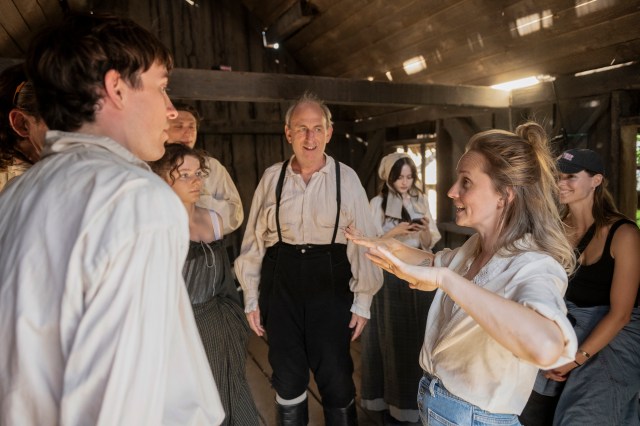
(© Searchlight Pictures)




Latest Reviews
See all
Latest Videos
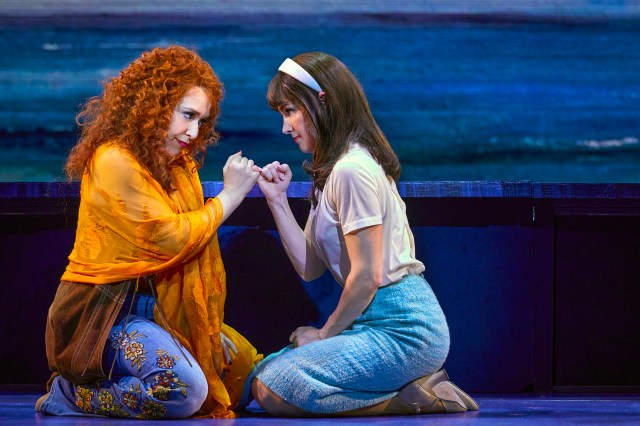
Watch Jessica Vosk and Kelli Barrett Sing a Song From the Upcoming Broadway Musical Beaches
Broadway performances start on March 27 at the Majestic Theatre.