
Review: Hate Radio, the Rwandan Genocide Podcast
St. Ann’s Warehouse presents the Milo Rau’s staging of an RTLM broadcast from 1994.
 |
Off-Broadway
|
|
Off-Broadway
|
February 17, 2026
(© Amir Hamja)
Are words directly responsible for violence? There is a conspicuous Atlantic divide on this question. We in the United States, with our First Amendment, take an extremely liberal approach by permitting all speech short of direct incitement to violence. But European states, with their fresh memories of fascism, are more restrictive. Of course words lead to violence, the logic goes, and it is the duty of the state to protect citizens from dangerous ideas.
Stepping up to buttress that conventional wisdom is Swiss director Milo Rau, whose Hate Radio is now performing at St. Ann’s Warehouse. It re-creates an hourlong broadcast of Radio Télévision Libre des Mille Collines (RTLM), the Rwandan radio station most responsible for stoking the resentment of the Hutu majority against the Tutsi minority during that country’s terrible genocide.
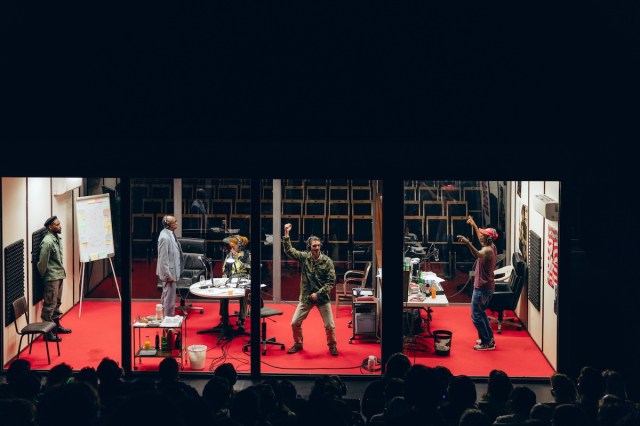
Performed in French with a smattering of Kinyarwanda, it opens with a 20-minute video introduction, which designer Marcel Bächtiger projects onto venetian blinds obscuring the central part of the stage (the audience is divided in two, so the video projects on both sides). Four figures, staring directly and unsettlingly at the audience, offer context: the civil war of the early ’90s, the assassination of President Juvénal Habyarimana, the ethnic tensions that boiled over into genocide, and the subsequent prosecution of the génocidaires and their media cheerleaders. It would be harrowing stuff if it wasn’t presented in the style of a dusty video exhibit playing on repeat in a forgotten corner of a museum.
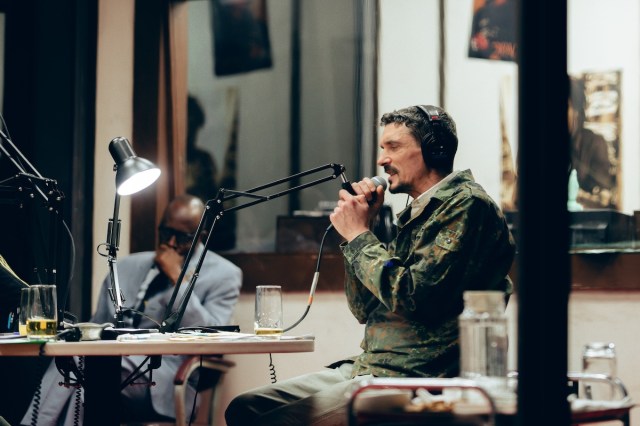
But then the blinds rise to reveal Anton Lukas’s set, a cheaply furnished radio studio adorned with posters of popular musical acts (MC Hammer and, incongruously, Bob Marley) and wall-to-wall blood red carpet. This life-size diorama allows us to observe the relatively banal office rituals of broadcasters Kantano Habimana (Diogène Ntarindwa), Valérie Bemeriki (Bwanga Pilipili), and Georges Ruggiu (Sébastien Foucault). They refuel on snacks and beer, dance around to the music played by DJ Joseph (Eric Ngangare, appearing permanently stoned and having a marvelous time), joke with the security guard (Sylvain Souklaye), and then sit down to incant vile racist invective.

(© Amir Hamja)
“They raped your wives, they raped your children. And now, with the help of the Americans and the Belgians, they’re planning to wipe us out once and for all,” says Bemeriki, her hunched frame radiating anger but her voice remaining steady as she rattles off alleged Tutsi atrocities. More than her two male co-stars, Pilipili conjures real rage, sadness, and fear. The latter is perhaps her strongest motivation. With Kigali surrounded by enemy forces, she knows that she’s in grave danger should her side not prevail. Her dead eyes staring off into the middle distance at the conclusion of the broadcast tell the story of the ensuing years better than any epilogue could.
As Habimana, Ntarindwa betrays no such doubt. He dances to Afrobeat like he’s just snorted a line of ketamine. Revealing a pair of holstered guns, he reads off a list of the Tutsi dead as if triumphantly reporting soccer scores. This is a man high on carnage. He approaches orgasmic ecstasy from his role in propagating it.
Georges is more inscrutable, and in many ways the most sinister of the trio. An ethnic Italian who grew up in Belgium, he finds himself, a white man, one of the leading voices of Hutu supremacy. How he got there and where he went after could be the subject of its own play. But Foucault’s performance makes it clear that he’s here for the fun and adventure, that his proximity to bloody history is more stimulating than any drug. We should always be wary of individuals who reinvent themselves as rabid partisans in an ethnic conflict in which they have no personal stake. Most likely, they’re just there to revel in death.
(© Amir Hamja)
At one point Foucault breaks Rau’s painstakingly built fourth wall by directly encouraging audience members to dance with him to the Reel 2 Real track “I Like to Move It.” Some viewers of the performance I attended shockingly obliged despite the gory subject (in fairness, they were in the front row and may have stopped following the English supertitles, which appear high above the stage and flash by at such a rapid clip that no one can catch every word).
Rau reveals the eagerness of audiences to be led, even to the most unspeakable acts of violence. The RTLM broadcasters don’t just encourage their Hutu listeners to surrender to their anti-Tutsi passions; they receive reports of where Tutsis are hiding and reveal those locations live on air, an action that would qualify as incitement even under the American definition.
Jens Baudisch’s sound design captures the intimacy of radio by pumping RTLM directly into our ears through individual headphones at each chair. Remove them and all you’ll hear is rain and crickets. This is the audio experience most of us living in the 21st century know. It is also not how most Rwandans in the early ’90s would have experienced RTLM.
Rau and his company obviously want us to think about our 21st century audio propagandists— the podcasters who cultivate parasocial relationships with the audience through each heretical thought whispered directly into the ear. Don’t we have a responsibility to stop them before things get out of hand? To the good liberal theatergoers taking that question seriously, I would only say this: Consider the clique currently in control of Washington. Honestly assess the prospect of their reelection, perhaps not in 2026 or ’28, but throughout the early part of this century. Are these really the people you want deciding what can and cannot be said in America?




source on Google
Featured In This Story
Latest Reviews
See all





Latest Videos
Broadway Cast of The Rocky Horror Show Pays Tribute to Tim Curry
Paul Soileau, Jake Shears, and Luke Evans led the cast in “I’m Going Home.”