
Review: Sylvia Sylvia Sylvia, Where Plath and Hughes Come to Life
Geffen Playhouse premieres a new play by Beth Hyland.
 |
Los Angeles
|
|
Los Angeles
|
February 17, 2026
(© Jeff Lorch)
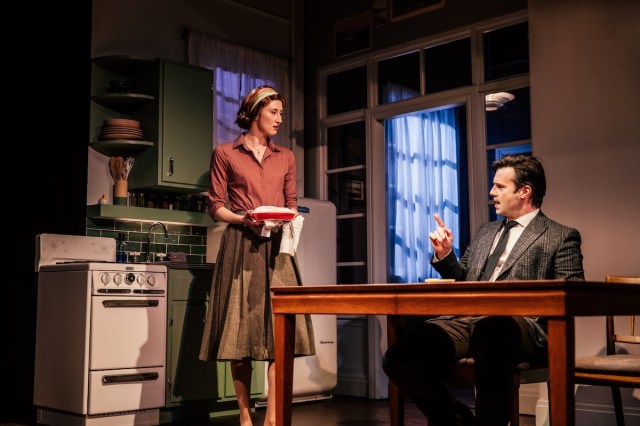
Writing a narrative with parallel stories is tricky because both sides need to be equally compelling. In Sylvia Sylvia Sylvia, having its world premiere at Geffen Playhouse, author Beth Hyland juxtaposes Sylvia Plath and Ted Hughes’s turbulent relationship with a modern couple also struggling when both are novelists with imbalanced successes. The play’s issue is that despite the toxicity between them, Plath and Hughes are more compellingly written than the 21st century Theo and Sally.
While living in Boston, Sylvia (Marianna Gailus) finds minor success writing poetry while her already revered husband Ted (Cillian O’Sullivan) struggles to find a new subject matter and it brays at their unstable relationship. Half a century later, in the same apartment, married Sally (Midori Francis) and Theo (Noah Keyishian) fall into similar traps, the two couples converging when Sally starts having conversations with the long-dead Sylvia.
Sally and Theo’s marriage parallels the previous tenants, yet it is Sally who had both earlier success and struggles with mental health issues. That puts a strong dramatic burden on her, leaving Theo with less meat on his bones. Much of the parallels Hyland draws between the four, including similar names, strengths and weaknesses, and clashes over children, are heavy-handed. Hyland appears to want to convey the strain both marriage and the demand for creative output can put on delicate humans. Sally and Ted’s conversations and battles are deliciously vicious. Sally and Theo feel like a carbon copy. Hyland accurately portrays women in the throes of a nervous breakdown, but not engrossingly.
Hyland does a great job of questioning how much of Plath’s insanity was innate and how much was gaslighting from a manipulative man losing his superiority. The ethereal Gailus uses that to build a bewitching character, with an upper-crust New England accent that melds a touch of Irish and British, appropriate for a character who lived in England and married an Irish National. She captures both Plath’s ingenuity and fragility. O’Sullivan is masterful at conveying Ted’s insecurity and cutting cruelty, at one point even adopting the cool, calculated tone of a sociopath. Keyishian and Francis are given less rich material. Francis is forced to be on the brink of hysterics and Keyishian is essentially a cipher.

(© Jeff Lorch)
Director Jo Bonney uses stagecraft to keep these counteracting stories from confusing the audience. By launching the play with a loud ding from the oven, Bonney alerts us that despite the tragic story of Plath, who would kill herself in a similar appliance, the evening will be colored with black humor.
Scenic designer Studio Bent slides panels across the stage to change the scene from the 60s to the 2010s, while also creating a visual metaphor for the parallel tales. Costume designer Samantha C. Jones contrasts the buttoned up early ‘60s, where Plath and her husband could have stepped out of the cover of Better Homes and Gardens, with the more relaxed current fashions. Lighting designer Lap Chi Chu uses harsh reds to crank up the tension and the fallibility of our characters. The play’s star is sound designer and composer Lindsay Jones, who begins the evening as if we’re in a drawing room comedy, with light bossa novas and other lounge pieces, only for the chords to grow increasingly dissonant as the evening goes on. Eventually, it’s a cacophony of chaos.
An entire play with Sylvia and Ted would have been quite an evening, elevated by Hyland’s crackling dialogue. Inventing the second couple undercuts what Hyland achieves. Truth truly is stranger and more intriguing than fiction.




Featured In This Story
Latest Reviews
See all
Latest Videos
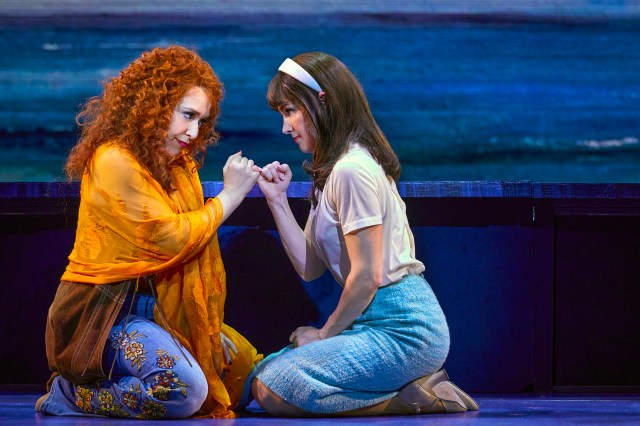
Watch Jessica Vosk and Kelli Barrett Sing a Song From the Upcoming Broadway Musical Beaches
Broadway performances start on March 27 at the Majestic Theatre.