
Review: Classical Theatre of Harlem’s Othello Is the Best of a Recent Batch
You won’t miss Denzel Washington or Jake Gyllenhaal in the new free outdoor Shakespeare production at Marcus Garvey Park.
 |
Off-Broadway
|
|
Off-Broadway
|
July 6, 2026

(© Richard Termine)
New York City has had an explosion of Shakespeare in the past couple of months. Five recent productions come to mind, with the Public Theater behind three of them (the Mobile Unit As You Like It, a bilingual Romeo and Juliet in Central Park, a remount of the National Asian American Theatre Company’s two-part Henry VI). Also among the crop was Bedlam’s Othello, which was noteworthy mainly for its virtuosic cast of four.
A mere two months later, the Classical Theatre of Harlem has jumped into the fray with its own new production of Othello, with both productions coming a year after a cost-prohibitive one on Broadway starring Denzel Washington and Jake Gyllenhaal. Leave it to this ever-reliable uptown theater company, then, to come up with the best of the recent takes on Shakespeare’s tragedy of the Moor of Venice.
Actually, those who scrounged up a small fortune to see the Broadway revival might feel some déjà vu at the start of director Carl Cofield’s free production. Cofield has similarly set Shakespeare’s play in a contemporary military environment, with costume designer Mika Eubanks dressing many of the performers (most male, but some female) in various shades of black and camouflage green. Even Christopher and Justin Swader’s set design comes off as a more brutalist variation of Derek McLane’s similarly column-based Broadway set. But Cofield wisely keeps the concept at the level of abstraction, with Brittany Bland’s video design and Anya Kutner’s props design coming the closest to imbuing the milieu with any specificity.
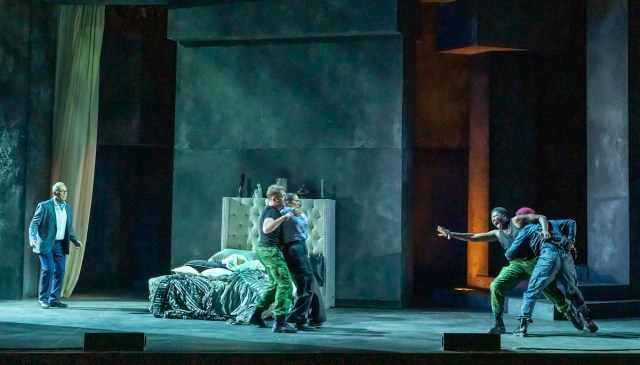
(© Richard Termine)
Regarding the text, Cofield keeps directorial interventions to a minimum, though he has made enough judicious cuts for the production to run a lean two hours without intermission. He does add a scene at the beginning in which the military promotions of Emilia (Keren Lugo), Cassio (Orlando Grant), and Iago (Nick Westrate) are announced in the manner of a reality TV show, economically establishing both the production’s modern-day concept and the envy that fuels Iago’s mission to bring down Othello (James Udom). More controversially, Cofield has staged the play’s finale in a way that grants Othello a measure of spiritual redemption, thereby subverting its tragic tenor.
The story itself is otherwise fundamentally unchanged. Driven by jealousy at being passed over for a promotion to lieutenant in favor of Cassio, Iago hatches a complex scheme to stoke Othello’s jealousy, gradually convincing him that his wife Desdemona (Isabel Arraiza) and Cassio are having an extramarital affair. The ruse requires Iago to manipulate a slew of people around him: from Roderigo (Hiram Delgado), a whiny aristocrat who pines for Desdemona; to Cassio’s mistress, Bianca (Rebecca Ana Peña); to even his own wife, Emilia. The latter turns out to be the most faithful to Desdemona even as she unwittingly sows the seeds of her demise by stealing a handkerchief Othello gifted her.

(© Richard Termine)
As with his previous Shakespearean productions for Classical Theatre of Harlem, Cofield’s Othello thrives on subtle interpretive choices that cumulatively speak volumes. Udom, for instance, has adopted a Nigerian accent for his performance as Othello, which adds a regal quality to the character while underlining the sense of otherness that gives Iago’s machinations a nativist edge. Making Emilia a member of the military, plus having her wear androgynous military garb throughout, adds an intriguing gendered layer to her monologue late in the play in which she decries men’s capacity to treat women as objects to be possessed. Cofield is also not shy about bringing out the homoeroticism in Iago’s relationships with Othello and Cassio. Through their choreography, fight directors Rick and Christian Sordelet imbue scenes of Othello and Iago training together with a faintly romantic charge.
Mostly, the pleasures of this Othello lie in seeing excellent actors doing justice to Shakespeare’s classic text. Udom hits notes of genuine poignancy as he agonizes over the jealousy that eventually consumes him. Westrate conveys Iago’s villainy with a palpable glint in his eye, but without going over the top. Arraiza finds an inner strength and resolve in Desdemona even when Othello subjects her to physical abuse at his most paranoid. By contrast, Lugo brings the tomboyish femininity of this production’s conception of Emilia vividly to life. Though it’d be a stretch to call it revelatory, Classical Theatre of Harlem’s Othello is solid enough to temporarily banish a feeling that we have reached the point of Shakespeare oversaturation.




source on Google
Featured In This Story

Latest Reviews
See all









Latest Videos

Watch the Trailer for Elsinore Starring Andrew Scott
The film is based on the true story of Ian Charleson, who played Hamlet at London’s National Theatre after being diagnosed with AIDS.