
Review: Singing and Shtupping Through the Catskills in A Walk on the Moon
A young mother has a strange, erotic journey in this new musical.
 |
Off-Broadway
|
|
Off-Broadway
|
June 29, 2026

(© Joan Marcus)
The summer of 1969 was an eventful one. In the span of just three months, the Stonewall uprising ignited the modern gay rights movement; thousands gathered for the Woodstock music festival; Ted Kennedy drove his car off a bridge on Chappaquiddick Island and left his passenger dead; the Manson Family murders shocked the nation; and, perhaps most remarkably of all, man walked on the moon for the first time, temporarily stitching together a nation torn apart by the Vietnam War.
It seemed, for a moment, that anything was possible. For Pearl Kantrowitz, the protagonist of Pamela Gray and AnnMarie Milazzo’s new off-Broadway musical A Walk on the Moon at the Laura Pels Theatre, anything means discovering that there might be more to life than being a wife and mother. All it takes is a handsome dress salesman to awaken feelings she thought she had buried.
A Walk on the Moon is based on Gray’s 1999 screenplay, which became a Tony Goldwyn film starring Diane Lane as Pearl, Viggo Mortensen as her paramour, and Liev Schreiber as the spouse Pearl betrays during her summer of self-discovery. The stage version feels very similar to the movie: it’s earnest to a fault despite the unnecessarily harsh judgement it places on Pearl and her actions, with a mega-talented cast doing a yeoman’s job of finding shades of color in something disappointingly beige.
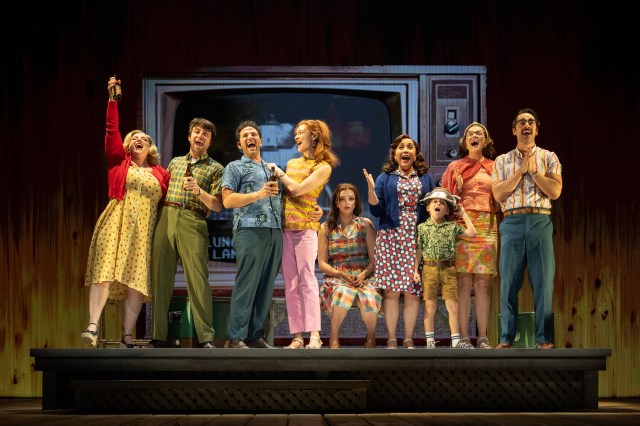
Each summer, Pearl (Talia Suskauer), her TV repairman husband, Marty (Max Chernin), their two children, and his mother Lillian (Andréa Burns) travel from Flatbush to a bungalow colony in the Catskills, a seasonal rite of passage for all lower-middle-class Jewish families of the era (the wealthier set vacationed at resort hotels like Kutscher’s and Grossinger’s). Pearl and Marty married as teenagers when she became pregnant with their now-15-year-old daughter, Alison (Sophie Pollono). So much for having aspirations: this has been their life ever since.
But in a summer where man can achieve the impossible, why must Pearl remain bound by the constraints of domesticity? The arrival of blouse salesman Walker Jerome (Sam Gravitte) offers Pearl a tantalizing glimpse at a life defined by passion, tie-dye, and Kerouac.
(© Joan Marcus)
The movie’s greatest strength is its evocation of a bygone era of Jewish life, and Gray’s book—along with Burns’s warmly rendered Yiddishkeit as Lillian—replicate that quality here. All it took was one “shayna madela” and some loving Brooklynese for me to get the fuzzies for an era that I personally never experienced (though my parents did take me to Kutscher’s once before it closed so I could experience their childhood summers).
But it’s hardly replicated in Sheryl Kaller’s disappointingly economical physical production, with its flimsy cardboard set and screensaver projections by Tal Yarden, unflattering costumes by Ricky Lurie, and lighting by Robert Wierzel that never seems to find the actors. Josh Prince is billed as the choreographer, but that title seems aspirational: save for Pearl’s three Mahjongg partners and their husbands, there’s no ensemble, and even less dancing.
Earlier versions of the show featured music and lyrics billed to Milazzo and Paul Scott Goodman, who had been working with Gray to develop the show since the mid-2010s. Goodman’s involvement seems to have ended in 2022 after the more successful George Street Playhouse run. What exists now, credited to Milazzo, lacks specificity. The nondescript lyrics and a blandly contemporary rock sound don’t even attempt to evoke a period defined by artists with singular artistic voices like Janis and Joni and Jimi. Similarly, there’s little to Gray’s book beyond its loving tribute to the old days, which too often substitutes nostalgia for dramatic urgency.
As is often the case, the actors are in the middle. Pollono is a standout, sparking an engaging chemistry with the goofily charming Oscar Williams, who plays her aspiring musician boyfriend. Gravitte doesn’t offer much beyond a six-pack as the Blouse Man, while Chernin is moving as the dull husband who gets cuckolded despite being a generally good, if milquetoast, father and spouse. He and Pollono are given the best song, about how she changed his life for the better. It was so unbearably moving I almost cried.
It’s a song that clearly asks for sympathy for the offended parties, because just like in her screenplay, Gray seems to actively dislike Pearl, casting an unsympathetic eye towards her actions throughout. It’s not unfair in theory, but it’s so one-sided that it doesn’t allow any kind of nuance in the writing: Gray seems to be communicating that Pearl is a bad person for wanting things and deserves her public comeuppance. That they eliminated a song from George Street where Pearl, who dreamed of being a journalist, conducts an imaginary interview with Neil Armstrong, proves the point. Pearl doesn’t have that dream anymore — she doesn’t have any dreams anymore.
Susakauer, in turn, is forced to supply Pearl’s humanity entirely on her own, an impossible burden for an actor of any experience level, let alone someone who is originating their first big role in New York (she is a long-running Elphaba in Wicked and recently played Lucille on the Parade tour opposite Chernin). Suskauer not just carries the show itself, but essentially invents Pearl’s backstory, hopes, and motivations in real time, while eliciting a level of compassion and sympathy that the author withholds. It’s a preternaturally intelligent performance that really drives the piece.
A Walk on the Moon might be one small step for musical theater, but it’s a giant leap for the actress at its center.

(© Joan Marcus)




source on Google
Featured In This Story

Featured Artist

Related Articles
See all
Latest Reviews
See all








Latest Videos
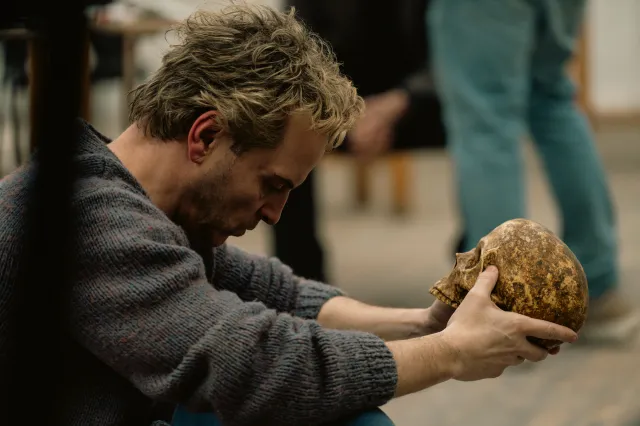
Watch the Trailer for Elsinore Starring Andrew Scott
The film is based on the true story of Ian Charleson, who played Hamlet at London’s National Theatre after being diagnosed with AIDS.