
Review: Birthright Is a Safe Three-and-a-Half-Hour Play About Israel, Palestine, and Fractured Friendships
The latest work from the playwright of Eureka Day settles for less than it should.
 |
Off-Broadway
|
|
Off-Broadway
|
June 29, 2026
(© Emilio Madrid)
You can be forgiven for thinking you’re crossing an international border when you arrive at the Robert W. Wilson MCC Theater Space for Jonathan Spector’s Birthright. Before taking your seat, you’re sent through metal detectors and required to lock your phone in a pouch. There are even security guards stationed on either side of the auditorium for the play’s entire three-and-a-half-hour duration. It’s a lot of tsuris for a disappointingly mild dramedy about a group of American Jewish friends and how their differing views on Israel and Palestine splinter their relationships.
Spector’s six characters met on Birthright, the all-expenses-paid trip to Israel for Jews aged 18-26. Depending on whom you ask, Birthright is either a rite of passage that strengthens a person’s Jewish identity, or a vehicle for Zionist indoctrination. For most participants, though, it’s an excuse to float in the Dead Sea, eat hummus, and maybe give a handy to a soldier in a Bedouin tent.
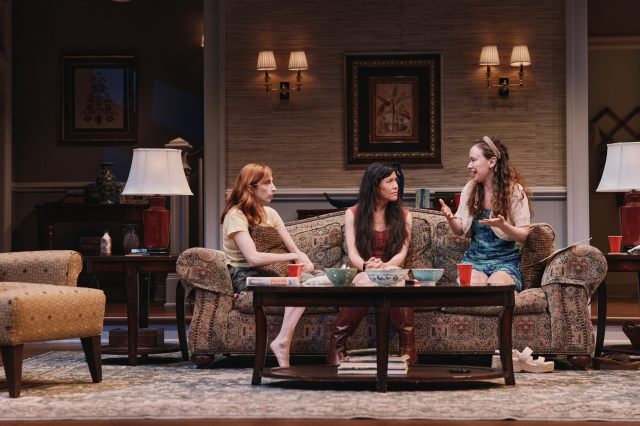
Three weeks after their 2006 Birthright trip, the six friends reunite in Chaya’s (Zoë Winters) parents’ living room for what amounts to an intervention: Alona (Molly Ranson) has fallen for the IDF soldier who took her virginity and is ready to make Aliyah, prompting Chaya to rally the troops into talking her out of it. The group also includes Izzy (Molly Bernard), Chaya’s best friend since preschool; Noah (Eli Gelb), an aspiring political blogger; Lev (Hale Appleman), a budding Rabbinical student who ditched the official itinerary to explore the “real” Middle East; and Emerson (Nate Mann), a would-be musician ditched by his semi-famous rock band.
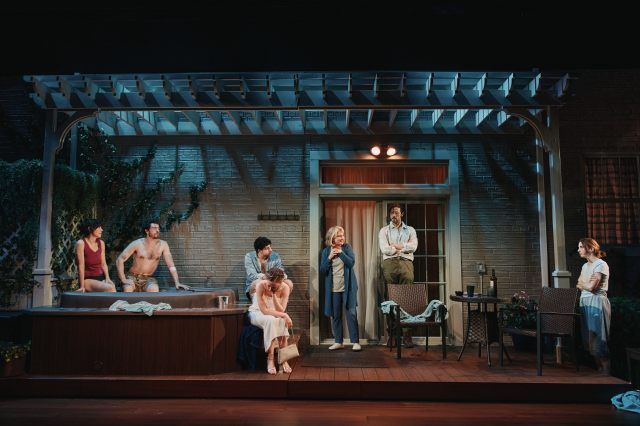
Ten years later, the friends gather again at Chaya’s house on the eve of Alona’s wedding. This time, she’s really making Aliyah: her fiancé is Israeli. As they linger around the jacuzzi, they speculate about whether Donald Trump could win the presidency, commiserate over unhappy relationships, and struggle to write a group toast for the bride. Then Izzy mentions that the groom’s uncle is, “like, Netanyahu’s right-hand man.” Uh-oh. The N-word.
We meet them one last time in 2024. It’s here that Spector is at his most nakedly political. He pits anti-Zionist Izzy against pro-Israel Chaya, before exposing the inadequacy of both women’s American media-shaped worldviews when faced with Alona’s lived experience as an Israeli citizen grappling with the real consequences of the October 7 Hamas attacks.
(© Emilio Madrid)
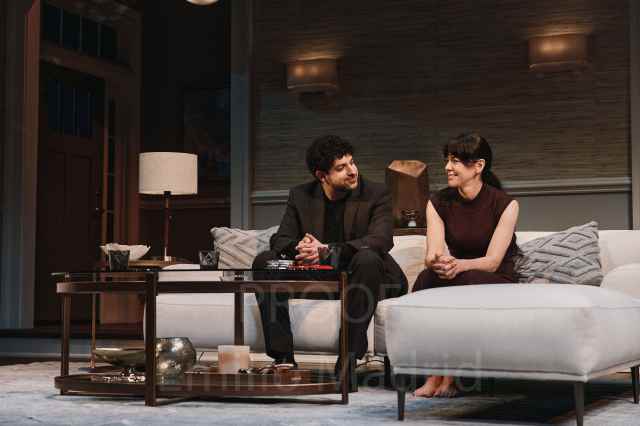
Though Teddy Bergman’s direction moves apace, each act could use a judicious trim to land the plane faster (each act clocks in around 55 minutes, and there are two 15-minute intermissions to accommodate the changeover of Scott Pask’s elegant sets, of which there are three). Most expendable are the recurring appearances of Chaya’s mother Deborah (Liz Larsen), who shows up late in each act to deliver exposition that could be folded in elsewhere. It’s not Larsen’s fault; I saw so much of my own mother in her that I almost did a double take.
As he proved with his calling-card work, the Tony-winning vaccine debate comedy Eureka Day, Spector knows how to supply the members of a theatrical ensemble with neatly calibrated bombs that detonate into writerly viewpoints. He even recycles some of his own dramatic techniques here, with text messages and emails flashing on the walls of the stage to provide additional information (David Bengali’s projections are just as amusing now as they were on Broadway in 2024).
But unlike in Eureka Day, which, for all its “both sides” framing still had a very clear point-of-view, Spector goes to great pains to avoid taking any sides in Birthright. Instead, he simply opts for presenting extremely basic liberal arguments about the legitimacy of Israel’s existence and the ongoing war in Gaza (“oh my god, that fucking word,” Chaya exclaims when Izzy refers to it as a genocide).
On a personal level, the cautiousness is understandable: the Israel-Palestine argument is even more unwinnable in real life than it is onstage, and no play is worth inviting death threats from people who probably haven’t seen it and likely never will (Spector even initially turned down the play’s commission from Miami New Drama). But the result is an evening that ultimately feels overly cautious and disappointingly half-hearted. At least say something to justify the security guards sitting there all night (though, as it turns out, phones are locked up due to full frontal nudity from Gelb and Winters).
Appleman, Gelb, and Mann deliver intelligent and crisply lived-in performances, wearing Clint Ramos costumes that precisely match their individual sensibilities. I was particularly taken with Mann’s Niandra LaDes and Usually Just a T-Shirt T-shirt, a delightfully specific choice for a burnout indie rocker like Emerson to wear. But this play belongs to the women.
Winters is characteristically brilliant as Chaya, whose comfortable existence as a girl boss Obama operative/philanthropist eventually implodes under the weight of her own convictions and missteps. Bernard is excellent as Izzy, stepping into a difficult role on what seemed like barely any notice following the abrupt departure of cast member Abbi Jacobson (Bernard rehearsed the role of Alona, which Ranson plays with a finely wrought conviction). Despite the play’s generally milquetoast sensibility, Winters and Bernard turn introductory-level discourse into the kind of crackling theater that keeps the audience on the edge of its seat.
Yet even at its most electric, the arguments never stop feeling like carefully structured moments of disagreement, rather than a truly destabilizing conversation that could alter the audience’s thinking in any meaningful way. Birthright is a play that should feel dangerous. Instead, surrounded by metal detectors and security officers, it just feels agonizingly timid.
(© Emilio Madrid)




source on Google
Featured In This Story

Related Articles
See all
Latest Reviews
See all





Latest Videos
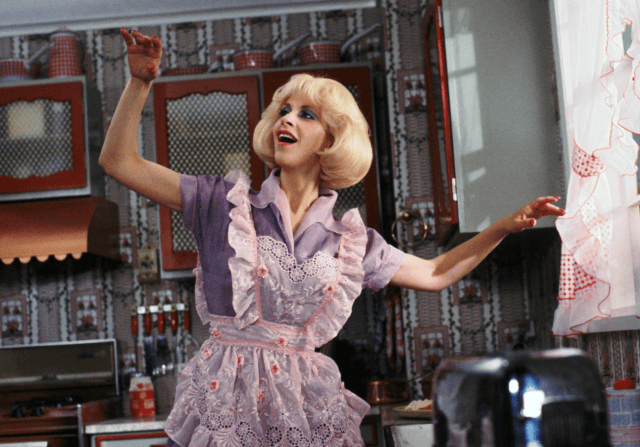
Watch: Ellen Greene Reflects on the Enduring Legacy of Little Shop of Horrors
Frank Oz’s cult classic movie-musical has gotten a new 4K restoration in celebration of its 40th anniversary.