
Review: The Curious Case of Benjamin Button Is a Musical Fable That Jigs to the Rhythm of Life
The Olivier Award-winning adaptation of F. Scott Fitzgerald’s magical tale comes to the Public Theater.
 |
Off-Broadway
|
October 21, 2026
(© Joan Marcus)
“Time and tide wait for no man.” Jethro Compton and Darren Clark make that the refrain of their Olivier Award-winning musical adaptation of The Curious Case of Benjamin Button, now stateside at the Public Theater with its sights set on Broadway.
If you were wondering whether the turn of phrase is another fake-out from a pair of artists who have written original Celtic folk songs that could pass for centuries-old trad tunes, it is in fact an old English proverb (often credited to Chaucer, who popularized a lengthier version of it in The Canterbury Tales). Now, if the internet has taught us anything, it’s that archaic aphorisms aren’t safe in modern hands that make Etsy pillows.
Luckily, The Curious Case of Benjamin Button is no Pinterest board. It’s one of the most alive musicals you’re likely to see this season with words and melodies that feel drawn from the wisdom and heartbeat of the ages.
For fans of the 2008 David Fincher film that pulls you along with the promise of an ever-hotter Brad Pitt, this is your reminder that F. Scott Fitzgerald is the one who first dreamed up this reverse-aging title character for a 1922 short story. While that original narrative was primarily satire with a fantastical bent, Benjamin Button has since become a source of philosophical meditation on time and mortality. What does youth look like when it’s not wasted on the young? What does death look like when you spin it around?
Plenty of musicals have tried to tackle the cosmic poetry of time: Merrily We Roll Along struggled for decades to nail the impact of its reverse chronology; The Notebook (in its brief run) suggested the fullness of a life by putting characters onstage with their past and future selves; Tuck Everlasting, with its own magical premise (and even briefer run), made its 11-o’clock number a dream ballet about the beauty and heartbreak of a life cycle.

(© Joan Marcus)
When it comes to the great joy and tragedy of time, musical theater has tried every which way to distill but not dilute, move but not manipulative. Compton and Clark’s Benjamin Button finds that near-impossible balance, due in no small part to the fact that there’s more Chaucer than Fitzgerald (or Fincher) in this Benjamin.
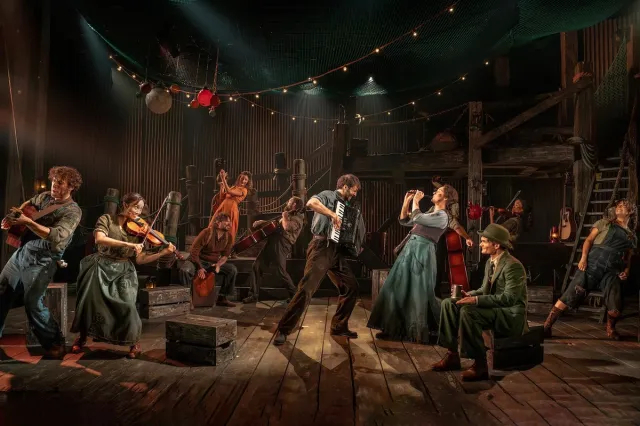
A chorus of extraordinary actor-musicians narrate Benjamin’s story like a piece of folklore (Luke Swaffield’s sound design swaddles these roaming musicians). They swap roles and instruments in plain sight on Compton’s brilliantly versatile set modeled after an old wooden ship (Compton wears several hats as book writer, lyricist, director, and scenic designer). Set in Cornwall at the end of the First World War, this iteration is tethered to specific moments in history. It’s even book-ended by the American space program. And yet, it perpetually reaches across time through the age-old traditions of this little fishing village where Benjamin is born as a cigar-smoking old man who’s been bitterly rejected by his parents.
The opening number, “Western Wind,” makes deities of the wind and sea, and deference to those natural powers (and their indelible link to time) is threaded through the rest of the score. When Benjamin’s mother (an excellent Sachiko Mae), filled with shame about her son, sings the haunting “Kraken’s Lullaby” as her song of desperation, her life feels simultaneously as minute as her gossiping town and infinite as the ocean (lighting designer Zoe Spurr paints beautiful stage pictures with her soft, nautical palette).

(© Joan Marcus)
And then there’s “When E’re She Looked at Me,” the infectious jig that feels like both remembering and discovering giddy romance. It could be a staple at any Dublin pub, but in this tale, it recounts the beginnings of the great love story between Benjamin and barmaid Elowen Keene. Andrew Durand, a proven commodity from oddball shows like Dead Outlaw, Shucked, and last season’s revival of Rocky Horror, delivers an understated and vulnerable performance in the title role. Most importantly, his journey of de-aging is wholly believable in its subtlety. Delicate shifts of voice and posture (paired with the most minor modifications in Anna Kelsey’s costuming) are all this fable needs when imagination is already in the mix.
Kelsee Kimmel, meanwhile, gives Benjamin Button’s breakout performance as Elowen, the musical’s humble pivot point. She may be portraying a life that unfolds in the traditional direction, but she has nearly as much ground to cover as Benjamin, and she does it with just as much care and grace. Elowen is Benjamin’s definition of a life well spent, and in Kimmel’s hands (and entrancing voice), it’s no wonder why.
That question of what makes a life well spent is at the heart of this Benjamin Button—mortality, of course, being its looming specter. And still, Compton and Clark don’t make an easy landing on some approximation of “carpe diem.” Notice how death in the world of this show doesn’t condemn you to oblivion. It simply gets you reabsorbed into the music-making chorus. Because life is short and long. Time is finite and infinite. You are a drop of water and the whole ocean.




source on Google
Featured In This Story
Related Articles
See all
Latest Reviews
See all







Latest Videos
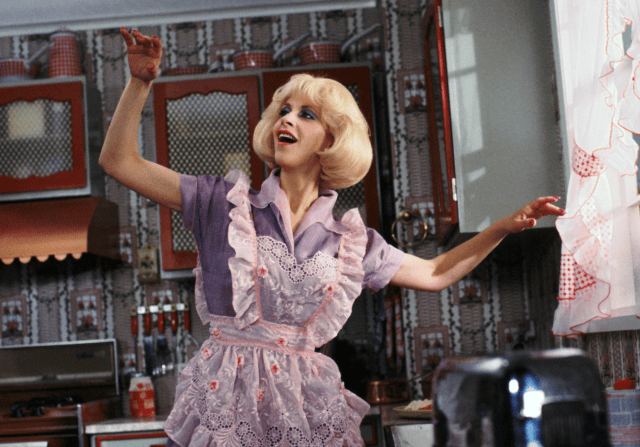
Watch: Ellen Greene Reflects on the Enduring Legacy of Little Shop of Horrors
Frank Oz’s cult classic movie-musical has gotten a new 4K restoration in celebration of its 40th anniversary.