
Interview: The Curious Case of Jethro Compton and Darren Clark's Collaboration on Benjamin Button
Meet the writers behind the West End hit, now making its New York debut at the Public.
 |
Off-Broadway
|
|
Off-Broadway
|
October 14, 2026
Writers Jethro Compton and Darren Clark were both coming off bad professional breakups when they began collaborating.
Compton had literally been ghosted by his previous theatrical partner, while Clark had been navigating a situation that appears to have involved a power struggle. Fortunately, when the two met for the first time, they realized almost immediately that they could work together.
The product of this theatrical marriage is an unlikely one: an actor-musician adaptation of F. Scott Fitzgerald’s short story The Curious Case of Benjamin Button, reimagined in the seaside county of Cornwall, England. And yet, Benjamin Button became an unexpected hit, with runs at London’s Southwark Playhouse both before and after Covid, followed by a yearlong engagement in the West End.
This month, the musical, which is already generating Broadway buzz, makes its official American debut at the Public Theater, bringing its distinctive blend of Celtic folk music, theatrical ingenuity, and Cornish charm to New York audiences for the first time.
And for Compton and Clark, the success of Benjamin Button is proof that sometimes the best creative partnerships begin when the wrong ones end.
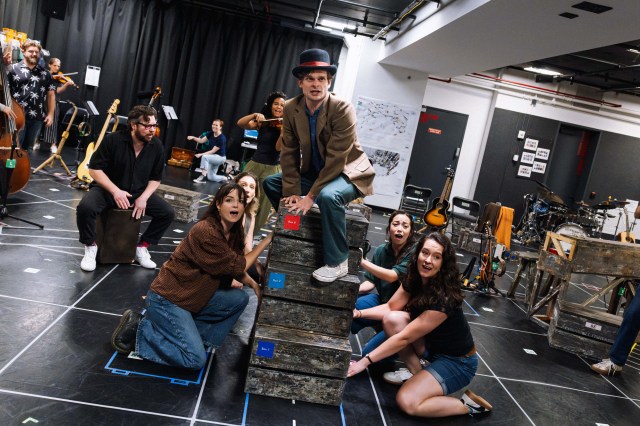
(© Rebecca J. Michelson)
This conversation has been condensed and edited for clarity.
Tell me the origin story of Benjamin Button.
Jethro Compton: I wanted to make a musical and I wanted it to be set somewhere where the music felt like it should exist. I didn’t like the idea of it being an environment where music didn’t belong. Cornwall has such connection to folk music and sea shanties that it just felt like the perfect setting. I knew I wanted it to be actor-musician because I had just worked with some actor-musicians on a play and I thought that was a way I could make a musical [where I didn’t need] to learn an entirely new way of making theater. Little did he know, it’s really, really hard. The idea of an orchestra in the pit? What a relief.
At the same time, I had come across the short story, which had recently become available in the public domain, and I thought that could make an interesting show. For about four months, I was working on them as two separate projects, and then I realized they could be the same thing, taking that fairy tale kind of story and fitting it into the magical realism that exists within a lot of Cornish folklore.
Darren Clark: Jethro did a two-week workshop in Cornwall with another composer involved, but that composer was, like…They disappeared.
Jethro: Yeah, I raised a load of money and got five actor-musicians and rented a space, and he showed up a few days late and then left and then came back and said, “I’ll get you all that music next week” and I never heard from him again. I chased and chased and chased, by which point I booked the Southwark Playhouse for the following spring and knew I needed to get moving on this. Do I cut the music and just do it as a play? But what I had learned from the workshop was that, even just using traditional songs as placeholders, it felt right. I got in touch with a friend of mine who knew I was looking for a composer with an interest in folk music, and I said I needed them to be someone that will reply to emails. Which I regret now.
Darren: I like emails.
Jethro: You email me too much. Always first thing in the morning. You’re always up at 8am writing emails. I’m pretty much an insomniac, so I’m just going to bed when these emails start coming in. Anyway, I got in touch with you and what did you say? Maybe interested?
Darren: I’d just been burnt on a project where the communication wasn’t very good, so in a way, we’d both been burnt on communication.
Jethro: Which is how all great relationships begin, coming out of a bad one.
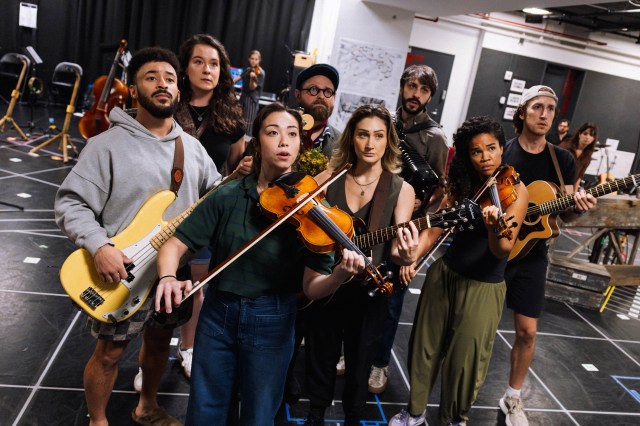
(© Rebecca J. Michelson)
You have a terrible breakup and then you meet the person you’re going to marry.
Darren: Exactly. So I asked Jethro to provide me with a lyric and I would set it and see what you think. I’m going to change the lyrics, change the structure, play with everything about it, and if he is excited working that way, we’ll be alright. If he’s precious about everything, I’m not interested, because I can’t work like that again. He couldn’t have been more enthusiastic about it.
Jethro: Because you didn’t change anything for the sake of changing it. You changed it to make it work better musically. At that time, I was going to do book and lyrics and I was just looking for someone to do the music. During our first writing weekend, that was still the plan. We wrote “The Moon and the Sea” and we went to the pub and I said, “it felt like we wrote those lyrics together, should we just do that?”
Obviously, this show has developed quite a fanbase over the course of its runs. What is that like for you to see?
Jethro: When I conceived the project originally, I thought it would get published and available for licensing and I’d make some royalties from it, which I’ve done on some Fringe projects. Basically, a way to offset the losses of producing at the Fringe is to get it licensed quickly and earn back some cash and then pour that into the next project. But this went so well that it became clear there was an appetite for it. There was a bidding war from a load of commercial producers in the West End and it’s grown and grown. I’d be interested to hear your thoughts, Darren. I’m always so focused on the climb up the mountain that I’m rarely stopping to enjoy the view.
Darren: I’ve been working for so long and have gotten used to the idea that you make a show and maybe it’s revived once; twice, if you’re lucky. This was the realization of a secret dream that something could survive and grow. I don’t want to sound big-headed, but this is the result of all the people involved in it that have developed it and the heart they’ve put into it. I’m glad that it’s getting the chance to live beyond the initial production. For so many shows, you never get the chance to get it right because there’s never enough time. Every time we’ve done this, we’ve rewritten it. We’re still rewriting it. We’re very close.
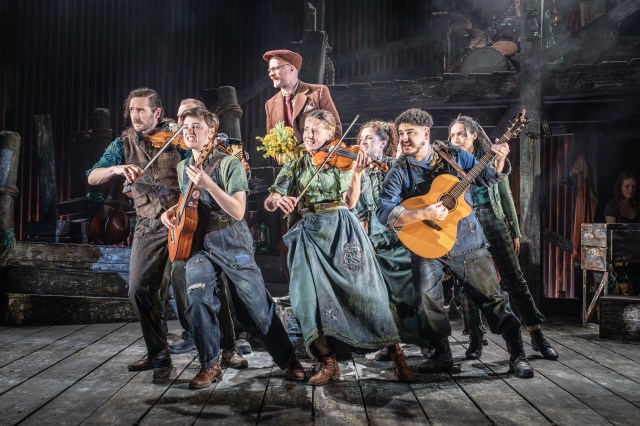
(© Marc Brenner)
How has it been to get an American company to figure out the Cornish vibe, compared to a UK cast?
Jethro: It definitely is more tangible to a British company. But as I said on the first day here, we’ve never acutally had Cornish actors in the show. There were Cornish people involved, but in terms of accents and dialect, that’s written into the piece. Although for an American, everything is referred to as a dialect, which I’m trying to get my head around, because dialect is actually the words you use, as opposed to the sounds you are making. Of course, for a company in the UK, it’s accents they have heard. It’s rare for Americans to have heard [Cornish]. There are certain vowel sounds that just don’t exist in any American accent.
We’re working, for the first time, with a dialect and accent team. Andrew Wade, who’s the head of voice here at the Public, has appointed a wonderful dialect coach, David Jarsen, and we’ve been supported by Molly Osborne, who was our Elowen Keene in the 2023 Southwark production, as our dialect consultant, who is now doing a Masters in voice and dialect in London.
Darren: One of the things that unites both the UK and the American cast is the people. Aside from all the instruments you’re playing and the ability to act and sing, we were looking for a type of person with an open heart, a curious mind, and a sense of being part of a community. That was the main thing we were looking for.
Jethro: That’s the nicer way of saying it. I say we’re looking for weirdos and geeks.
Darren: Yeah, we are.
Jethro: Not in a bad way. People who are comfortable with themselves. People who are comfortable having their weirdness on display. Because that is certainly true of myself, and I would say that is true of you.
Darren: Absolutely. Anyone who plays however many instruments is a bit weird.
Jethro: That weirdness, that uniqueness, that quirkiness, is what this show is a celebration of. People that feel like they don’t fit in and are searching for a place where they belong, and essentially realizing it’s not a place. It’s finding other weirdos who accept you and celebrate you for everything that makes you who you are. That’s Benjamin’s story.




source on Google
Featured In This Story
Latest Reviews
See all




Latest Videos
Watch: Inside Wanted on Broadway, With Stars Solea Pfeiffer, Liisi LaFontaine, Ledisi, & More
Get a first look at the new American musical featuring powerhouse vocals from a dynamite cast.