
Review: Ayn Rand’s Night of January 16th Gets a Campy, Guilty-Pleasure Revival
Ruth Stage turns the audience-jury murder mystery into a deliciously chaotic haunted-house spectacle.
 |
Off-Broadway
|
|
Off-Broadway
|
October 13, 2026
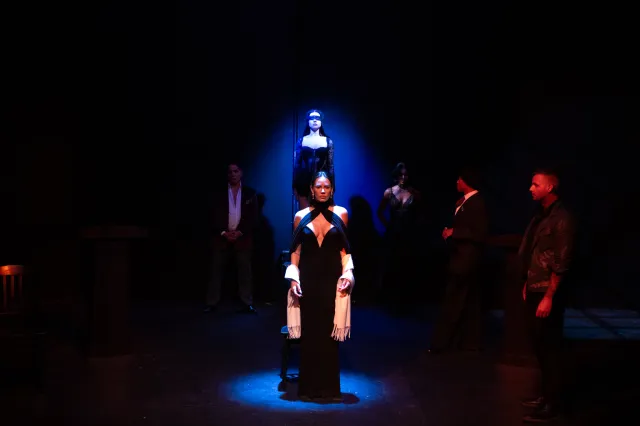
(© Gabby Scimeca)
“This play is a murder trial. The jurors are to be selected from the audience and bring in a verdict at the end of the last act.” Thus starts the script for Ayn Rand’s Night of January 16th, in a note to producers in which she insists that the trial comes down to “two different types of humanity.” Serving as a juror on the night I attended, however, the question I agonized over was not “Guilty or not guilty?” but rather “How seriously should I be taking this?”
When I mentioned to my friends that I was reviewing a play by Rand, they all made a face. Agnostic as I try to be when it comes to letting everyone say their piece, I understand: What would Rand make of Trump, of Musk—of Epstein? This play gives us some sense.
Rand based her plot on the suicide of Swedish businessman Ivar Kreuger, who, by her own admission, was a “gigantic fraud” whose ambition exceeded his grasp (and morals). But she believes he was unduly reviled after his death: “Had there been a world press at the time of Icarus and Phaethon, this was the kind of obituary they would have received—a spree of gloating malice [whose] leitmotif was not: ‘How did he fall?’ but: ‘How did he dare rise?’” With this play, Rand means to put us on trial, forcing us to confront how we would respond to a man like that.
The fact that, almost a hundred years after the play’s premiere, there still might be some doubt about where this country lands on the issue of ambition versus morality could make a revival of Night Of… a thrilling exercise. But that would require the plot to hold its weight. For starters, the one on trial here is not Kreuger stand-in Bjorn Faulkner (Matt De Rogatis), but rather his mistress, Karen Andre (Christa B. Allen), who may or may not have pushed him over the balcony of his penthouse on the night in question. This is just the first in a series of inexplicable plot choices that bury the play’s intended themes so thoroughly that I eventually lost track of which vote would mean I was pro- or anti-Faulkner’s modus operandi. Where is “If the gloves don’t fit, you must acquit” when you need it?
The play’s true battle is not between two different types of humanity, but rather between its highbrow ambitions and tawdry story—which at one point includes a description of a platinum dress Faulkner would heat by the fire before Andre would cool it off on her naked body. While Rand states that her artistic impulse demanded “a theme involving great figures and crucial fundamentals,” she was aware that “most people would not see the issue on such terms.” Of her biggest nemesis, producer Al Woods, who took the play to Broadway, Rand says: “Melodrama was the only element of my play he understood, but he thought there wasn’t enough of it.”
Apparently, neither did the team behind Ruth Stage’s production, whose aesthetic is that of a carnival’s haunted house decked in Victoria’s Secret. The entire cast remains onstage the whole time, hissing and laughing manically while the trial goes on. District Attorney Flint (Maryam Basir) dons full dominatrix drag (costumes by Alexandra Rose), complete with a crop she uses to spank the witness chair—eliciting hearty laughter from the audience. The Judge (director Theo Devaney) presides via a Frankenstein-green projection on the back wall, lit from below like a kid telling ghost stories at camp (lighting by Christian Specht). Each actor puts on a different accent, without any allegiance to nationalities or time periods. Down to the poster’s “frosted steel” font—whose true calling is a B-movie horror adaptation of Frozen—the whole thing feels like a Halloween-themed episode of Selling Sunset.
Was this a deliberate, satirical send-up of Rand’s lofty aims and despicable philosophy? That was the true verdict I felt asked to render. The evidence for it was there: Prince Hamadi snapping open a clack fan during his testimony as a calligrapher, to the delight of everyone in the house; Bethany Lanza turning housekeeper (and Faulkner uberfan) Magda into a one-woman improv routine best described as “mean Swedish Rosie O’Donnell”; and Allen giving a magnificent reading of the line “That’s useless, I’m an atheist” in response to being told to swear on the Bible, getting the biggest laugh of the night. But I could not, as the votes went down the aisle, inching toward me, make up my mind.
When my turn finally came, however, I had a flash of clarity: it doesn’t matter. In fact, camp is at its absolute best when it is unintended. So I voted “guilty”: guilty of having been thoroughly entertained the whole time.




source on Google
Featured In This Story

Latest Reviews
See all









Latest Videos

Watch the Trailer for Elsinore Starring Andrew Scott
The film is based on the true story of Ian Charleson, who played Hamlet at London’s National Theatre after being diagnosed with AIDS.