
Reviews
Review: Dirty Dancing Has the Moves, but Its Book Needs a Lift
Lonny Price’s new touring production brings the movie to life, with some growing pains ahead of Broadway.
 |
Washington DC
|
|
Washington DC
|
October 9, 2026
(© Matthew Murphy)
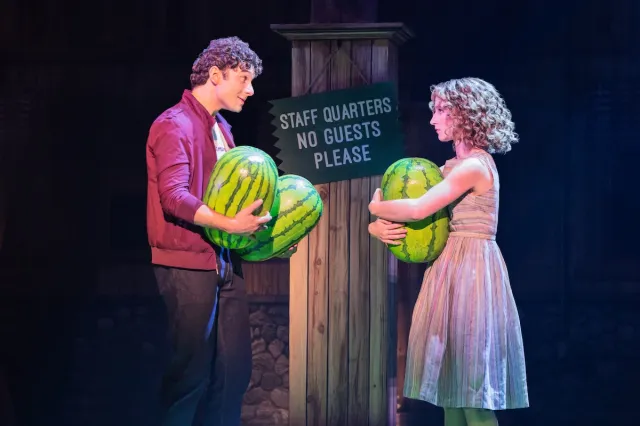
A watermelon may get Baby into the party, but it’s going to take more than a few famous lines to make Dirty Dancing a hit on Broadway.
The new touring production of Dirty Dancing: The Musical, which recently stopped at Washington DC’s National Theatre, offers plenty of reasons to revisit Kellerman’s. The dancing is spectacular, the costumes look wonderfully familiar, and the movie’s most beloved moments arrive with the reassuring predictability of an old friend’s favorite stories. Yet with a Broadway engagement slotted for next February at the Lena Horne Theatre, this production still has some work to do between those crowd-pleasing highlights.
Director Lonny Price knows this territory well. He played resort heir Neil Kellerman in the iconic 1987 film. Eleanor Bergstein, who wrote the original screenplay, supplies the book, retaining much of the story that made Jennifer Grey and Patrick Swayze stars. There’s obvious affection for the source material here, and it’s a joy to see the movie come to life onstage.
(© Matthew Murphy)
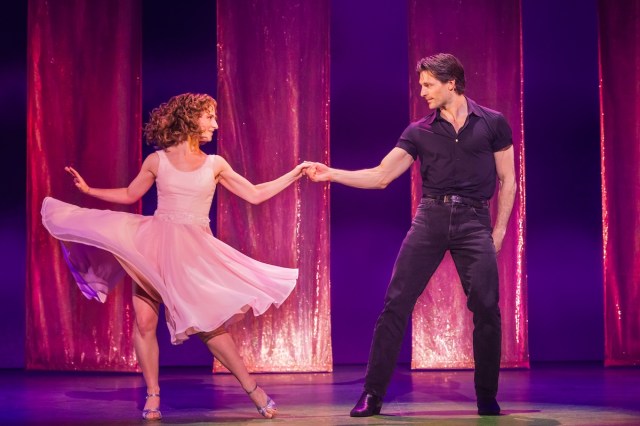
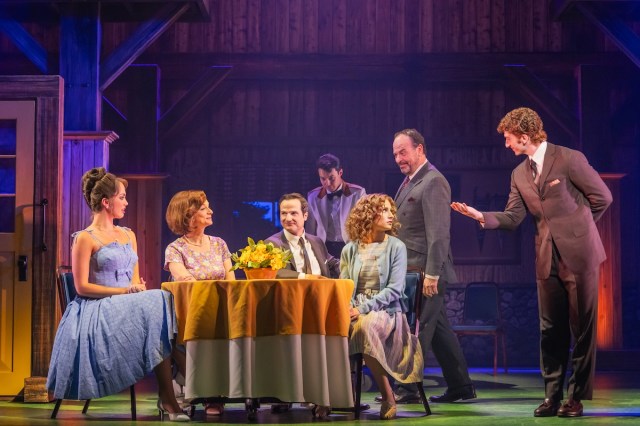
It’s the summer of 1963, and Frances “Baby” Houseman (Annalese Starzec) is vacationing with her family at a Catskills resort when she discovers a considerably more exciting world among the staff. Steamy dance instructor Johnny Castle (Blake Zelesnikar) becomes her unlikely partner after his regular partner, Penny Johnson (Olivia Cece), becomes pregnant by waiter Robbie Gould (Antony Sanchez) and needs Baby to fill in for a performance. Learning the steps leads to romance, and Baby’s growing independence challenges the comfortable assumptions of her physician father, Jake (Bryan Fenkart).
Fans of the film will find an almost scene-for-scene reunion with its pleasures. The watermelon gets its laugh, Johnny’s declaration that “Nobody puts Baby in a corner” delivers the expected smile, and the famous lift remains a terrific payoff. These moments have lost little of their appeal. The question is how much the show can accomplish when recognition isn’t doing the work.
Starzec is a particularly good reason to make the return trip. She captures Grey’s look and mannerisms almost uncannily, with the same mixture of curiosity and awkwardness that makes Baby so endearing. More than a recognizable face, though, she brings real enjoyment to the role. Her dancing is excellent, and she makes Baby’s progress from uncertain beginner to confident partner convincing. Watching her discover what she can do is one of the production’s most satisfying pleasures.
(© Matthew Murphy)
Zelesnikar is equally impressive on the dance floor. His strength and control make Johnny’s expertise immediately believable, and the demanding partnering looks effortless. What comes less naturally is Swayze’s charm. Zelesnikar’s Johnny has the physical presence, but his guarded manner doesn’t always reveal the warmth beneath the tough exterior. The romance could use more of that vulnerability, especially in the scenes where the choreography stops doing the talking.
There’s also something initially surprising about a show subtitled “The Musical” in which the lead (Baby) barely sings. Johnny gets somewhat more to sing, although Zelesnikar’s vocals don’t have the confidence of his dancing. Their relationship develops largely through dialogue and movement, with other characters supplying much of the soundtrack. That arrangement can make the musical numbers feel removed from the central love story.
Fortunately, those other voices are worth hearing. Ashley LaLonde, as Elizabeth, and Ethan Peterson, as Johnny’s cousin Billy Kostecki, bring power and personality to the songs, including the climactic “(I’ve Had) The Time of My Life.” Erick Pinnick lends bandleader Tito Suarez an appealing ease. Music supervisor and arranger Joseph Joubert and orchestrator Charlie Rosen provide the familiar material with a full live sound, delivered by the band under Patrick Tice-Carroll’s musical direction, with sound design by Kai Harada.
The instrumental treatment of “She’s Like the Wind,” however, feels like a missed opportunity. A song so closely tied to the film’s romantic atmosphere deserves more than an orchestral appearance. In a production so devoted to giving fans the moments they remember, this is a curious one to shortchange.
(© Matthew Murphy)
Cece’s Penny stands out with commanding dancing that makes clear why Baby has such intimidating shoes to fill. The character’s pregnancy and dangerous abortion also give the story stakes beyond the romance. Fenkart supplies Jake with the authority Baby needs to challenge, while Gina Lamparella brings a gentler presence to her mother, Marjorie. Lily Kren has fun with Baby’s attention-seeking sister, Lisa, and Dan Klimko supplies comic relief as the self-important Neil. Loren Lester rounds out the resort’s hierarchy as owner Max Kellerman.
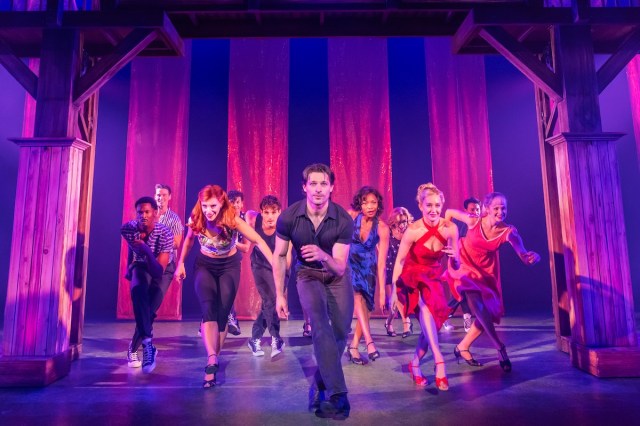
Darrell Grand Moultrie’s choreography is the evening’s strongest argument for putting this story onstage. The ensemble’s precision and energy make the staff’s dance parties feel like a world that Baby would desperately want to enter. The partnering is thrilling, and the movement gives her attraction to Johnny a physical immediacy that the dialogue sometimes lacks. Whatever reservations arise elsewhere, the dancing consistently earns its place in the spotlight.
Emily Rebholz’s costumes are remarkably close to the movie’s familiar wardrobe, including Baby’s pink finale dress and Johnny’s sleek black dancewear. They help deliver the feeling of watching the film step off the screen. Brett J. Banakis’s scenic design works with David Bengali’s video and Japhy Weideman’s lighting to move us through Kellerman’s changing spaces while keeping the dancing central. The visual transitions have a fluency the book could use more often.
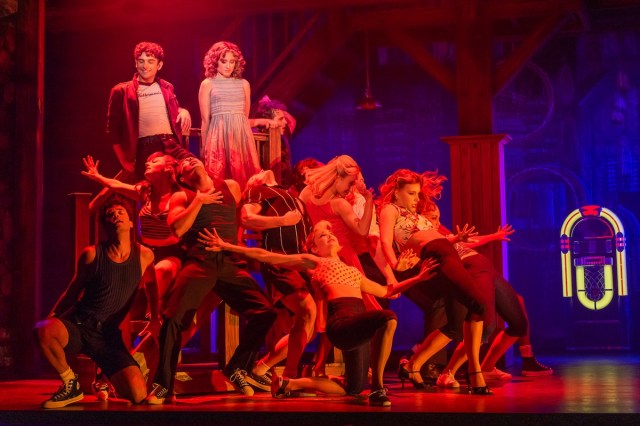
(© Matthew Murphy)
An expanded civil rights storyline, including references to Freedom Riders, offers a promising opportunity to give the summer of 1963 greater weight. Baby’s awakening has always involved questions of privilege and fairness, and the addition could deepen that part of her journey. As presented, though, it introduces an interesting direction without following it far enough. This is material worth developing before Broadway.
The larger problem is the balance between the acts. By intermission, so much of the movie’s main story has already unfolded that fans may reasonably wonder what remains. The second act then drags, stretching the wait for a finale whose destination is hardly in doubt. Price and Bergstein need to reconsider how the action is distributed and where the characters need room to develop. Another song could help if it gives Baby or Johnny an emotional moment that advances the story.
When the final dance arrives, the production delivers the release movie lovers have been waiting for. There’s plenty to smile about at this version of Kellerman’s. Before Broadway, the book needs the same care these performers have put into their footwork.




source on Google
Latest Reviews
See all


Latest Videos
Watch the Trailer for Elsinore Starring Andrew Scott
The film is based on the true story of Ian Charleson, who played Hamlet at London’s National Theatre after being diagnosed with AIDS.