
Review: Daniel Fish's Elektra Is Electric, Thanks to Ted Hearne's Choral Score
Tina Benko rages as a six-voice a cappella chorus powers Sophocles’s revenge tragedy.
 |
Brooklyn
|
November 20, 2026
(© Maria Baranova)
Choral music in dramatic theater is having a moment. This fall brought us Jack D. Coen’s delicious 16-voice setting of Mona Pinot’s monologue in I Became We at the Atlantic. Heather Christian’s ebullient Terce: A Practical Breviary will return for a weekend in January. And, most freshly, Ted Hearne’s vocal writing for an a cappella treble sextet throughout Theater for a New Audience’s production of Elektra, directed by Daniel Fish at the Polonsky Shakespeare Center is, well, elektric.
Hearne is a mainstay of the contemporary choral scene, and the compositional assignment on Elektra is right up his alley: the Greek Chorus here, in tight and crunchy harmony, chants recitative responses to the furious lamentations of the title character, played by Tina Benko—a gorgeously undulating undertow of sound that makes Fish’s entire enterprise mesmerizing.
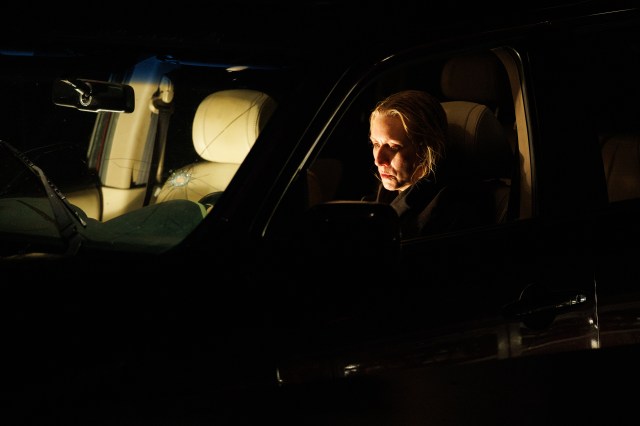
Like his symbolically opaque Kramer/Fauci, not all of Elektra‘s imagery makes much sense on the surface. Fish, totally upending his own 2024 West End production (which starred Brie Larson and Stockard Channing), installs a raised thrust platform through the Polonsky Shakespeare Center surrounded by a sort of pit, empty except for a red Honda Pilot and the lurking King of Mycenae Aegisthus (Michael Rudko).
Aegisthus is still and silent for most of the play, but he’s never absent from his stepdaughter Elektra’s mind—or our sight—as she stalks the stage, raging against him and her mother Clytemnestra (Sally Wingert). “I live in this house with my father’s own killers: / They rule me,” Elektra, clad in a neon green Blondie T-shirt, hisses in Anne Carson’s taut translation, which is both poetically heightened and richly accessible. She is overtaken with visions of vengeance; Clytemnestra and Aegisthus conspired together to murder her father Agamemnon upon his return home from the Trojan War, and she’s seething, boiling in place while her brother Orestes (Cricket Brown) stalls in coming home for revenge.
“There is something bad here, growing,” Elektra snarls in Benko’s bitter, brittle keening, her tongue all battered steel. Something is rotten in the state of Mycenae. And, especially with a production that seems to take place in part within its protagonist’s fractured psyche and a translation that hums with Elektra’s humanity, the parallels with Hamlet, who inherited this devastated daughter’s ravaged immobility, seem particularly present. “Should I call that thing ‘mother’ that lies at his side?” she growls.
Benko uncoils to face off against her mother in the play’s most vivid rhetorical battle. Wingert’s startlingly pugnacious Clytemnestra illustrates the consequences of violence begetting violence; she claims she slew her husband to avenge her daughter Iphigenia, sacrificed by Agamemnon to the gods, but although she insists, “I feel no remorse,” it’s apter to observe that she seems to feel nothing at all. They are wrestling verbally on the precipice of an abyss, almost indifferent to whether they fall in so long as the other goes down, too. “Call me baseminded, black mouthing bitch if you like,” Elektra crows, “for this is my nature. We know how I come by it, don’t we?”
Fish’s vision toggles between total abstraction and something closer to reality in both his staging and the performances, as if Elektra’s universe is glitching around her. Elektra cracks open a Coke can, swigs it, and pours the remaining liquid over her own head as a sort of grotesque middle finger to her mother: real enough. But when Elektra’s conflicted, self-preserving sister Chrysothemis (Rebecca Naomi Jones) speaks of carrying libations, she’s not holding anything; she doesn’t even mime. This both is and is not a world where props exist.
Similarly, while Benko and her sparring partners speak like real people in some exchanges, there are moments where Fish directs his cast to speak in near-monotone without affect, especially Brown, whose Orestes seems a deliberately empty vessel, even at the moments of highest drama. But the movement between these modes of reality and something other, like a shift from color to sepia tones, can be arresting in itself.
As for that Honda Pilot or the visual of Clytemnestra draped in an American flag or the pause for a full performance of the Beyoncé song “Daddy Lessons,” Fish’s meaning is not obvious; unlike Ancient Greek, it’s not always possible to translate his emotional gestures. But, like Kramer/Fauci, the choices that do land—like the fierce backlighting that casts some of the play’s most haunting confrontations in shadow—carry weight for the moments that feel inscrutable.
Fish’s overt current-events commentary falls a bit farther afield. The Honda, the program reveals, is a replica of the car Renée Good was driving in January when she was killed by ICE agents. The script newly interpolates an excerpt from an October New Yorker piece about the botched execution of Christa Pike. The focus of these insertions seems to be something vague about injustice and cycles of violence that Sophocles’ characters can probably speak more clearly for themselves.
Or sing for themselves, as the case may be. Elektra draws its centrifugal power from the harmony at its core, and the harshly beautiful, straight-tone Balkan belt of these six vocalists pierces as brazenly as Elektra’s own howling in the darkness.




source on Google
Featured In This Story
Latest Reviews
See all






Latest Videos
Watch: Andrew Scott and Billie Piper on Elsinore, Ian Charleson, and Playing Hamlet
Screenwriter Stephen Beresford, director Simon Stone, and stars Scott and Piper discuss Ian Charleson’s historic Hamlet.