
Review: Tom Hiddleston and Hayley Atwell Are a Marvelous Duo in a Very Pink Much Ado About Nothing
Jamie Lloyd brings his confetti-forward production to the Winter Garden via the West End.
 |
Broadway
|
November 19, 2026

(© Andy Henderson)
Every year or two a Shakespeare revival arrives on Broadway with big names and a lot of hype—and no guarantee that you won’t regret that fifth-row orchestra seat you bought.
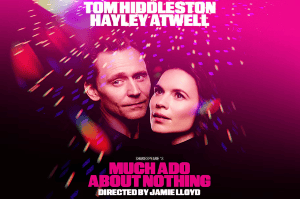
Let me put that worry to rest: Much Ado About Nothing, Jamie Lloyd’s eye-popping pink confection, starring a deliciously paired Tom Hiddleston and Hayley Atwell as beloved bickerers Benedick and Beatrice, is the most fun you’ll have on Broadway this season.
Aside from the star power (they’re both Marvel royalty), this Much Ado boasts an unabashed bonanza of talent and comical whimsy, with ushers dancing you to your seats, a nonstop playlist of ’90s pop anthems, and abundant confetti. Whether you come for the Marvel stars, Hiddleston’s abs, or even, dare I suggest it, a Shakespeare play, you’ll have a good time.
(© Andy Henderson)
Purists may grumble. Aside from the relentless party vibe, un-Shakespearean music, and the hilarious cardboard cutouts of Loki and Captain Carter that get trotted out mid-show, Lloyd has made sizable cuts to the text, getting rid of the Dogberry scenes completely to make room for his pop-music interludes. But the edits and Easter eggs are the right calls here. At a brisk two hours and 20 minutes, this Much Ado flies by like a night at the club that you don’t want to end.
Without the rustic scenes, Lloyd stays focused on the play’s two pairs of lovers: Benedick and Beatrice, erstwhile enemies who are tricked into admitting they’re hot for each other; and young Claudio (a magnetic James Phoon) and Hero (Mara Huf giving Gen Z realness), who have a more troubled romance.
Hero’s father, Leonato (Forbes Masson), has invited Don Pedro (Gerald Kyd) and his brother, the villainous Don John (Tim Steed), to his home in Messina. But envious John has a diabolical plan. He decides to besmirch Hero’s good name by raising suspicions about her fidelity so that Claudio will abandon her. Friar Francis (Phillip Olagoke) intervenes and engineers a ruse to prove Hero’s innocence, and when Don John’s treachery is exposed, all the lovers are left to wed under disco balls and a downpour of confetti.
(© Andy Henderson)
The main attraction of all this is Hiddleston and Atwell, whose chemistry is magical. Friends in real life for more than 20 years, they give off sparks every time Benedick and Beatrice flick a barb across the stage. You couldn’t ask for a better pair.
Hiddleston is a riot from the start, strutting onstage with Phoon to a thrashing guitar riff and Beastie Boys’ “(You Gotta) Fight for Your Right (To Party!),” and immediately getting the crowd going. “I am loved of all ladies,” he croons, gesturing to the screaming audience in one of his many fourth wall breaks. We’re putty in his hands.
Atwell counters him with a wittily poised performance as Beatrice, spraying cold water on all that male heat. But she brings her own fire to the play’s darker second half, giving Beatrice a terrifying intensity as she sidles up to Benedick and breathes, “Kill Claudio!” Where’s Captain Carter when you need her?
(© Andy Henderson)
The whole cast has been with the production since the London run, and their time together shows in the masquerade scene—a hilarious dance of bobblehead furries choreographed by Fabian Aloise. Phoon and Huf exude the intense passions of young love, and Masson gives a frightening tirade as Hero’s enraged father (Ben and Max Ringham’s otherwise impressive sound design unfortunately muffles his angry speech). Mason Alexander Park, impressive belter of party anthems, is a total scream throughout as Margaret, who pairs off with Mika Onyx Johnson’s Borachio in a furry take on the beast with two backs, and Kyd makes pink look positively butch as sexy daddy Don Pedro.
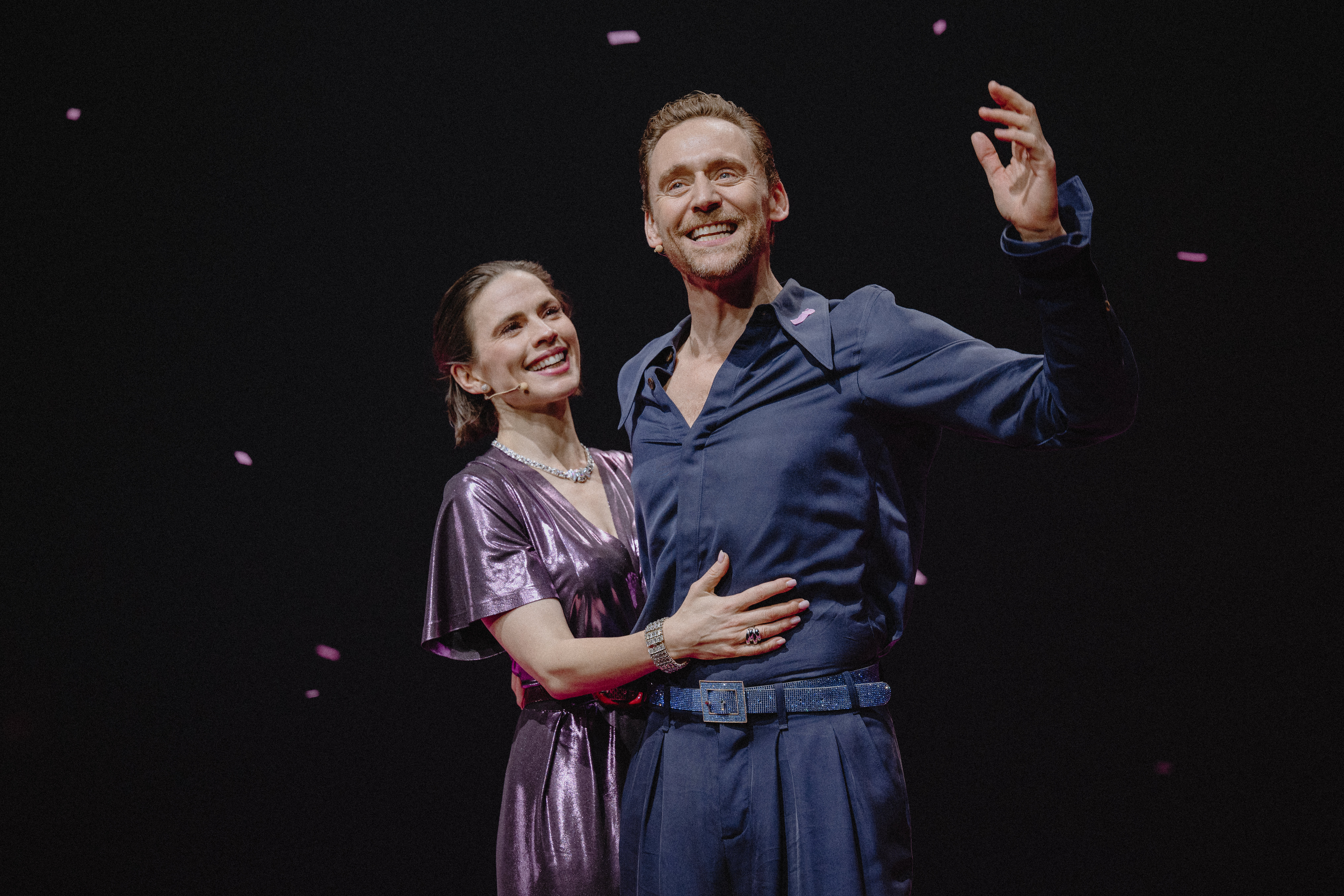
The bright clubby lighting (by Jon Clark) and festive vibe are a departure for Lloyd, known more for the brooding, shadowy minimalism of A Doll’s House and Sunset Boulevard. This production, however, is a wild kaleidoscope of purple, mauve, and pink. Soutra Gilmour manages to work this palette into her eclectic costumes, which subtly comment on the characters and their relationships. Notice how Hiddleston’s sparkling belt ties in with Atwell’s shimmering lamé jumpsuit.
(© Andy Henderson)
Gilmour’s sparse set—with its handful of chairs and vast stage—still has a Lloydian minimalism to it. But the openness gives Hiddleston the space he needs to show off his talent as a physical actor, tumbling through piles of confetti before letting himself be crushed under that inflatable heart.
And if you’ve ever wanted to see him dance to C+C Music Factory’s “Gonna Make You Sweat” (who hasn’t!), now’s your chance. In the end, it’s watching Hiddleston and Atwell going toe to toe, trading “paper bullets,” and falling in love, that’ll help justify that fifth-row seat.




source on Google
Featured In This Story
Latest Reviews
See all



Latest Videos
Watch the Cast of Benjamin Button Sing "When E're She Looked at Me"
The musical is currently running at the Public Theater through December 20.