
Review: Christopher Fitzgerald Delights the Audience in The Good Thief
A revival of Connor McPherson’s solo play opens at Irish Rep.
 |
Off-Broadway
|
November 17, 2026
(© Carol Rosegg)
The “Good Thief,” according to the gospel of St. Luke, was one of two criminals crucified alongside Jesus Christ. Stating that Jesus was undeserving of such punishment, he asked to be remembered by Christ when the Messiah entered heaven, to which Jesus replied: “Amen, I say to you, today you will be with me in Paradise.”
Nothing else is known about him, and it both strains credulity and offends morality to think that a lifelong sinner would repent seconds before his death and obtain pardon from the savior himself. But despite several apocryphal stories that try to speculate about his life and find earlier signs of sanctity, the Catholic Church holds the story of the good thief as a testament to the depth of God’s mercy and the power of repentance. To the bad Catholic, however, it can be more of a get-out-of-jail-free card: sin now, repent later—Jesus said it’s okay.
While the protagonist of Connor McPherson’s one-man show, The Good Thief, now being played by Christopher Fitzgerald in a revival at Irish Rep, never identifies himself as a Catholic (bad or otherwise), he is in desperate need of a get-out-of-jail-free card. The poster for the show alludes to the biblical story, depicting three crosses on a hill; it also shows the protagonist’s face in the rearview mirror, since he spends most of the play in a car, running from those who want him dead or imprisoned.
(© Carol Rosegg)
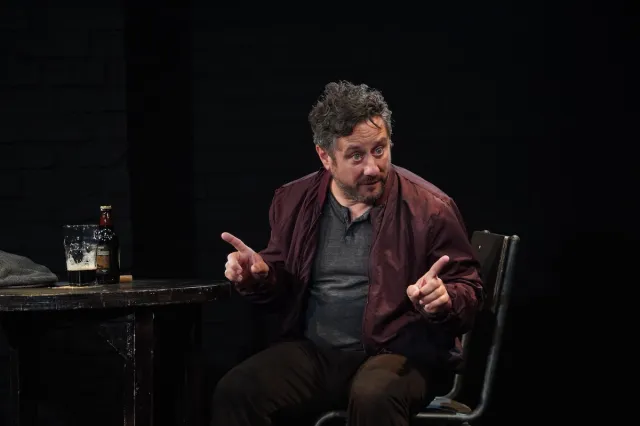
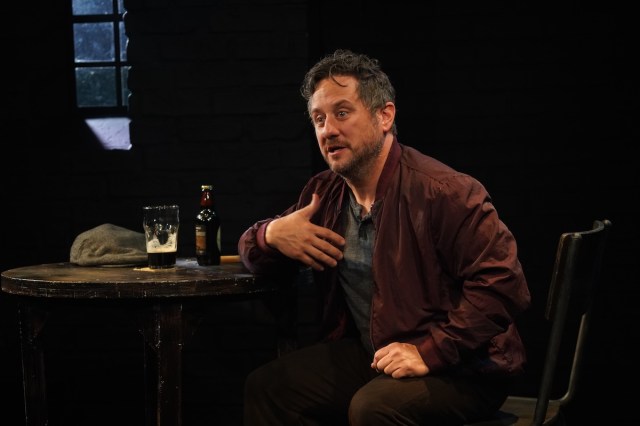
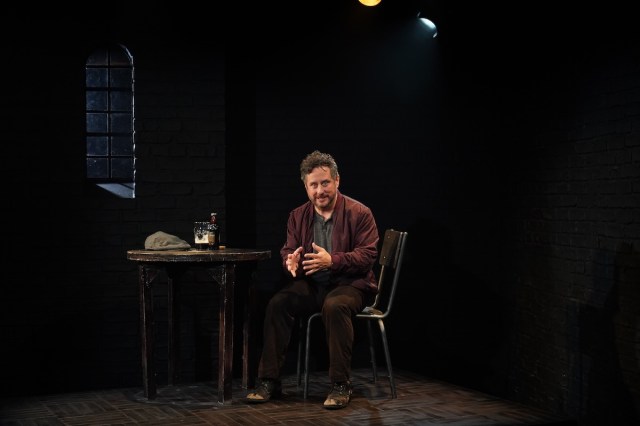
Or rather, he spends most of the story in a car. The narrator—who, like the good thief himself, goes unnamed—tells it to us directly, without any props or set beyond that of the table he sits at and the beer he drinks (set by Wilson Chin), plus the occasional sound effect (sound design by Drew Levy). It’s a bold choice, but one that is justified by the narrative, a sordid tale that checks several of the no-nos in the Ten Commandments (murder, fornication, false witness, stealing, and adultery are all represented) and completely held my attention for the 70 minutes I spent in this man’s company.
The narrator is not a thief, per se, but a goon: his job is to scare people who owe money to his boss, a mobster called Joe Murray. Things are not going well in his life. His girlfriend, Greta, has just left him (for the boss), and he seems to be in denial about his drinking problem (which explains why Murray doesn’t assign him truly important jobs, which go instead to his more professional colleague, Vinnie Rourke). It all comes to a head when what was supposed to be a simple extortion turns out to be an ambush—a classic noir twist that sets us on a wild ride, metaphorically and literally.
I was engrossed not just by the plot, but by the inherent tension in the performance. Much like the righteous Catholic would speculate about the good thief’s life to find earlier signs of his conversion, I spent the whole show scrutinizing Fitzgerald’s face and voice for signs of repentance. While I didn’t laugh as eagerly as other audience members at some of his most violent or insensitive jokes, I completely understood the pull to do so. Fitzgerald doesn’t try to win you over—he just does.
(© Carol Rosegg)
I did wonder if the play trafficked in Irish stereotypes: not just that of the alcoholic, but also of the non-plussed simpleton who can speak about the weather and murder in the same sentence, without any change in tone or expression. But Fitzgerald succeeds in creating his own person. As my date said after the show, “It’s hard to play an idiot without being condescending, but he managed it.”
My only quibble with this otherwise spartan production by director Justin Waldman (the artistic director of Two River Theater, which is co-producing the show) is that he has chosen to demarcate the divisions between the story’s chapters with music and light effects (lighting design by Jen Leno). These interruptions stop the show in its tracks without reason or need (there are no entrances, exits, or props to rearrange). Perhaps they were meant to be opportunities for Fitzgerald to catch his breath, but he seemed to wait impatiently for each one to end so he could go on speaking.
It is a testament to the show, though, that these interruptions upset me, because it speaks to how much I was enjoying it otherwise. I kept trying to anticipate it, waiting for its protagonist to turn, to live up to his biblical namesake. But, leaving the theater, I was reminded instead of a quote from Graham Greene’s The Power and the Glory, which similarly dealt with a lifelong sinner: “That was the fallacy of the deathbed repentance—penitence was the fruit of long training and discipline: fear wasn’t enough.”




source on Google
Featured In This Story
Latest Reviews
See all




Latest Videos
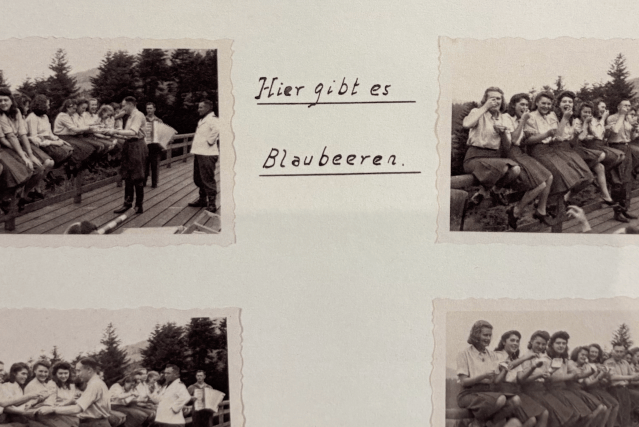
Find Out the Real Story Behind Broadway's Here There Are Blueberries
Moisés Kaufman and Amanda Gronich discuss the new drama along with their cast.