
Inside the World of Degenerates, Off-Broadway's Hot New Play About Incels
Playwright Else Went, director Emma Rosa Went, and stars Zachary Desmond and Christopher Dylan White discuss the search for connection in this Playwrights Horizons production.
The off-Broadway play on everybody’s lips this fall is Else Went’s Degenerates, a provocative peek inside the online world of the American incel community. The Playwrights Horizons production, directed by Went’s longtime collaborator and spouse Emma Rosa Went, received the kind of rapturous reviews that any artist would dream of, and tickets for the remainder of the run, through November 1, are scarce.
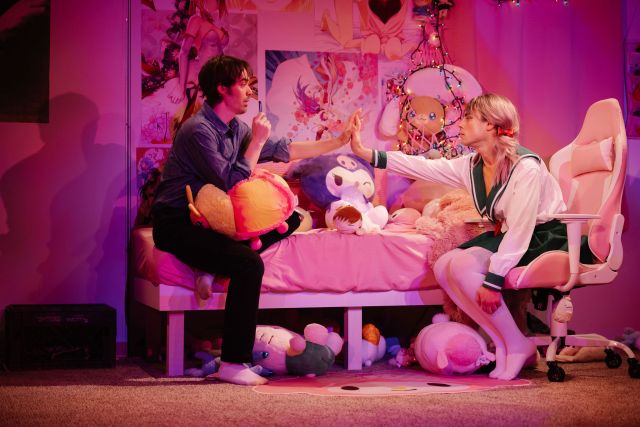
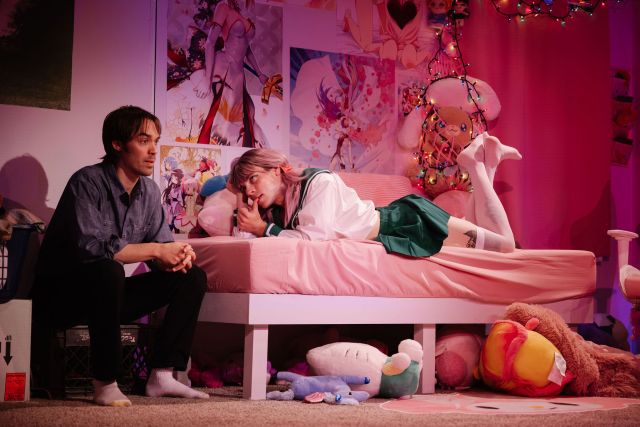
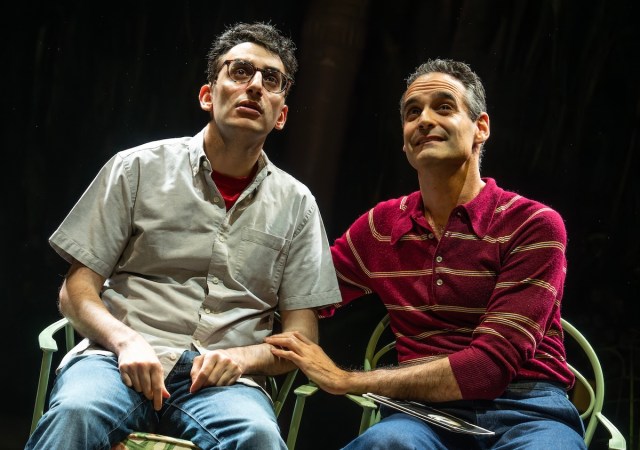
Degenerates, which begins with a call to a suicide hotline and ends, nearly three hours later, in both hopeful and horrific ways, is one of the first works, if not the first work, to really examine the fallout from the pandemic on a whole generation of isolated young men who believe their bodies make them unlovable. That’s certainly the case for the play’s dual-protagonists, 28-year-old virgin Miller (Zachary Desmond), who runs an incel Discord server, and Target (Christopher Dylan White), a 21-year-old agoraphobic dropout who makes money by doing niche online sex work.
Can Target and Miller actually find camaraderie? That’s the question the Wents have on their mind, one that Desmond and White have been figuring out an answer to since they got an early version of the script four years ago. Together, they’re all trying to figure out whether lonely people can find connection in a world that seems determined to keep them apart.
(© Jackie Abbott)
This conversation has been condensed and edited for clarity.
Else, what made you interested in writing about the subject of incels to begin with?
Else Went: There are a lot of intersecting reasons. One of them is that there are kids across America killing themselves every day. Another is that a lot of those people find themselves in communities online, which do not seek to better them, but seek to confirm and exacerbate their sense of isolation. There’s an overlap, I think, between people who are exploring trans identity and people who feel like failed men, which is something that incels often say about themselves, and also that repressing trans women say about themselves.
It became an exploration into the language of these spaces and the psychology of what is permitted to be said and how that creates this ideology of disenfranchisement that digs people deeper into a hole where everybody’s got a shovel and nobody’s trying to climb out.
And then seeing what it would be like to explore a version where people from these groups find a way out.
(© Joan Marcus)
Without giving away too much, it does feel to me that it’s almost like a romcom for certain characters, and then a grand tragedy for others. Like, it’s sweet and horrific at the same time.
Emma Rosa Went: I’m glad that you experienced it as a tragedy. I’m glad you also exited feeling hopeful. The tension between those two points is what we’re interested in. The tentative tendrils of happiness and health that [certain characters] are moving toward are held in balance with Miller’s endpoint, which is not only politically chilling but is also a very American kind of queer tragedy. It’s not the kind of tragedy that we’re conditioned to feel bad about, but [we’re] watching someone who was a real person [experiencing] the moment where [they have] a chance to stay real or move away from it.
That, hopefully, is the crux of the drama for us. Miller is now dangerous because he’s allowed his soul to be destroyed, and those are the people walking around in suits with nothing inside them we ought to really be frightened of. And yet, there was a way out for everyone. The pit in which the play is set is escapable, but some kinds of doom are self-imposed.
(© Joan Marcus)
Christopher and Zachary, I have to imagine getting a script like this is very confronting.
Christopher Dylan White: It was very frightening. It was a question of, “Am I even capable of doing what this play is asking me to do?” But I felt very seen by the script. What was on the page seemed to fulfill something that I had been dreaming about for a long time as an actor. [When I met] Zach, there was an instant chemistry and safety and respect that, when you’re dealing with a script like this, you would hope that you get. I was very lucky to find that.
Zachary Desmond: [The script] unlocked a thing in me as an actor just below the surface that was ready to be given air and space and oxygen. I just didn’t know I needed these particular facilitators to draw that out. They had been clear about who they were and that confirmation of “We want to see you erupt,” and I trusted that I’d find my way to understanding and [the ability to bring] so much love and care to [this character].
(© Jackie Abbott)
One of the things the play opened my eyes to is the incel-to-trans pipeline, which is the journey that Target takes.
Else: I wouldn’t say in that order. Because of the way that masculinity destroys sort of everybody, it has different expressions, and the expressions that it has for repressing trans women, trans femmes, and incels are similar: It’s something about my immutable characteristics that make it so that I’m going to be unhappy in life. There’s a lot of similar expressions of misery, so they find themselves in similar spaces a lot of the time. But a lot of young trans people who are repressing or don’t understand it yet also have difficulty understanding sexuality because they don’t know how they want to be desired, which is very different from what they desire.
In terms of the performances of femininity and the abstractions of the idea of womanhood, Target is going from the almost grotesque, fetishized idea of a slur used against women and then, by degrees, comes closer and closer to embodying a femininity that actually makes sense for them.
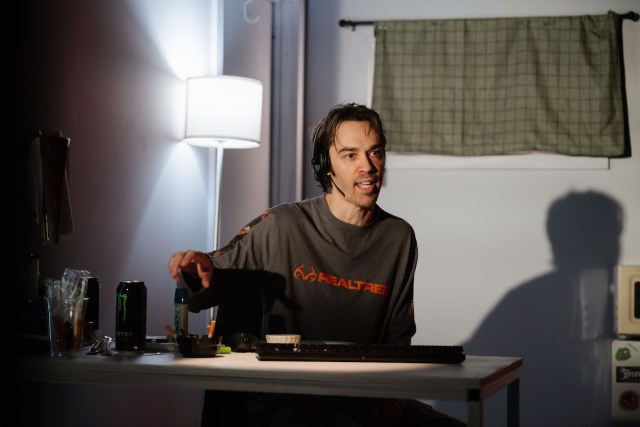
(© Jackie Abbott)
But before that, the second act of the play climaxes in an especially in-your-face sex scene; in-your-face because you’re inches away from the front row. As actors, how do you get in the headspace for that?
Emma: These freaks are fearless in similar ways. The way in which it was able to manifest physically was built on the foundation of their chemistry. The chemistry is the miracle sauce that makes the whole thing happen, but it’s not just a chemistry of vibe; it’s a chemistry of practice.
Christopher: Four years ago, Emma had us all take a breath before we started the work, where we allowed for the spirit of the play to enter the room. So, two hours into it, there was a safety to take the risk. Now, when we were working with Willow Funkhauser, who is an incredible choreographer and intimacy coordinator, she had us warm up with a series of—
Emma: Exercises about depth of touch: skin level, muscle level, bone level—
Christopher: And Zach and I felt it in our bodies and were able to approach each other. It was super informative to what we were going to build regarding the intimacy. There was a lot of careful consideration of each moment, and we also knew that we were going to build the whole thing and pare it down. But we didn’t [pare it down], because this is the story and it was honest. How do these people receive this thing that they’re claiming defines their inability to live their life now that they’re actually getting to experience it?
Zachary: The fact is that the play, as written and directed, is setting up [the idea that] eye contact is an enormous event that has real consequences on the bodies of these young people. The best part about that is the best part about what acting can be with a scene partner that you trust. I don’t know how to talk about chemistry, but what is happening on some level is that I’m stepping into a space, people are watching me look into the eyes of another person, and that person did, on the first day, really look back.
Any time that happens, it has a palpable magic. It has a molecule-changing effect on the people who are experiencing it. And then everything else is an expression of that effect. But it is the thing that happened when we met, and it’s just kept doing it. I don’t have to question it. I just get to show up, look at this person, and thank the fates that there is always light coming back at me. And then we fuck.
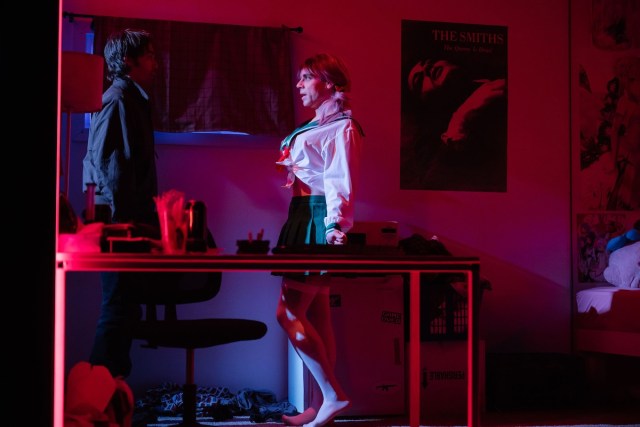
(© Jackie Abbott)




source on Google
Featured In This Story

Related Articles
See all
Latest Reviews
See all






Latest Videos
Watch the Trailer for Elsinore Starring Andrew Scott
The film is based on the true story of Ian Charleson, who played Hamlet at London’s National Theatre after being diagnosed with AIDS.