
Review: Daniel Fish Turns an AIDS-Era Clash Into Gripping Theater in Kramer/Fauci
At St. Ann’s Warehouse, Will Brill and Thomas Jay Ryan revisit a pivotal health-care debate.
 |
Off-Broadway
|
|
Off-Broadway
|
October 5, 2026

(© Maria Baranova)
It’s not hard to imagine what sparked director Daniel Fish’s interest in dramatizing the transcript of a C-SPAN segment, the 1993 face-off between Dr. Anthony Fauci (Will Brill), the Director of the National Institute of Allergy and Infectious Disease, and Larry Kramer (Thomas Jay Ryan), the AIDS activist and playwright of The Normal Heart. In its original form, the conversation is already gripping theater, largely because of the wildly complicated relationship between the two men.
As we learn at the top of Kramer/Fauci, a word-for-word restaging of these 53 heated minutes now playing at St. Ann’s Warehouse, the C-SPAN program aired just after Clinton’s White House had announced the formation of an AIDS research task force (the play had its world premiere at NYU Skirball in February). Fauci contends the best scientific minds are on the job. But Kramer, unfiltered and unflinching on live TV, is pissed off: there are 5,000 new infections every day, he reports, and nobody in power is responding with any urgency. By the time this task force convenes, it’ll already be too late for thousands more. “Why is everybody being so polite?” he demands, furiously. “We’re in the middle of a plague.”
But Fauci, the government’s chief leader in AIDS treatment research, doesn’t feel he can speak out against the legislators funding him or the president backing his work. Nor is he willing to buck the rigid guidelines for drug trials in which he’s been trained, even though that decision is likely costing lives. He’s Kramer’s closest ally in Washington, but the “bureaucratic bullshit” Fauci peddles is driving Kramer mad. These are uneasy allies, who deeply respect each other, and Kramer/Fauci is at once a tense debate and a darkly endearing buddy comedy.
(© Maria Baranova)
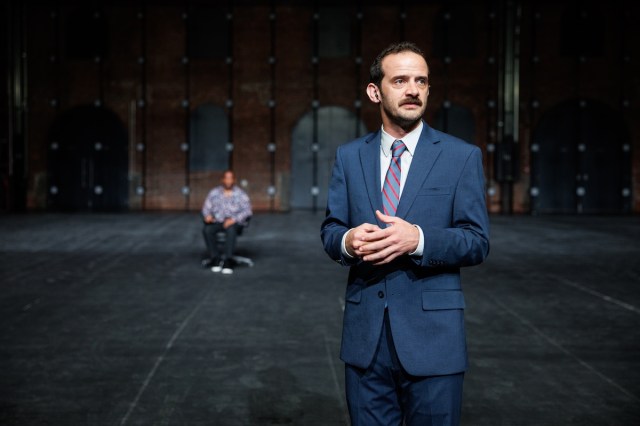
Fish’s staging is rarely literal and sometimes opaque in its symbolism. The play begins with the men begin standing on opposite corners of a wide void, the moderator Scott Scully (Greig Sargeant) between them. Jennifer Seastone, playing each of the C-SPAN callers who share questions and offer occasionally touching but sometimes bigoted commentary on the issues, performs much of the show on roller blades. I don’t know why she does that, but I do know that it works.
Tracking the visual somehow requires that we lean into her language; it’s as if in trying to make sense of the imagery, we focus more closely on the content. The real alchemical miracle of Fish’s concept is that his staging doesn’t distract from the language but rather sharpens our listening, attuning to us to the nuances of the debate even while absorbing the abstract gesture. (Only Seastone’s later appearance in an inflatable chicken suit left me totally at sea.)
At the heart of Kramer/Fauci is a lengthy silent sequence in which a small machine pumps out glistening bubbles that rapidly fill a third of the stage in waist-high foam while Kramer sits on a desk chair amid the rising soapy tide. In watching this sea of bubbles engulf the space, I saw the escalating plague itself, Kramer powerless to stop its growth but unwilling to get out of its way. Especially for audiences who grew up after the worst years of AIDS in the United States, the scale can feel unfathomable, even in Kramer’s frantic, horrified storytelling; Fish’s bubbles offer an overwhelming illustration to help us understand, if not the magnitude of the epidemic, at least the sense of its inexorability.

(© Maria Baranova)
Ryan’s performance searingly magnifies Kramer, physicalizing his ferocity as he paces the stage and gets in the faces of his combatants. Ryan embodies a despair that Kramer himself only describes in words on the broadcast. Fauci’s characterization is a little less clear: Brill spends much of the show lounging in the bubbles, propping himself up casually on an elbow. If in theatricalizing Kramer, Fish exposes what’s fomenting not so far below the surface, then is Fauci’s inner turmoil really represented in this nonchalant pose? It looks like he’s not taking the conversation seriously, but we know that’s not the case.
Fauci speaks like a bureaucrat, yes, but he also engages with Kramer and keeps him talking. However, we never really see Fauci’s inner conflict here; if Kramer/Fauci missteps, it’s in sometimes allowing Fauci to come across as the villain rather than leaning into his internal tension. And even in somewhat diminishing Fauci’s complexity, Fish lovingly restores to Kramer what he was so sorely lacking on that C-SPAN interview as a man of the theater: a live audience. Kramer’s wit is scathingly funny, and the collective response in the room to his quips changes the tenor of the conversation, making it clear how aware he is in every moment that he’s delivering a truth-telling performance for everyone tuning in.
Toward the end of the segment, Fauci frets over Kramer’s projections for future infections; he doesn’t want to lose credibility by agreeing with Kramer’s statistics. Kramer rebuts him: “You lose credibility when you become a coward.” There are no cowards here: Kramer/Fauci is high-risk theater-making that pays off as it amplifies a pivotal, passionate conversation of the past.




source on Google
Featured In This Story
Latest Reviews
See all









Latest Videos

Watch the Trailer for Elsinore Starring Andrew Scott
The film is based on the true story of Ian Charleson, who played Hamlet at London’s National Theatre after being diagnosed with AIDS.