
Review: Degenerates, Else Went’s Drama About All the Lonely Incels
This must-see play makes its world premiere at Playwrights Horizons.
 |
Off-Broadway
|
|
Off-Broadway
|
September 29, 2026
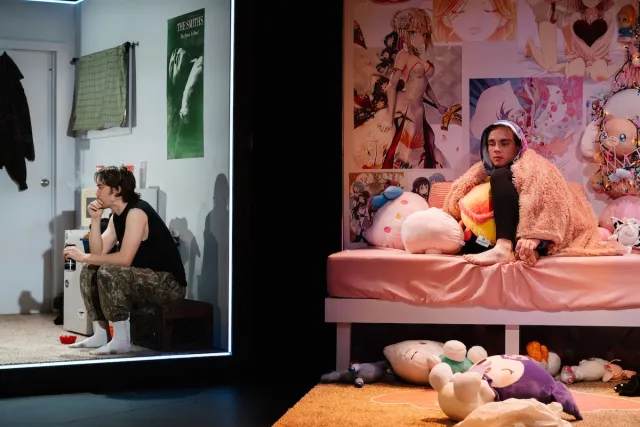
(© Jackie Abbott)
Else Went’s Degenerates, now making its world premiere at Playwrights Horizons, begins in darkness tempered by chintzy pleasantry. A man has called the national suicide prevention lifeline only to be placed on hold, overprocessed music left to keep him company as he peers into the void.
When he finally does get through, he is acutely aware that voice on the other end is providing a service. He’s not sure she’s even real. As AI becomes uncannier and the urge to self-destruct becomes more pervasive (two trends not entirely unrelated), it stands to reason that AI-powered counselors would be deployed to fill the gap between supply and demand. This is the cold, brutal logic of the market.
Those same dynamics, when applied to coupling, have kept Miller (Zachary Desmond) a virgin at 28, or so he has convinced himself. Shown from an early age that he belongs on the clearance rack of humanity, he now moderates a Discord server for similarly unloved men, colloquially known as incels, meaning “involuntarily celibate.”
There’s 21-year-old Kemp (Tyler Nowell Felix), a self-described weeb still smarting from a painful rejection. Target (Christopher Dylan White) is a mentalcel, an agoraphobic shut-in at 19, ordering sustenance online and paying for it through highly niche cam sex work. It’s obvious that the pandemic did a lot of psychic damage to these boys, as it did to their entire generation. We wonder if there’s a way for them to translate their pain into real fellowship or even love.

(© Jackie Abbott)
But Miller wants them to stay mad. His rage has myriad targets: feminists, trans people, online manosphere grifters (mostly out of a sense of professional jealousy). His disgust for the blue hairs of BlueSky boils over into this pithy plea for sexual socialism: “Supply is dwindling and I’m the starving class! So if you’re such a woke communist, why don’t you prioritize the collective and distribute some resources, fuck!”
Went’s mastery of the discourse of the young and terminally online is just a small part of what makes Degenerates an illuminating journey into a dark corner of American life. With great sensitivity and empathy, Went shows her audience how the misery of these incels is rooted in the same unfulfilled desire for human connection that most of us feel as atomized consumers in a crumbling liberal society.
She once again works with her spouse, director Emma Rosa Went, who last season helmed her five-hour millennial epic, Initiative. Their collaboration has quickly become one of the most exciting theatrical partnerships in New York, wedding fearless curiosity to sharp-eyed storytelling that doesn’t flinch from a challenge. The major one in Degenerates is that so much of the action takes place online, limiting the potential for stage action, a hurdle the Wents overcome through gripping performances and clever design.
Mikiko Suzuki MacAdams’s set depicts the very different habitats of Miller (bare basement walls spare a single Smiths poster) and Target (like an anime convention vomited into a bedroom). Though they share the same stage, the gap between them feels cosmic, and when the characters finally do come together, it is with an explosion of light and sound (thrilling work by lighting designer Jiyoun Chang and sound designer Angela Baughman).
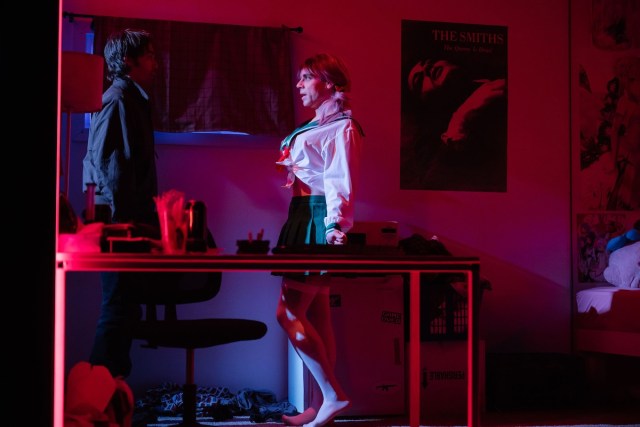
(© Jackie Abbott)
The physical separation of Miller and Target in the first act makes their IRL meeting in the second feel dangerous an exciting—a raw encounter without the prophylactic of the screen. It’s the kind of moment that shortens breaths, lest we deflate the soufflé, making us all feel the high stakes of real human interaction for these characters. And it pays off. Would you believe that Desmond and White have the most electric sexual chemistry I’ve encountered onstage in 2026?
White is giving a particularly brave performance as Target, an effeminate male whose life has been shaped by the opinions (sometimes violently expressed) of others. With sad eyes and soft voice, White gorgeously embodies a noble soul’s quest to connect.
As the older man, Desmond’s Miller has had more time to stew in his grievance, resulting in a tougher exterior. Terrified of his desire and chronically wound up on nicotine and Monster energy drink, he has transformed his anger into armor. The moments Desmond allows us to peer underneath are among the most revelatory and beautiful in the entire play.
In the supporting role of Kemp, Felix delivers a performance that will make you want to run onstage and give him a big hug. But you wouldn’t dare with Juan Arturo, who gives a crushingly effective walk-on as “Chad,” an avatar for the kind of men who are besting betas like Kemp in the sexual marketplace.

(© Jackie Abbott)
Underscoring all is the sneering disembodied voice of Stacy (Olivia Rose Barresi, casual disdain dripping from every syllable). She reads stage directions and offers editorial commentary on the action in a manner reminiscent of Kate Benson’s [Porto]. She is the authorial voice of the dominant culture, aurally holding these pathetic male specimens at arm’s length with a pair of tongs and inviting us to laugh and judge.
Unsurprisingly, many in the off-Broadway audience accept this invitation. But the Wents have something to say about that when they unsentimentally demolish this convention in the third act. We are a part of this story, and it might just be in the role of unwitting villain.
Arriving just a week after the opening of Max Wolf Friedlich’s The Holes, Degenerates offers more hopeful evidence that the theater is finally climbing out of its entrenched position in the culture war and looking for survivors. I’m convinced that it will be in this no-man’s land that the next great American plays will be found. Degenerates is an early contender for this season’s best.




source on Google
Featured In This Story

Latest Reviews
See all









Latest Videos

Jocelyn Bioh, Whitney White, Jasmine Amy Rogers, and Patina Miller Talk School Girls
The playwright, director, and stars of School Girls; Or, the African Mean Girls Play discuss the comedy, sisterhood, and themes behind the new Broadway production.