
How Mona Pirnot and Jack D. Coen Turned a Solo Monologue into a 16-Member Choral Piece
Their show I Became We is currently running at the Atlantic.
 |
Off-Broadway
|
November 13, 2026
A couple forms, they marry, they buy property, they have children. It is a simple human trajectory that is awfully mundane until you stop to consider how your life will never be the same again.
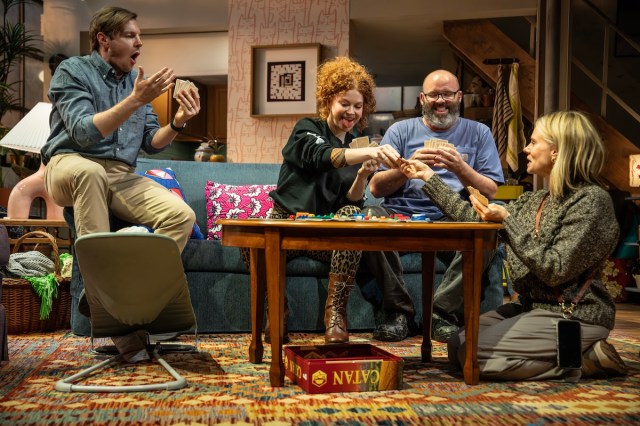
The fear that accompanies these life changes permeates Mona Pirnot and Jack D. Coen’s I Became We, a solo play performed by a 16-member choir at the Atlantic. It’s the story of a 30-something who struggles to decide whether parenthood is the right option while talking all the steps toward it. And while the central characters are, more or less, auto-fictional facsimiles of Pirnot and her husband, playwright Lucas Hnath, the story takes on a universal quality as performed by the vocalists, who vary widely in age and gender. It’s also hilarious, with Coen’s musical score, performed by a solo pianist, showcasing as much personality as his and Pirnot’s words.
The collective voices within I Became We transform one couple’s personal reckoning into a meditation on the universal anxieties of commitment. And it’s writers are quite pleased that audiences are getting as much out of it as they seem to be.
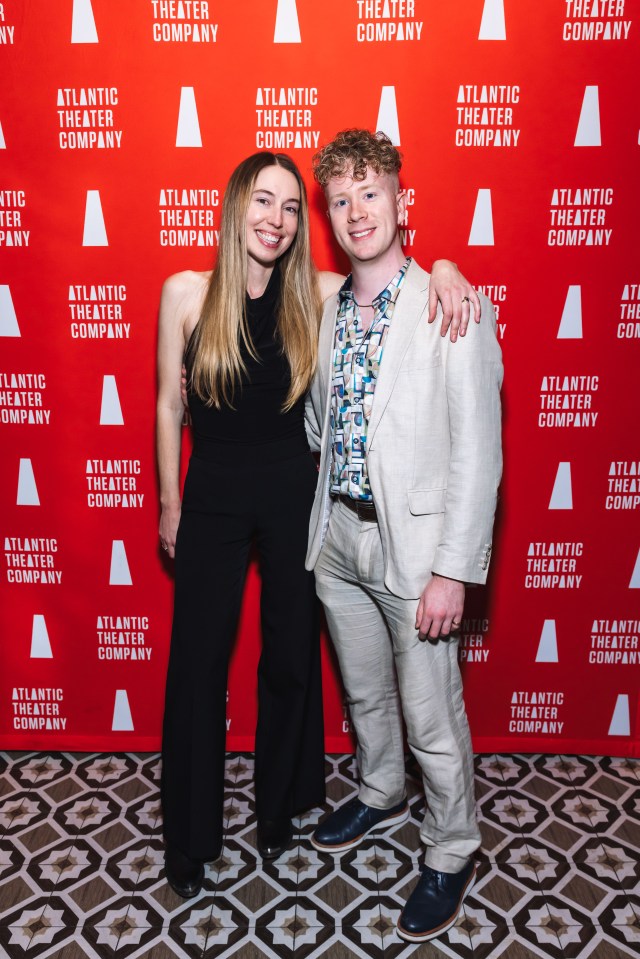
(© Rebecca J. Michelson)
This conversation has been condensed and edited for clarity.
How did you two start working together?
Mona Pirnot: I did a show at New York Theatre Workshop called I Love You So Much I Could Die, which was a solo show. I played guitar, and for the final song, my friend Will Butler had arranged an accompaniment on pump organ. We needed to find an organist who would do eight shows a week but sit backstage and play for four minutes at the end. And it was Jack. I learned that he was the music director at a church, that he wrote musical theater, that he was brilliant, and we became friends.
I had seen a choral piece that was a benefit for a nonprofit I was working with, and I wanted to steal that form and sort of merge it with a first-person monologue. Jack said yes, and we worked on it for two years.
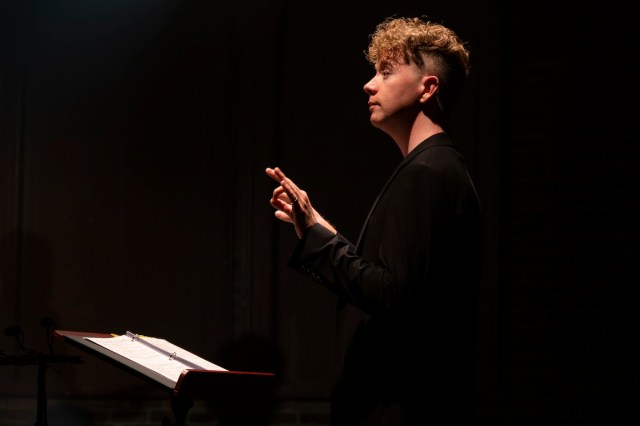
(© Ahron R. Foster)
What was it about the choral form that interested you?
Mona: Whenever I write autofiction, I want to find some big formal gimmick that, first of all, is pleasurable, exciting, theatrical. But the aim is always to provide a highly specific but faceless avatar so that other people can hopefully have the feeling that, “This play was written for me.” Or that it provides an opportunity for people to have a private experience where they populate the characters in their heads with people from their lives.
I knew I wanted to do something big, because the other two were solo plays. When I saw that choral concert, I loved the big sound, I loved the harmonies, I loved the multiplicity of voices. I love looking at every individual person, getting attached to them. I love that they’re performing, not acting. I wanted to do something that would be a tribute to that.
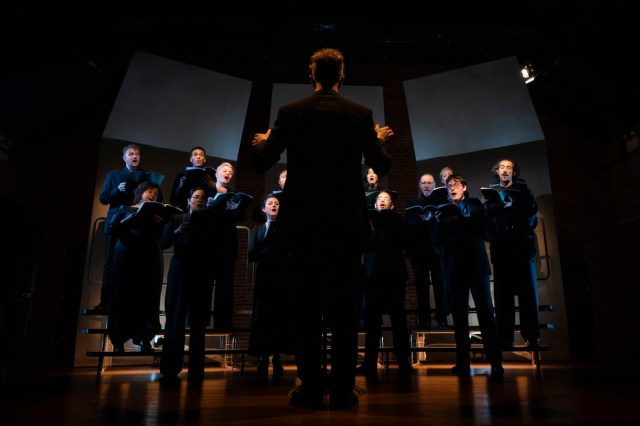
(© Ahron R. Foster)
This is the chicken or egg question: what was your process like for writing music and lyrics?
Jack D. Coen: We basically wrote like the entire show in the same room, with the exception of like a few small moments. Mona would come in and say, “This is where I want to take the story. We’re going to Florida. We’re going to a barbecue.” And then I would tinkle around at the piano and think of what that could sound like melodically. When we landed on a musical vibe and a direction for where the scene story was going, then together, we both would say, “how does that text fit into this music?” We really, painstakingly and tediously, worked through all the lyrics together, matching the accents to what Mona was trying to say.
Mona: We’re both musicians, but we’re very different musicians. I write folk music on guitar with a lot of slant rhymes that Jack would never allow me to use. Jack is much rangier. He can do it all. But we both have a shared language of wanting to find the right syncopation, knowing what feels forced.
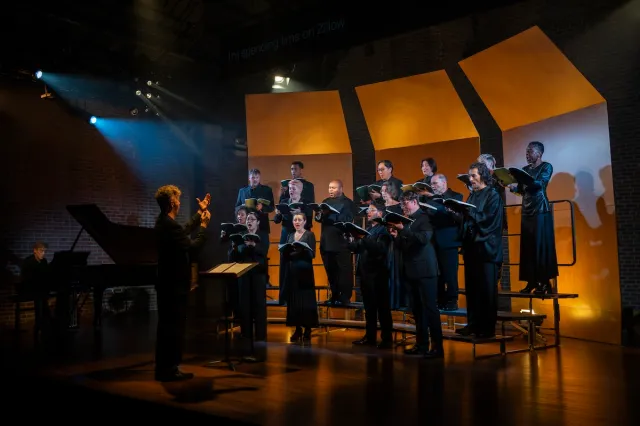
(© Ahron R. Foster)
The music just has so much personality.
Mona: That’s what we were going for. In lieu of a person, in lieu of an actor to look at, where can we get character? Primarily the music.
Jack: What’s so brilliant about Sarah Benson’s staging is that everything is so restrained. In the absence of physical activity, you really do enable the music to become a character in that way because it has our full attention.
Tell me about assembling this group of singers.
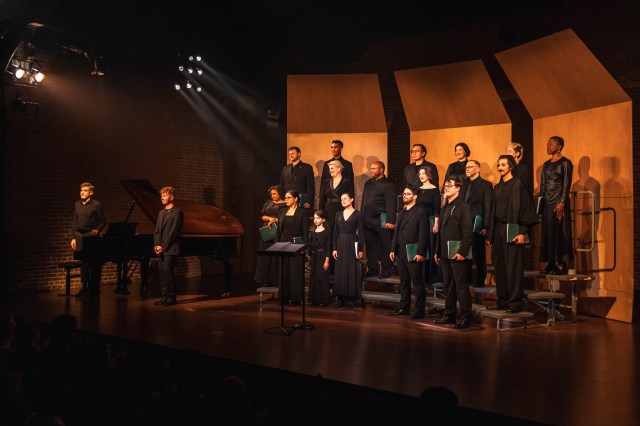
Jack: I’ve been working in the sacred music scene as an organist at my job at Church of the Epiphany in Gramercy and at Temple Emanu-El, so I had this relationship with [casting director] Marjorie Daley and she knew all of them. There’s an incredible network of people who can sight read this stuff and have been living in this repertoire for decades. The most fulfilling part of this for me is seeing these people who love choral music have the opportunity to sing it in a context that they never would have expected. It’s given a whole new meaning to their craft and their practice. They get to do what they’ve always done, but in a new way that people are relating to and are really moved by.
(© Rebecca J. Michelson)
Mona, as a writer of auto-fiction, how much of your goal is to find a personal catharsis in creating a show like this?
Mona: At least with my last three plays, there will be a question that is so complicated in my own life, where I make a point in my head and then an objection follows. If I am having that experience, it’s probably ripe territory to dramatize it. I tend to write things where I’m genuinely wrestling. And I still don’t know [the answers]. It’s a spoiler to say how it ends, but in the penultimate song, I’m sure trying to get closer to the truth instead of ending with a tiny bow.
The narrator says at the beginning, “Good thing I never wanted children,” period. Sung with such certainty, literally by a choir. You would think that the tyranny of narrative necessitates that by the end, she’s changed. And she has, but not in a way that’s tidy. I wanted to try and be brutally honest and confessional to invite people to do it in their own heads, too.
I find myself questioning if I want to have children all the time, and I literally have two kids that I have no complaints about. My wife and I still look at each other several times a day and say, like, “We could be on a yacht right now.”
Mona: I talked to a lot of female playwrights who I look up to and Bess Wohl told me the exact same thing, and I found it so healing. Because I’m sure you love your kids more than you ever thought you could love another human being, but thank you for saying that, because I sometimes put parents on this pedestal of certainty that feels like they’re on a different plane than me. So, you know, thanks for making yourself human by saying that. I met a woman after the show the other day and she said, “I’m 80 years old, and I have to tell you, I feel like this play is about me where I am in my life right now.” That was so gratifying. I wasn’t sure if it was just for 35-year-olds at the exact same crossroads, but it turns out it’s for everyone at every phase of life. Those kinds of responses are really moving.
(© Rebecca J. Michelson)




source on Google
Featured In This Story

Related Articles
See all
Latest Reviews
See all




Latest Videos
Find Out the Real Story Behind Broadway's Here There Are Blueberries
Moisés Kaufman and Amanda Gronich discuss the new drama along with their cast.