
Review: I Became We Is a Musical Monologue About Thoughts of Motherhood
Mona Pirnot’s latest autofictional experiment, featuring a 16-person choir, is her most resonant yet.
 |
Off-Broadway
|
October 27, 2026
(© Ahron R. Foster)
Three plays in, and playwright Mona Pirnot’s project is becoming clear: experimenting with fresh ways to tell autofictional stories onstage. In I Love You So Much I Could Die, Pirnot used a speech-to-text program to relay a tragic story involving her late sister, which she broke up with songs she performed with her back to the audience. Instead of herself onstage, she had the great chameleonic solo thespian David Greenspan acting out a four-person drama in her follow-up, I’m Assuming You Know David Greenspan.
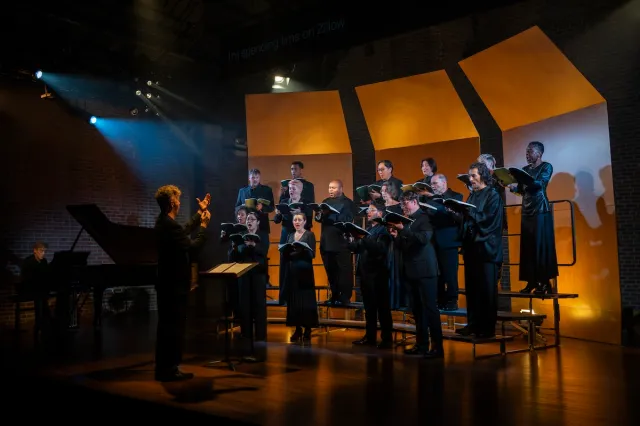
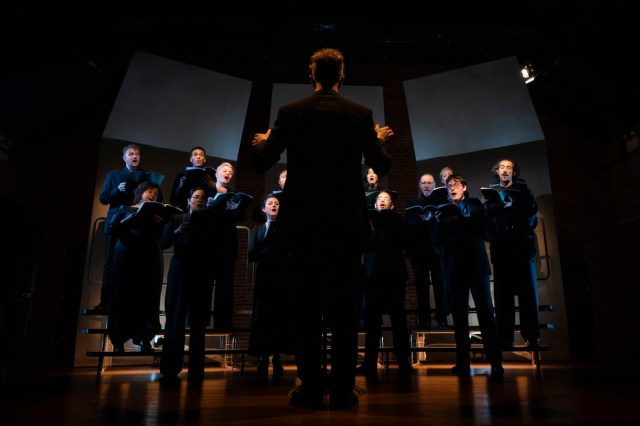
Now, with I Became We, she tries for something like a full-on musical, collaborating with composer Jack D. Coen to have a pianist and a 16-person choir perform an entire 70-minute monologue. Clearly, her stylistic ambition has grown. Thankfully, in this case, so has her thematic ambition.
“I saw a segment on Jimmy Kimmel Live! / called ‘What Do You Know About the Female Body?’” That’s the first line of I Became We, and naturally, the mere idea of hearing such a line given a choral setting is enough to draw hearty laughter from the audience. (Supertitles are projected above the stage in Mimi Lien’s small-concert-hall scenic design.) But while a fair amount of the show elicits amusement from that marriage of contemporary speech and classical music, Pirnot has legitimately serious concerns on her mind: chiefly, motherhood. Though she and her husband long ago mutually agreed that they didn’t want children, a return to Florida to celebrate her mother’s retirement from her job as a university mathematics professor leads her to start questioning that decision.
(© Ahron R. Foster)
Instead of confronting this internal conflict directly, though, she channels her energies into the search for a house in upstate New York, having convinced herself and her husband that what she really wants is to settle into a quieter environment, away from the chaos of New York City. But only after they’ve gone through an arduous home-buying process does she realize that she still feels something missing from her life. Her thoughts about having children trigger broader anxieties of aging and potentially saying farewell to the freedom of her younger days.
As with her previous two works, Pirnot is telling a resolutely personal story, with barely any concessions made toward broadening its perspective beyond the narrator’s. While one could admire her commitment to following that age-old maxim of writing what she knows, her zeal for formal experimentation was not quite enough to transcend the feeling of navel-gazing solipsism in both cases. In the case of I Became We, it’s not so much that Pirnot has transcended insularity and attempted to imagine an outside perspective. As someone who has just entered middle age and wonders whether I have an interest in fathering children, I simply found more to relate to this time around.
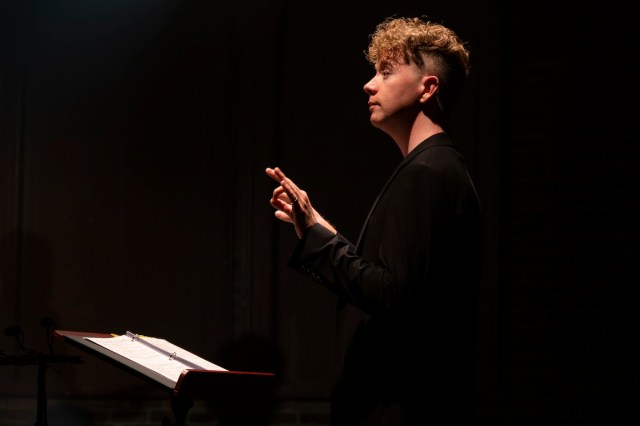
Or maybe I was simply seduced by the music. I Became We represents Jack D. Coen’s off-Broadway debut; he also co-wrote the lyrics with Pirnot and conducts the performers, including pianist Blair McMillen, onstage. Based on his music here, he’s a talent to watch. The sheer stylistic range is impressive: Though initially starting with numbers that sound like conventional musical-theater fare, by the end his score has taken on a J.S. Bach-like cast.
(© Ahron R. Foster)
But Coen isn’t just showing off his versatility. Every tempo change, key modulation, and compositional technique is keyed to the activities and emotions of a given moment. When the narrator, at a barbeque with her husband, is forced to hold a baby, Coen underscores her description of the baby’s behavior in her arms—“She starts squirming. / She starts clawing. / She starts crying. / She starts screaming”—with blasts of chromatic melisma that convey not only the behavior itself but her own discomfort verging on revulsion. Coen’s use of a fugue to depict the complications of closing on a house is also quite imaginative.
Coen’s score also features solo and quartet numbers. These usually underscore more intimate moments in Pirnot’s monologue, when she gets introspective or another character offers words of wisdom. (Under Sarah Benson’s direction, lighting designer Tuçe Yasak adds to the intimacy of these moments by discreetly spotlighting individual performers.) He saves his most memorable stylistic coup de théâtre, though, for a concluding number in which a child (Paige Nesle) walks onto the stage and performs a duet with an alto in the context of a phone conversation in which the narrator finally confesses her increasingly complicated feelings about motherhood. In a show that offers a brilliant demonstration of the power of music to make deeply personal feelings broadly accessible, this moment carries the force of a universal epiphany.




source on Google
Featured In This Story

Latest Reviews
See all






Latest Videos

Watch Original Rent Cast Members Sing "Seasons of Love" at 30th Anniversary Concert
The performance features Idina Menzel, Adam Pascal, Anthony Rapp, and more.