
Review: A Rich Family Confronts Their Privilege in Aftermath
David Zax’s play about a journalist recovering from a traumatic experience in Afghanistan makes its New York premiere.
 |
Off-Broadway
|
October 26, 2026

(© Marc J Franklin)
Though the starry Broadway revival of Other Desert Cities is garnering much attention right now, there’s another family drama playing in New York that is worth considering. Aftermath represents the off-Broadway debut of playwright David Zax, and though nowhere near as accomplished as Jon Robin Baitz’s play is, it offers an arguably more scalding, relevant, and thought-provoking take on white privilege and shattered ideals, political and otherwise.
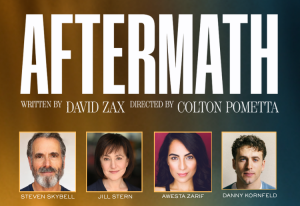
Set in 2011, freelance journalist Josh Goldman (Danny Kornfeld) has just returned home to Washington, DC, after a stint in Afghanistan during which he was kidnapped and held for ransom by the Taliban before he escaped. He is amid a 10-week trauma recovery schedule conceived by his mother, Linda (Jill Stern), and approved by a doctor—though his father, Allan (Steven Skybell), occasionally chafes at Linda’s insistence on following that regimen so rigidly. An even bigger wrench is thrown into this process with the appearance of Mina (Awesta Zarif), an Afghan-British fellow journalist whom Josh invited to stay at their home without telling his parents initially.

(© Marc J Franklin)
Much of the drama of Aftermath revolves around the tension between Josh’s desire to return to Afghanistan and his parents’ desire for him to stay home. Unlike Allan, a former political activist who settled down and became a lobbyist, Josh still harbors a passion for shining a light on the plight of the underprivileged. His proactiveness may have cost the life of his translator, Mina’s cousin Hamid (whom Mina has recently decided to write a book about). But for Josh, this is as much about breaking out of his comfortable suburban-DC bubble and doing something that makes a positive difference in the world. “Some of the reporters say ‘war is the drug,’” Josh says to Mina. “No, privilege is the drug.”
The nature of that privilege, however, becomes a point of contention during the couple days over which Aftermath is set. While trying to clean up a wine spill on the Goldmans’ rug, Linda lets slip the fact that the rug cost them $50,000, a price Josh finds obscene, later opining that such a hefty sum ought to have gone to, say, an NGO in Afghanistan. (Chen-Wei Liao’s scenic design of the Goldmans’ home certainly exudes a feeling of domestic comfort.) A much broader dispute develops when revelations start piling up surrounding the circumstances of Josh’s kidnapping and eventual “escape.” Without spoiling too much, the reveals expose, among other things, just how easy it can be for a certain kind of well-meaning liberal to trumpet their bleeding heart when they don’t have to worry about money.

(© Marc J Franklin)
With a bracing lack of compromise, Zax is wading into thorny sociopolitical territory in Aftermath. That makes the clumsiness in some of his writing regrettable. Zax is himself a former freelance journalist, and unfortunately that shows in some overwriting. Surely, for instance, Josh is well-versed enough in US politics for his father not to feel a need to refer to John Ashcroft, whom he says he ran into at his local post office early in the play, as “former US Attorney General John Ashcroft.” And Aftermath is also well-constructed to a fault. In a play overrun with parallels and foreshadowing, even Josh’s penchant for panic attacks in high-pressure emotional situations finds an analogue in his dad’s depression, which occasionally manifests itself in similar bouts of heavy breathing. Such details are enough to threaten the play’s credibility as Zax pushes things into family soap-opera territory, an overwrought feeling that Colton Pometta fails to stave off with his somewhat stiff direction.
That it never fully goes off the rails is thanks in large part to its cast—most of it, at least. Zarif infuses Mina with glimmers of an inner life that goes beyond the two-dimensional way Zax has written her character. As Josh, Kornfeld nails both his character’s journalistic passion and his familial resentment. Alas, Stern—who is also the founder of The InterCircle, the show’s production company—is the weak link, strangely underplaying even the moments when Linda ostensibly bears her fangs out of desperation to keep her family together. Skybell, by contrast, brings such imposing authority to the tough yet loving Allan that, in some ways, Aftermath becomes his show. Whenever Skybell is onstage, Zax’s play shows a genuinely provocative edge that transcends its schematic morality-play trappings.




source on Google
Featured In This Story
Latest Reviews
See all









Latest Videos
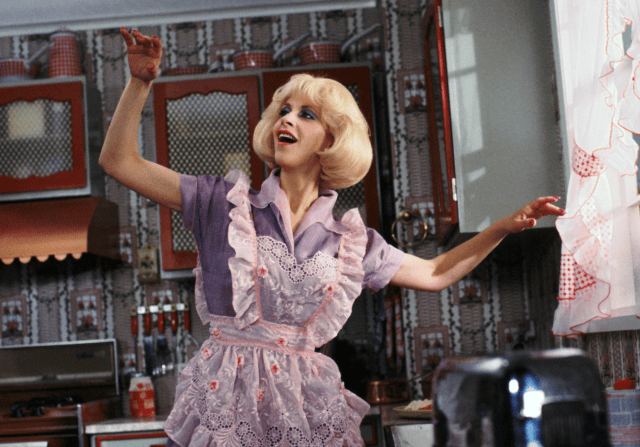
Watch: Ellen Greene Reflects on the Enduring Legacy of Little Shop of Horrors
Frank Oz’s cult classic movie-musical has gotten a new 4K restoration in celebration of its 40th anniversary.