
Special Reports
Three Playwrights Explain Why Live Theater Makes Horror Even More Terrifying
The authors of 2:22—A Ghost Story, A Ghost in Your Ear, and Paranormal Activity discuss the unique experience of scaring an audience in real time.
 |
New York City
|
October 26, 2026
Three spooky plays are haunting New York City right now, but the real trick isn’t simply making audiences scared: it’s making them scared together.
Unlike cinema, which can make use of creative editing, live theater means that every scare unfolds in real time, with the performers, designers, and spectators all sharing in the experience. 2:22—A Ghost Story, A Ghost in Your Ear, and Paranormal Activity are vastly different works with vastly different goals. But they all have a big advantage over merely watching a scary movie: when the room erupts in screams, the audience becomes part of the fabric of the production itself.
For Danny Robins, whose 2:22—A Ghost Story at the Lortel Theatre turns a dinner party into a supernatural mystery, the starting point was less of a desire to frighten than an interest in what happens when a fundamental disagreement arises in a relationship. “I was talking to a friend of mine who told me this story about having seen what they thought was a ghost,” Robins says. “I remember thinking that all of our friendship group would react in different ways. Some people would be irritated by it, some people would believe it, some people would mock her, some people would think she was going crazy. That incredible spectrum of reactions to the idea of “Do ghosts exist?” felt like a very exciting problem that can throw a Molotov cocktail into a relationship. How can you love me if you don’t believe me?”
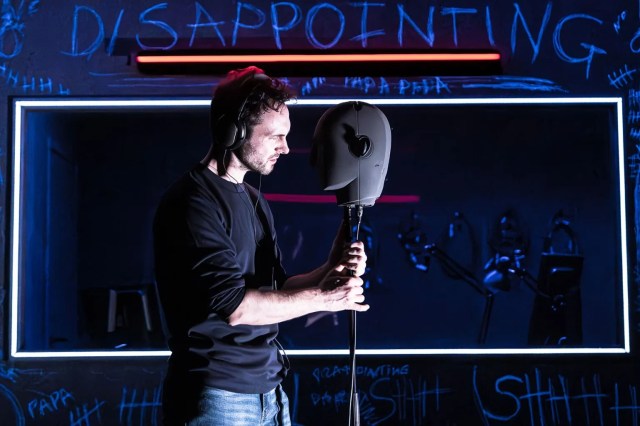
Jamie Armitage’s A Ghost in Your Ear, an Audible production at the Minetta Lane Theatre, began as a challenge. “A friend asked me, ‘Do you think you could do a horror show which is just one person telling a ghost story?'” Armitage recalls. “And I was like, ‘It’s not a good idea.’ But then I remembered my love of binaural audio, and how I’d always wanted to find a way of doing a horror show that justified why the audience were wearing headphones.” That’s how he hatched the idea of setting his play in a sound studio, during a haunted audiobook recording session.
(© Matthew Murphy)
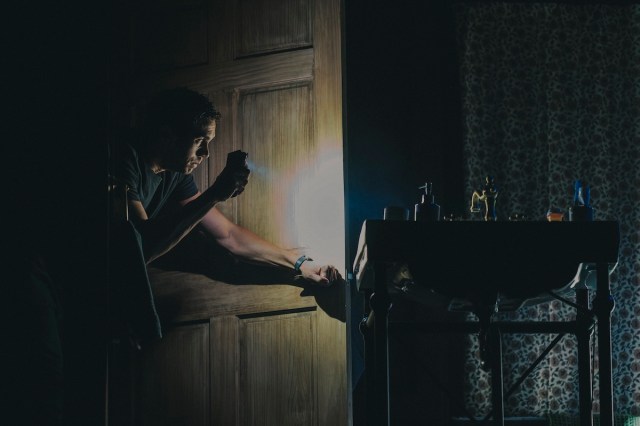
For Levi Holloway, Paranormal Activity at the August Wilson Theatre emerged from trying to figure out what actually scares him and director Felix Barrett, with the challenge then becoming how to translate impossible ideas into a theatrical setting. “Most of my stage directions aren’t obviously achievable at first glance,” Holloway explains of the domestic drama, which finds a couple haunted by their past. “In an early draft, one character spontaneously combusted. We stress-tested how to do that by bringing in [illusion designer] Chris Fisher, who offered his own mischief, and then we burnished them, deepened them, economized them, and made them what they are today.”
The three plays may be built around supernatural phenomena, but the writers aren’t interested in horror for horror’s sake. Each author is quick to point out that the scares emerge from recognizable human situations.
Armitage wanted A Ghost in Your Ear to combine the classic tradition of “old-school British ghost stories” with “the very modern setting and technology,” while also exploring the concept of passing on urban myths between generations. Holloway, meanwhile, realized that a haunting could be an effective way of exposing the vulnerabilities of a marriage: “I wanted to talk about how sometimes the person you think you know the best is the person you don’t know at all,” he explains. In 2:22, Robins has made his scares deliberately mundane. “It’s a really powerful thing to have real-world scares,” Robins adds. “The threats are the noise of the foxes in the garden. The rustle of the baby monitor. Can you trust the people you’re having a dinner party with? That sustains the tension and peril throughout the evening.”
That sense of reality enhances the frights. “What I think is so interesting is that the roots of these stories are in a realistic world,” Armitage says. “Because you’re in a space which is tending to be real, you’re like, ‘I understand what the rules are,’ and therefore, when anything happens, it is genuinely scary. The whole thing you have to convey is that this is scary to the characters, and therefore it should be scary to you.”

(© Helen Murray)
It helps that “there are a lot of universal and accessible themes” within these works, Robins notes. “You could go anywhere in the world and start a conversation around the question, ‘Do ghosts exist?’ People really relate to that.”
Of course, knowing what they think will scare an audience and knowing whether it actually will are two very different things. But when the scares land, the audience isn’t merely watching; they’re taking part in a collective experience in which not only are the barriers between stage and spectator broken, but the barriers between spectators are, as well.
“When we were doing [A Ghost in Your Ear] at the Hampstead Theatre, people who were strangers when the show started were really connected at the end,” Armitage remembers. “They held onto each other. One of my friends was sitting next to another of my mates who she didn’t know, and she was gripping their arm so hard through the show that she actually drew blood.”
This collective reaction is what makes the experience worthwhile. “It feels really good to know that we’ve made these little tribes of people, these little communities that, even if they don’t know each other, they’re grabbing each other and coming out a little bit closer,” Holloway concludes. “It’s bone-chilling and heartwarming at the same time.”
(© Marc Brenner)




source on Google
Latest Reviews
See all

Latest Videos
Watch: Ellen Greene Reflects on the Enduring Legacy of Little Shop of Horrors
Frank Oz’s cult classic movie-musical has gotten a new 4K restoration in celebration of its 40th anniversary.