
Review: Wanted Isn’t a Perfect Shot, But Its Leading Ladies Are
Liisi LaFontaine and Solea Pfeiffer star as gun-slinging sisters in the new musical at the James Earl Jones Theatre.
 |
Broadway
|
November 8, 2026
(© Julieta Cervantes)
Wanted, a new Broadway musical about white-passing sisters turned outlaws in 1893 Texas, is built on a foundation of delicious rage. That it’s loosely based on book writer/lyricist Angelica Chéri’s family lore only feeds the revenge fantasy—a dose of fact to anchor this piece of fiction for its primal scream. Wanted is at its most satisfying when it surrenders to the guttural. But that catharsis comes in fits and starts, getting caught in the throat of a poked and prodded musical that’s become all too self-conscious.
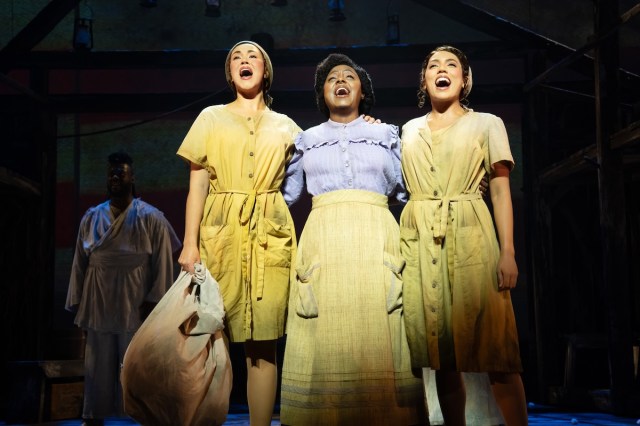
To be sure, none of that restraint is coming from the show’s three lead actresses. Liisi LaFontaine and Solea Pfeiffer are giving star-making performances as Martha and Mary Clarke, twins who decide to use the skin they inherited from their white father to game the system that Reconstruction-era America has rigged against them.
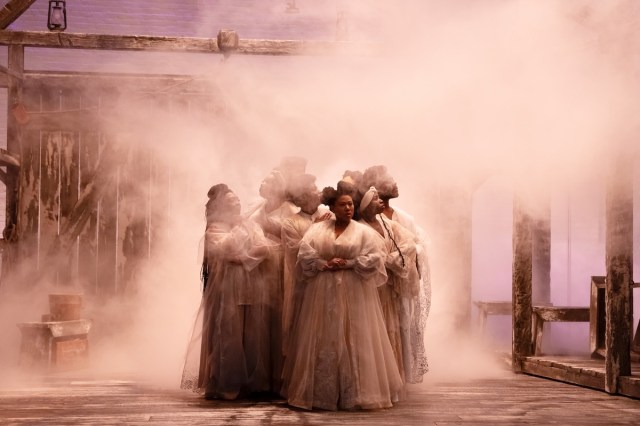
And then there’s Ledisi, who, as their mother Tallulah, is the production’s stately, load-bearing pillar. She kicks off the show singing the story of the Clarke family’s evolution from enslavement to sharecropping to hopeful landownership in an earthy opening number prefaced by the gospel wailings of an ancestral chorus of narrators (choreographer Chelsey Arce gives most of the musical’s ritual-soaked movement to this ensemble).
(© Julieta Cervantes)
Chéri, composer Ross Baum, and director Stevie Walker-Webb frame Wanted as a piece of folklore, the kind of oral history that thrives on incredulity and turns humans into idols. As the Kinfolk lay out in the prologue, “Our two brave girls made their own way from farmgirls to outlaws to legends.” They draw us into a story that promises to blend the mythology of a hero’s journey with the audacity of Thelma and Louise.
Wanted soars when it strikes that balance (Adam Honoré’s lighting design feels mythic in the show’s heightened moments). But you can feel the weight of its multi-pronged plot, its mishmash of contemporary and traditional musical styles, and the desire to explicate all its racial complexities—ones that, admittedly, are rarely seen on a Broadway stage. Mixed-race identity, the dark legacy of “passing” in America, and the many asterisks that come with a Black woman’s definition of “freedom.” Wanted is giving Broadway something genuinely new and exciting. And yet, it never ascends to something bigger than the sum of its parts.
The Clarke sisters’ (anti)hero’s journey starts when a failed attempt to buy the land they’ve been working puts their mother deep in debt to vindictive white landowner Mr. Billingsley (Nathan Quay Thomas). Impelled by the stirring duet “Wide Open Plains,” Mary and Martha set off across Texas to earn money passing as white women, only to stumble into a life of crime when the gun their mother lent them for protection proves useful against a couple of creeps on a train.
(© Julieta Cervantes)
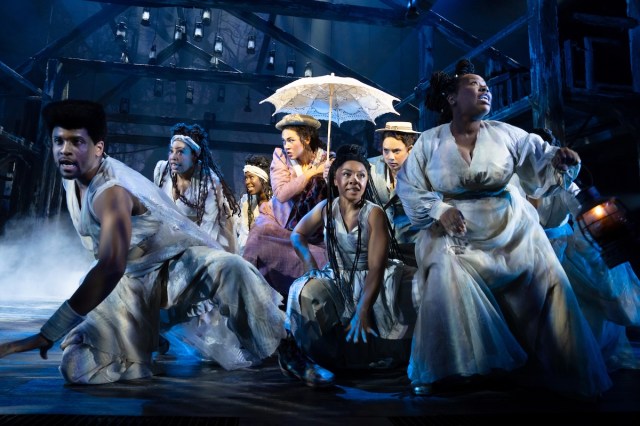
The montage of heists that follows sends us into the rowdy fun of a Spaghetti Western. Though their rise to eminent outlaw status falls prey to some underwhelming staging, we’re told the Clarke sisters have become two of the most wanted criminals in Texas (Beowulf Boritt’s set of rearrangeable wooden structures is beautiful but sometimes cramps the playing space and obscures Stefania Bulbarella’s projections). Mary insists it’s time to hang up their pistol, lest they fly too close to the sun. But Martha is high on the drugs of vengeance and cash and wants to continue their tour of stick-ups.
As their desires diverge, their opposing worldviews come into focus. Mary is the twin who’s managed to hold on to some optimism. With a sufficient supply of money, the Clarke women can surely wipe the slate clean and make their way in postbellum America. Martha, meanwhile, has no pretty illusions of justice. The boot will always be on her family’s neck, and she has no interest in asking for either permission or forgiveness. Emilio Sosa, amid his other eye-catching period work, costumes this stark philosophical split—Mary in feminine house dresses and Martha ready for a train robbery in all black, gun holster exposed.
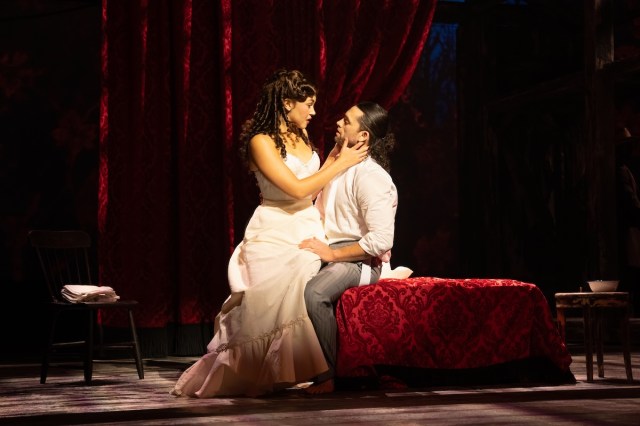
The surprising lack of controversy around a woman in pants aside, this is the musical’s most electrifying tension. And Pfeiffer and LaFontaine—with their comfy but biting sisterly rapport—hardly need their love interests to enhance it. Mary catches the eye of wealthy white businessman Jesse (Bradley Jaden) who, wise to her criminal past but not to her roots, feeds her intoxicating visions of security with a marriage proposal. Martha then gravitates to Elijah (Luke James), a former slave and Jesse’s right-hand-man, who sees through both sisters’ disguise (Awa Sal Secka and Aurelia Williams as maids Flo and Sissy also clock them immediately and are the musical’s comedic highlights).
(© Julieta Cervantes)
Neither romance grabs us by the throat, either with passion or the imminent danger they pose. Each man is more like a stand-in for his respective camp, making it even more confusing when the source of Jesse’s wealth is presented as a surprise in Act 2. (It’s barely 30 years post-Confederacy. Let’s not be naïve.) James beautifully sings Elijah’s R&B-flecked ballad “Invisible,” but it floats untethered in a musical that doesn’t do much more with his character.
Like a dust storm in the Texas plains, there’s a perpetual haze obscuring what Wanted is striving to be. That is, until everything briefly settles at the end of Act 1. In a frenzied haze of the white powder that’s been Mary’s armor, Pfeiffer sings “The Way I Am” in her most luscious low register. It’s a haunting dirge for the half-death she’s about to commit to, and it bubbles with the mania of a shattering psyche. Then, towering above her, comes LaFontaine singing “Trigger,” a song where Martha, rather than imploding with shame like her sister, threatens to explode with fury.
This is the Wanted that has the power to shake up Broadway: the show that delivers the powerful truth that no matter the path to freedom you choose, it inevitably comes with a catastrophic blast.




source on Google
Featured In This Story

Related Articles
See all
Latest Reviews
See all

Latest Videos

Find Out the Real Story Behind Broadway's Here There Are Blueberries
Writers Moisés Kaufman and Amanda Gronich discuss the new drama alongside their cast.