
Review: Ms. Blakk for President, a Drag Queen’s Long Shot Campaign in ’92
Tarell Alvin McCraney and Tina Landau’s play opens at Vineyard Theatre.
 |
Off-Broadway
|
November 8, 2026
(© Carol Rosegg)
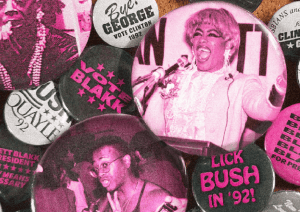
Arguably, we’ve already elected our first drag queen president—twice—if one considers the garish orange makeup, the gravity-defying hair, and the lecherous way he talks about men’s bodies like he’s hosting a go-go competition upstairs at Hush. But Terence Alan Smith was at least honest about it when he ran as Joan Jett Blakk under the slogan “Lick Bush in ’92!”
Hot off the heels of a significant election in the United States, Tarell Alvin McCraney and Tina Landau remind us of a minor player in another with Ms. Blakk for President, now making its off-Broadway debut at Vineyard Theatre (it made its world premiere at Steppenwolf in 2019). As a serious work of drama, it’s what the girls on Untucked might call a “hot mess.” But as a tribute to an underappreciated American icon who probed the limits of a purportedly free society, it’s a marvel.
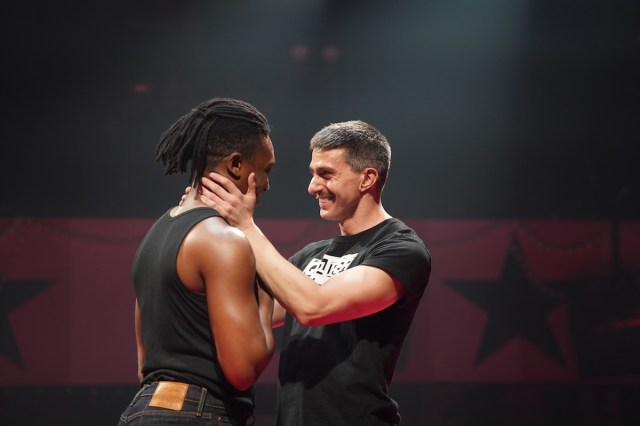
It takes place after the fall of Communism, but before the Internet, when thousands of Americans were dying of a plague but no one in elected office, Republican or Democrat, cared to acknowledge that. It’s in that grim reality that Terence (Ato Blankson-Wood), a purveyor of illusion, meets Mark (Gideon Glick). We instantly feel the spark of attraction between them.
But Mark isn’t interested in Terence for his body, just his body-ody-ody. His partner is dying, and that has made him an activist with Queer Nation, a group committed to focusing national attention on the AIDS crisis. He thinks a drag performer could garner quite a lot by running for office and “losing loudly”—first for mayor of Chicago and then for President. We witness their chaotic journey from the gay bar to the floor of the Democratic National Convention in a series of punchy scenes that ask the audience, Wouldn’t this make a great movie?
(© Carol Rosegg)
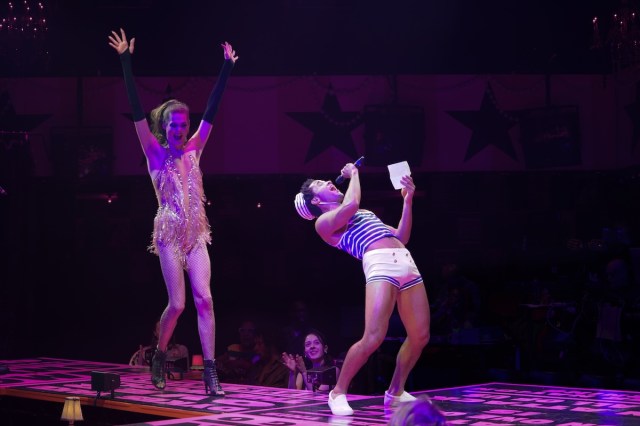
But the real value of Ms. Blakk for President is the resurrection of a particularly ephemeral kind of street theater: the queer protest. Landau, who also directs, beautifully re-creates that spirit of gleeful resistance, in which tragic injustice is spotlighted through farce, and where frivolity and terror dance a mad tango. We feel that heady cocktail of dopamine and cortisol in our guts every time a cop strolls onstage accompanied by a note of tension (the evocative sound design is by Lindsay Jones), and the man in a dress must devise a way to charm this agent of state-sanctioned violence.
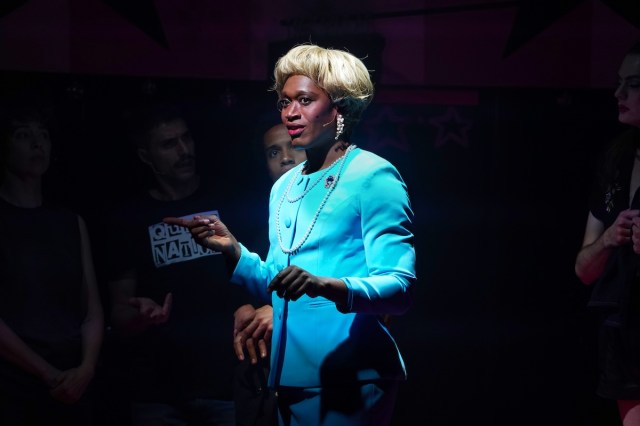
Luckily, Blankson-Wood, who took over this role from Wayne Brady in September, is more than charming. His beaming smile and irrepressible confidence capture the essence of a smart gay boy with an omnivorous taste in culture who could talk to anyone about anything, and could host a protest rally or boozy bingo with the same unflappable grace. Decked out in a sparkly pink Chanel suit and a string of pearls (Ari Fulton’s costumes are full of delightful little details), we absolutely believe she could be, if not the first drag queen president, at least the first to serve as night mayor.
(© Carol Rosegg).
Glick, whose boyish sparkle remains undiminished in his daddy form, slyly slips into the role of ball-busting manager, channeling all of Mark’s sublimated fear and anxiety about mortality into a publicity stunt. Nic Ashe, Kelvin Moon Loh, Sawyer Smith, and Adina Verson play the various queens, correspondents, tricks, activists, and cops who populate this world. They create an expansive cast of characters with just four actors, powerfully telling a story of furious improvisation with limited resources.
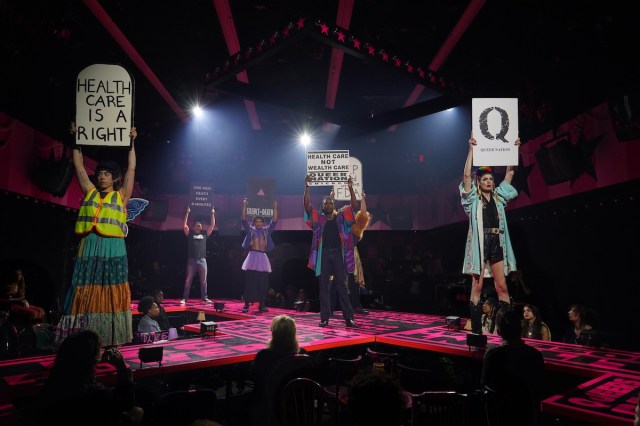
They leap on and off David Zinn’s jigsaw puzzle piece of a stage, a series of jagged runways that proves to be just as versatile as the actors despite its numerous tattoos (Zinn has branded the stage with protest slogans like “Queer as Fuck”). It transforms (partially from Bradley King’s assertive lighting, partially from the actors, who fully inhabit the reality King conjures) into a bar, a meeting hall, Michigan Avenue, and Madison Square Garden, with many smaller spaces in between. Zinn has ringed the room with boxy Philips televisions, which display Rasean Davonté Johnson’s projections, a well-curated collage of video from the ’90s. Were it not for the expletives, it could be the set for Nickelodeon’s election night coverage, hosted by Linda Ellerbee.
(© Carol Rosegg)
McCraney and Landau’s script often feels like channel-surfing in the previous century. Short scenes give way to montage in the playwrights’ cinematic imagination, with plenty of pit stops at MTV for music videos, like the one Terrence performs with his idol, David Bowie. It’s all highly entertaining and informative, if a bit manic and unpolished, with unresolved plot threads poking out like wool from a sweater that you just ran through the dryer (I wished we could have gone a little deeper with Terence and Mark’s relationship). It’s messy, fascinating, and heedless of the rules—and isn’t it nice that an Academy Award-winning Yale professor of playwrighting can still write something like that?
The most interesting dramatic question Ms. Blakk for President raises (and quickly casts aside) is about the line between activism and narcissism. Will seeing a drag queen onstage at the DNC really move the needle for AIDS? Or does Joan, the creation of a young man who once sat in awe watching Janis Joplin on television, really want to join her in the celestial body of the screen? It’s a question we should always be asking in the attention economy, when we have all become drag queens broadcasting to our audiences online.




source on Google
Featured In This Story
Latest Reviews
See all


Latest Videos
Find Out the Real Story Behind Broadway's Here There Are Blueberries
Writers Moisés Kaufman and Amanda Gronich discuss the new drama alongside their cast.