
Review: Revival of The Verge Aims to Bring Susan Glaspell Back Into the Canon
Miriam Silverman stars in the Public Theater and Fiasco Theater’s production of a 1921 play that deserves to be better known.
 |
Off-Broadway
|
November 5, 2026
(© Valerie Terranova)
In The Hairy Ape, Eugene O’Neill told the story of a brutish common man coming to terms with his personal and societal limits as he gradually developed a broader social and political consciousness. That 1922 play is currently getting an excellent revival at Irish Repertory Theatre. Venture further downtown to the Public Theater, though, and you’ll encounter something of its opposite: the story of an intelligent woman reckoning with what she considers the stultifying common-ness of the people around her. That’s the basic trajectory of Susan Glaspell’s 1921 play The Verge, now receiving a revival of its own in a co-production with Fiasco Theater.
The contemporaneity of both plays is no coincidence. As one of the founders of the Provincetown Players in 1915, Glaspell helped launch O’Neill’s career, producing some of his earliest works before the collective disbanded. At the time, though, Glaspell herself was also highly regarded as a playwright, eventually winning a Pulitzer Prize in 1931 for Alison’s House. While O’Neill’s plays continue to be produced, Glaspell’s work has fallen into general neglect, with only her 1916 one-act play Trifles being at all considered canonical. Based on this production, the historical and cultural oversight seems grievous.
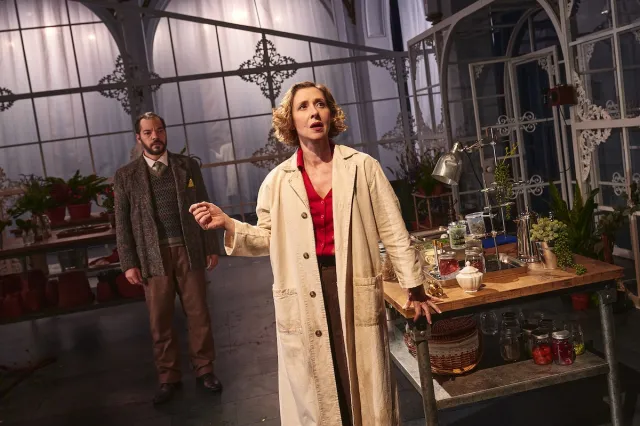
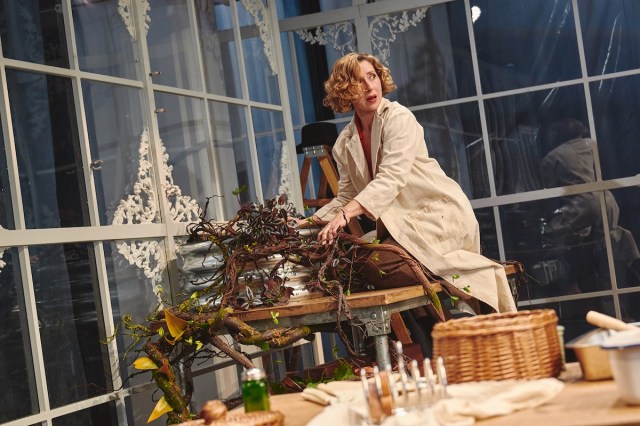
The woman in question is Claire Archer (Miriam Silverman), a scientist experimenting with creating new varieties of plants. Though those around her recognize her brilliance, her eccentric behavior causes her husband, Harry (Noah Brody), to suggest bringing psychologist Dr. Emmons (Paul L. Coffey) around to check her out.
(© Valerie Terranova)
Narratively speaking, not much happens in The Verge. Beyond Claire’s obsession with her plants, she, in one lengthy exchange, confesses to one of Harry’s friends, Tom (Paco Tolson), that she’s in love with him, an affection he reciprocates but feels he cannot fulfill. At another point, she lets slip she had a fling with another of Harry’s friends, Dick (Devin E. Haqq).
Yes, Tom, Dick, and Harry are the names of the major male characters in the play. In addition, Claire has given two of her plants names: one Edge Vine, the other Breath of Life. These and other such metaphorical signifiers place The Verge squarely in the realm of expressionism. Some of Glaspell’s dialogue intensifies that impression, eschewing naturalism for heightened, barely articulated poetic feeling. All of it is geared toward putting across a portrait of a difficult, forward-thinking woman who yearns to break free from the shackles of middle-class norms in her pursuit of deeper knowledge and greater truths. It’s a quest that, in a certain light, could be seen as the equivalent of getting closer to God—something that Claire seems aware of, given her occasional invocation of the Christian hymn “Nearer, My God, to Thee.”
Off-putting yet also magnetic, profoundly serious yet also dryly funny, formidably intellectual yet also possibly verging on insane: As written, Claire Archer is the kind of complex role that might be impossible for even the finest actor to fully capture in all her many facets and contradictions. The key to Miriam Silverman’s interpretation lies in a monologue she delivers to Tom in the second act, in which Claire theorizes that Tom is afraid of her because of her excess of passion. That’s the quality Silverman emphasizes throughout her performance without indulging in any temptations to overdo her potential inner madness. (Costume designer Sarita P. Fellows’s outfits for the character similarly balance glamour and detachment.) Perhaps her performance could have used a bit more prickliness, to really challenge our sympathies for the character.
(© Valerie Terranova)
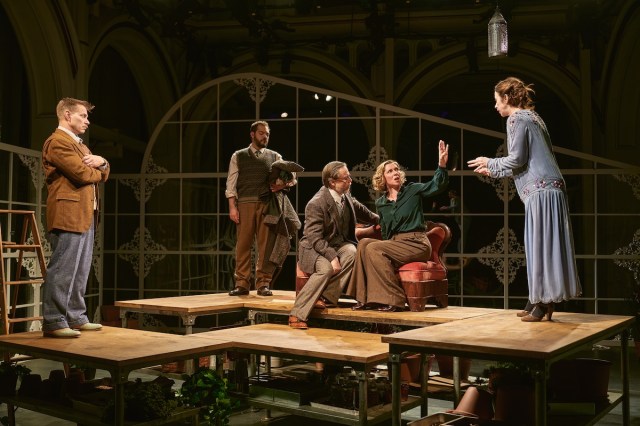
Lawrence E. Moten III’s scenic design is most successful at evoking the play’s expressionistic side, with Claire’s laboratory surrounded by glass walls with floral patterns on them, the back wall extended upward with a deliberately asymmetrical semicircular flourish. Less palatable are some of Jessie Austrian’s directorial interpolations. Though Jacques Offenbach’s famous “Barcarolle” from his opera The Tales of Hoffman plays an important part in that scene between Claire and Tom, Austrian’s decision to have two of the performers sing the song behind the back wall seems excessive (atmospheric sound design by Bailey Trierweiler, with musical supervision by Daniel Kluger). Even stranger is Austrian’s decision to lift the back wall at a roughly 45-degree angle above the ground for Act 3, creating a stage image that feels more awkward than expressive.
And yet, it’s a tribute to the strength of Glaspell’s writing that this production’s oddities and shortcomings ultimately don’t matter all that much. If this revival garners enough interest among theatermakers to produce more of her work, perhaps that means there will be more productions of this particular play to dig even deeper into the intricacies and nuances of its rich text. Based on the dark poetry and feminist verve of The Verge, Glaspell’s oeuvre is one worth rediscovering.




source on Google
Featured In This Story

Latest Reviews
See all






Latest Videos

Watch the Radio City Rockettes in the New Christmas Spectacular Number "Ring"
The modern tap number is choreographed by Emmy Award nominee Chloé Arnold.