
Review: Richard Nelson's Apple Family Confront the End of History in We'll See
Jay O. Sanders, Maryann Plunkett, and more return for Nelson’s eighth play about a fictional Rhinebeck family.
 |
Off-Broadway
|
November 4, 2026
(© Joan Marcus)
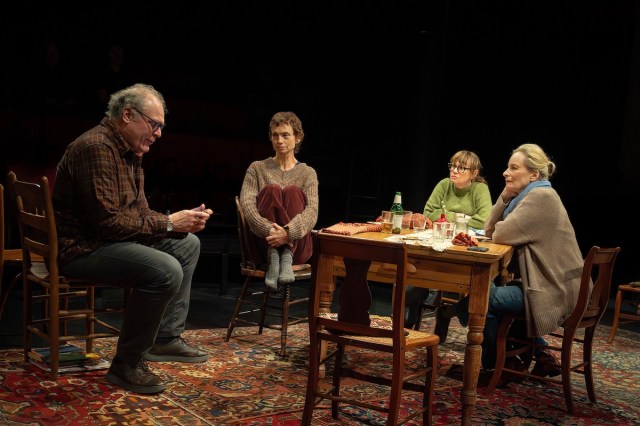
A sense of dread hung over the opening of Richard Nelson’s We’ll See at the Public Theater on November 3, 2026. Onstage and in the audience, everyone seemed to be sharing the same palpable sense of doom. The eighth installment of Nelson’s Apple Family series and the 13th in his larger Rhinebeck Panorama, the new play follows a group of boomer liberals as they nervously await the results of the midterm elections on November 3, 2026. The characters have promised themselves they won’t check their phones; those of us sitting in the dark were similarly unable to do so (because, decorum). There was no better place to spend an evening like this than in the company of others feeling the same unease.
Nelson introduced the Apples back in 2010, after a request from artistic director Oskar Eustis for a largescale epic about the war in Iraq. Nelson instead offered what he casually referred to as “disposable,” a topical, intimate work about the way an average American family in upstate New York navigates the modern world. The Apples are decent people doing their best to weather life’s everyday triumphs and challenges, and it feels like we’re intruding on their private moments.
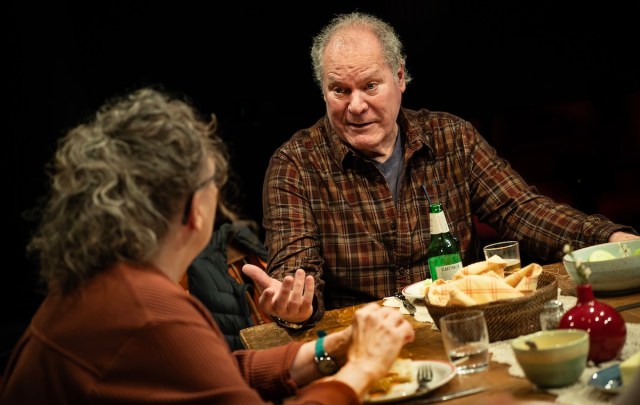
The Apples are in their 60s and 70s now. Their hair has gotten gray, they’ve put on some weight, and their hands occasionally tremble. But siblings Barbara (Maryann Plunkett), Richard (Jay O. Sanders), Marion (Laila Robins), and Jane (Sally Murphy) remain best friends, their bond enduring despite the paths their lives have taken.
Barbara, a beloved teacher at the local high school, is retiring next month following an incident with a student. Marian, whose daughter and husband died more a decade ago, has sold her house and moved in with her sister. Richard travels through Europe when he’s not caring for his terminally ill partner, Yvonne (Yvonne Woods). And Jane is temporarily transient, having sublet the apartment she shares with her longtime companion, Tim (usually played by Stephen Kunken, though he is only mentioned in this installment).
(© Joan Marcus)
We’ll See lacks the urgency of some earlier works and occasionally meanders where others hurtle forward. But whatever it lacks in dramatic tension, it more than makes up for in its elegiac confrontation with the end of the world—that is to say, the end of the world as the Apples have known it.
Barbara, essentially pushed out by her principal (a former student), now must figure out what to do with her remaining years, while refusing to read emails sent by generations of people she taught. Marian has sold her house to a flipper because she can no longer afford the Rhinebeck property taxes. Jane, politically adrift, doesn’t recognize anything about the world anymore, overtaken as it is by “woke.”
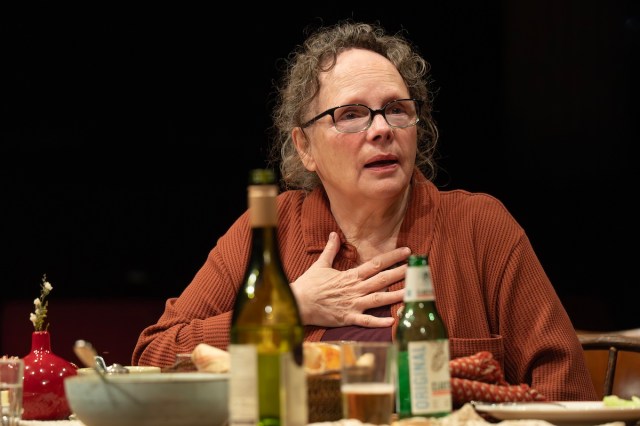
As always, the acting—if you can even call it that, because after all this time, are they really acting?—is phenomenally natural. Plunkett, Sanders, Murphy, and Robins have become a surrogate family at this point, and their years of building these people with Nelson have created an intimacy and familiarity that you’re not likely to find anywhere else. Woods is a worthy addition to the ensemble, tenderly embodying a resilience that the other characters clearly admire.
(© Joan Marcus)
It’s obviously Nelson relishes in writing for Plunkett, and as always, she knocks it out of the park in the way she manages to convey so much through so few words. But I was especially taken by Murphy, whose Jane has found herself left behind in a world that is rapidly moving forward. It helps that costumer Susan Hilferty has given her an excellent green sweater that makes her stand out amid the sea of brown that is Jason Ardizzone-West’s classic set and Jennifer Tipton’s lighting.
Nelson captures the anxieties of early old age with an astuteness that is instantly recognizable. These characters, their refusal to mention the him in the White House, their cultural despair, their discussions of how the sound of his voice makes them want to puke—they’re us. Or if not us, our family members. And while the play has a topicality that might in fact render it obsolete a year from now (hence Nelson’s frequent comments about the “disposable” nature of the plays), taken as a whole cycle, it really is the American epic that Eustis once dreamed of.
Hopefully, the Apples woke up this morning just as elated as I did.




source on Google
Featured In This Story

Latest Reviews
See all



Latest Videos
Watch: Lisa Rinna, Harry Hamlin, Megan Hilty and More Discuss It's a Wonderful Life on Broadway
Andrew Rannells, Tituss Burgess, playwright Joe Landry, and director Jerry Zaks join the conversation about the Broadway premiere of this live radio play.