
Review: Waiting for Lefty in the Museum of Agitprop
Steven Pasquale makes his directorial debut with this Clifford Odets revival at Classic Stage Company.
 |
Off-Broadway
|
November 2, 2026
(© Marc J Franklin)
“Don’t shoot vermin! Step on them,” an older man advises a young colleague in Clifford Odets’s Waiting for Lefty. He’s not talking about rats in a literal sense, but capitalists. Odets is unflinching in this 1935 work of leftist agitprop: The capital-owning class is squeezing American workers to death, and the only way for those workers to survive is to organize and squeeze back. It’s a message that should resonate in 2026, in the twilight of an era of market orthodoxy that has calcified into monstrous aristocracy. The people are ready to revolt, and across the Atlantic, many already are.
Sadly, the tepid revival at Classic Stage Company is unlikely to prompt a general strike. The most it may inspire is attendance at a No Kings rally—but only after brunch.
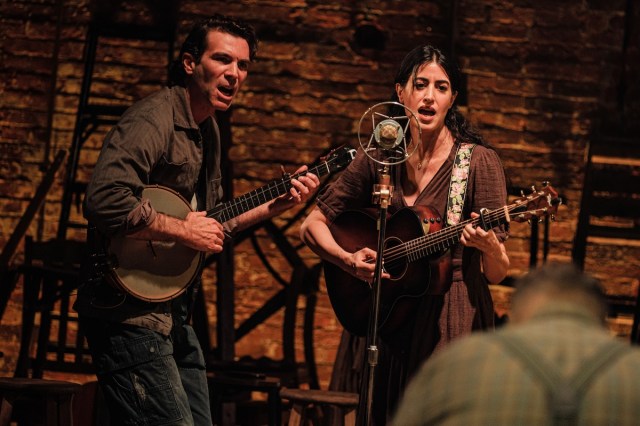
The tone is set in the opening moments, when Sahar Milani performs “Bella Ciao,” here less of a rousing anti-fascist anthem than a dirge. Cameron Scoggins joins her for the transition into Woody Guthrie’s “Union Prayer,” equally sedate. Milani and Scoggins are the folk duo Yeller Tooth, responsible for the music in this production. Their arrangements of classic protest songs are gorgeously harmonic, expertly sung, and convey all the proletarian rage of an NPR tiny desk concert.
(© Marc J Franklin)
As they sing, the cast performs Susan Misner’s wistful choreography, a succession of leans, sighs, and self-hugs more suited to an industrial for the American Psychological Association. Silently, it seems to ask, Are you a member of ANTIFA contemplating suicide?
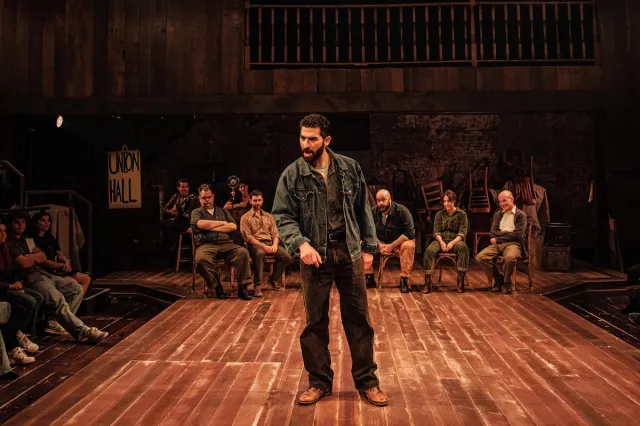
This placid overture gives way to the first scene of the actual play, a raucous meeting of the taxi drivers’ union, which is debating a strike. Union boss Harry Fatt (Greg Hildreth) urges restraint, reminding them of the history of failed strikes and assuring them that the man in the White House is working hard to make life better. But through a series of vignettes depicting the drivers’ home lives and the shattered careers that forced them behind the wheel, we come to understand that direct confrontation with their employers is the only way forward.
At least, that is what Odets intended. Under the guidance of Steven Pasquale, here making his directorial debut, the play takes on the deadly aura of high art, a suffocating formalism that, through modern dance and elegantly interpolated musical numbers, envelops a still-dangerous script like English ivy on unexploded ordnance. You oughta hear the Lincoln Center vowels in their rendition of “Brother, Can You Spare a Dime?”
(© Marc J Franklin)
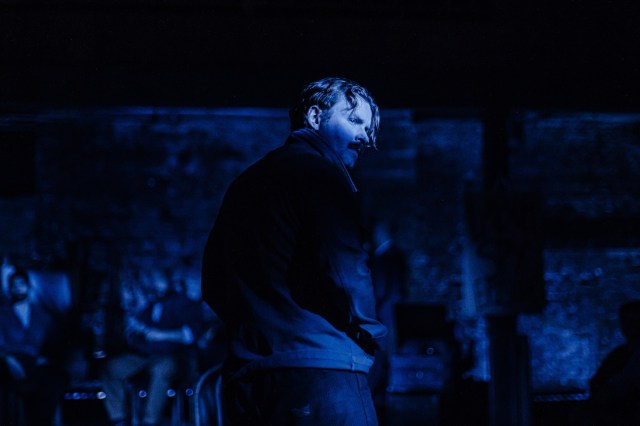
In addition to salving Odets’s sting with music and dance, Pasquale has audaciously cast Zach McNally to play the title role. A scruffy ginger Jesus, McNally is the only member of the cast who could pass as authentically working-class—but his presence onstage is a little bit like having Godot actually turn up.
Some of the actors seem more at home with this material than others. Raffi Barsoumian looks and sounds like an Odets antihero, with the subtle growl and downcast eyes of a kicked dog as his wife, Edna (Tala Ashe), tells him that unless he brings home more money, she’s leaving. Unfortunately, the usually excellent Ashe seems like a middle-class invader from an entirely different play. Emotions restrained to a simmer, she scolds him like an Upper West Side co-op dweller who is very disappointed by the renovation performed by her general contractor.
Henry Stram is far better at channeling the dark cordiality of Fayette, an industrialist who promotes lab assistant Miller (Austin Durant) to work on a top-secret project developing poison gas as a weapon. Durant musters percolating anger, but it never quite boils over. When Miller turns down the job, Fayette asks, “No hard feelings?” And Miller responds, “Enough to want to bust you and all your kind square in the mouth!” In the original stage directions, Odets writes that he “does exactly that,” but not here. Before Miller can lay a hand on the boss, the lights shift, and we’re onto another musical number.
That lighting, by Mextly Couzin, fulfills the task of distinguishing the harsh glare of the present from the soft incandescence of memory. Costume designer Márion Talán de la Rosa is less successful distinguishing the characters, dressing everyone in the working-class drag of muted colors, jumpsuits, and suspenders—even Fatt, who can surely afford a nice suit with all those embezzled dues.
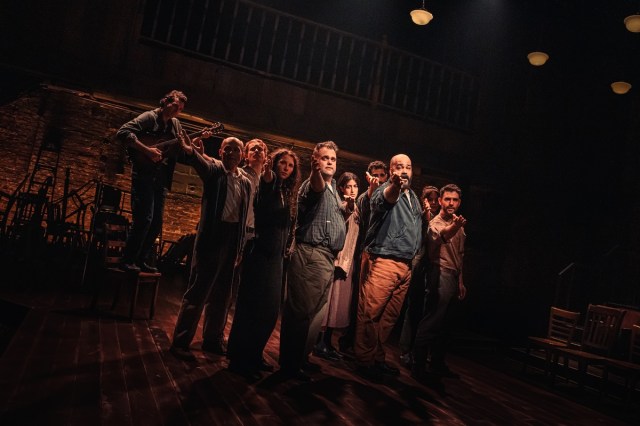
The mismatched wooden chairs of Scott Adam Davis’s set aid in the quick transitions, with title cards announcing each scene resting on an upstage easel—a fairly standard touch when BFAs do Brecht. In an ideal production, the audience would join the cast in the end as they shout, “STRIKE! STRIKE! STRIKE!” It’s telling that sound designer Palmer Hefferan must pipe in the sound of a braying crowd, compensating for the lack of enthusiasm in the house.
(© Marc J Franklin)
This revival of Waiting for Lefty made me wonder if the institutional off-Broadway theater as it exists—beholden to wealthy individuals and foundations to cover rising production costs that the sale of $96 “standard” tickets simply cannot recoup—can ever do justice to a play like this without paying a severe price.
Odets certainly paid for his convictions: He was subpoenaed by the House Un-American Activities Committee in 1952, and a promising career in Hollywood was derailed, though the theater still occasionally mounts his early plays: A revival of his masterpiece domestic drama, Awake and Sing!, begins performances next month on Broadway.
His stories still have the power to inspire audiences in 2026: No matter how much Silicon Valley has oversold AI, robots cannot easily perform this country’s most difficult jobs, and if workers were to down tools for a week, the American economy would grind to a halt. But it’s hard to hear that message when Lefty is gathering dust in a display case.




source on Google
Featured In This Story

Latest Reviews
See all




Latest Videos
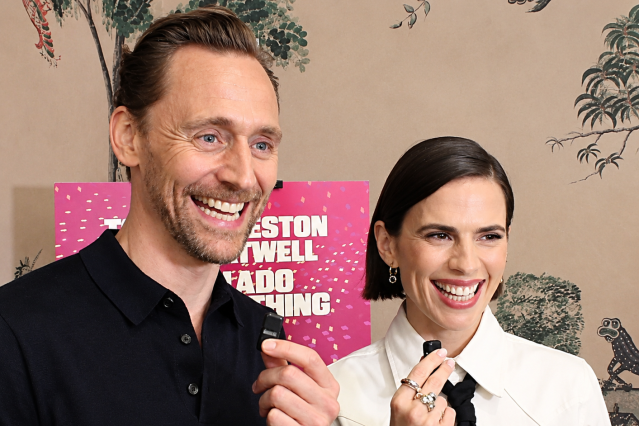
Watch: Tom Hiddleston and Hayley Atwell Are Ready to Spar in Much Ado About Nothing
The longtime friends take on Shakespeare’s beloved Benedick and Beatrice in Jamie Lloyd’s confetti-filled production on Broadway.