
Review: Are You Now or Have You Ever Been, a Red Scare Docudrama
Anna D. Shapiro directs a revival of Eric Bentley’s drama at New York City Center Stage I.
 |
Off-Broadway
|
|
Off-Broadway
|
June 12, 2026
(© Marc J. Franklin)
As Americans, we like to think that our witch-hunting days are behind us. Depending on your level of delusion, the beautifully rendered off-Broadway revival of Eric Bentley’s Are You Now or Have You Ever Been could reinforce that notion, seducing you to conclude that star chambers and guilt-by-association are relics of the gorgeously costumed past.
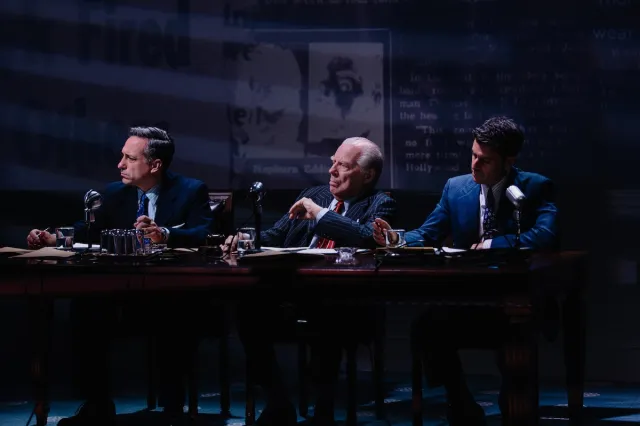
The ghosts of history hover through a veil of cigarette smoke (I hope you like the smell of clover) in director Anna D. Shapiro’s meticulously designed and powerfully acted production, which gives audiences a look at the House Un-American Activities Committee from 1947-56, the height of the second Red Scare.
Bentley, who was instrumental in promoting the work of Bertolt Brecht in America and who had politics significantly to the left of Bernie Sanders, focused on the effort to root-out Communist influence in Hollywood. He used real transcripts from those congressional hearings as his text.
At the center of the hearings is the so-called “64-dollar question” to which all witnesses are subjected: “Are you now, or have you ever been, a member of the Communist Party?” It’s an outrageous line of inquiry in a country that purports to value free expression and the privacy of the ballot, but the three members of the committee (Adam Kantor, Jason Babinsky, and a nauseatingly smirking Michael McKean) pursue it doggedly, confident that they represent the authentic will of the American people.
Some witnesses meet this inquisition with defiance. “I decline to answer on the ground of the First Amendment and the Fifth Amendment,” says Tony Kraber (Brooks Ashmanskas oozes disdain as he takes a drag on his cigarette and rolls his eyes). Others politely decline but are eventually exhausted into submission (as Larry Parks, a man who knows his career is over and just wants to stay out of jail, Andrew McCarthy is giving the most tragic performance off-Broadway).
(© Marc J. Franklin)
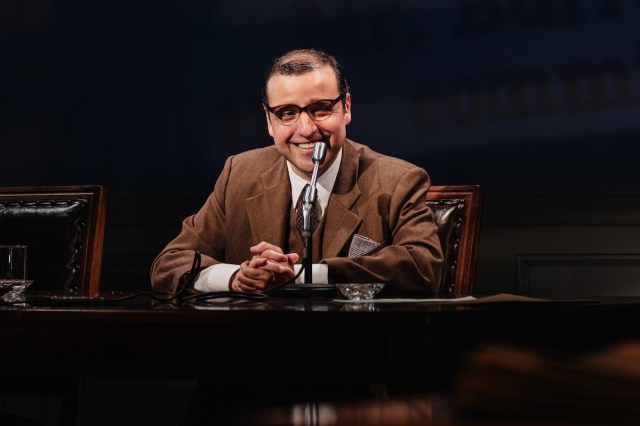
Others retreat to humor, as if by cracking jokes they might reveal this committee to be the farce that it is. David Krumholtz vividly resurrects Abe Burrows with an amused smile, expressively shifting eyes, and a soft Brooklynese. When informed that two of his former comrades, who seemed to be having a wartime romance, were now married, he retorts, “Well, that’s the end of the romance!”
Some witnesses are all too delighted to name names. Resentment drips from every syllable in Frederick Weller’s performance as Elia Kazan. But Steven Boyer’s performance as Jerome Robbins is harder to read and therefore more terrifying. He icily rattles off the names of alleged Communist colleagues like he’s taking attendance at a ballet class (Boyer also proves himself to be a master of antique American dialects).
The grand finale is the testimony of Paul Robeson, whose righteous fury at being denied a passport leads him to punch back at the congressmen. Billy Eugene Jones is electrifying in the role, sending a shock wave through the audience when he bluntly tells a committeeman, who had been alluding to gulag slave labor in Stalin’s USSR, “Nothing could be built more on slavery than this society, I assure you.”
With performances this engaging, Shapiro doesn’t need to do much to make history come alive. And yet her occasionally frenetic pacing betrays a fear that audiences will tune out from what is essentially a C-SPAN highlights reel. Brittany Bland’s text projections on the cyclorama backing up Andrew Boyce’s committee room set often fly by too quickly to be properly read and digested. They arrive to the sound of slamming typewriter keys, with the sight and sound of camera flashbulbs punctuating each scene (the lighting is by Donald Holder, sound by Rob Milburn and Michael Bodeen). Johanna Pan’s well-curated period costumes are a feast of double-breasted suits and striped ties, their muted colors belying the red-hot subject matter. With all this aural and visual stimuli, it can be easy to lose sight of the message Bentley is trying to impart.
(© Marc J. Franklin)
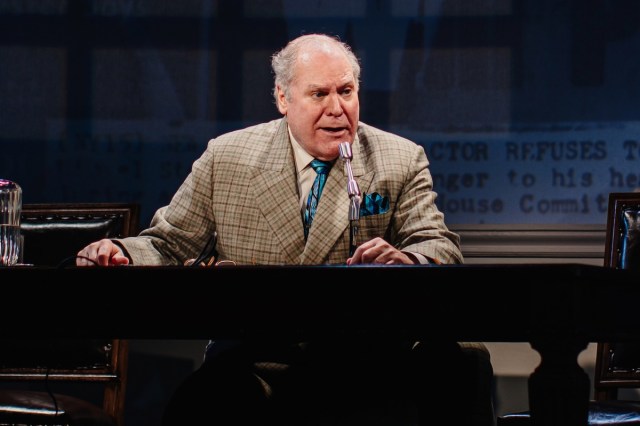
Actors (like all people) are driven by an objective, and in case that motivation is not immediately apparent in Are You Now or Have You Ever Been, Jay O. Sanders spells it out plainly in his striking performance as an initially bumbling then suddenly clarion Lionel Stander. He points out that he was offered a television show (and $150,000 a year) if he swore before Congress that he wasn’t a Communist. He suggests that the other witnesses who have named names are driven by similarly mercenary considerations. He roars, “They will do anything to get back into pictures!” And when you’re trying to maintain a foothold in a notoriously slippery industry, where there is always someone younger and hungrier coming down the stairs behind you, it might be worth selling out your ideals.
Far from being a relic of the 50s, that’s a social dynamic that is as current as your last paystub and rent check.




source on Google
Featured In This Story
Latest Reviews
See all







Latest Videos
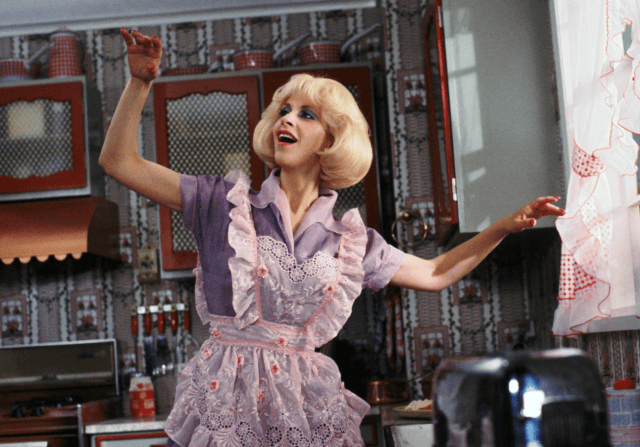
Watch: Ellen Greene Reflects on the Enduring Legacy of Little Shop of Horrors
Frank Oz’s cult classic movie-musical has gotten a new 4K restoration in celebration of its 40th anniversary.