
Review: The Potluck, a Musical Massacre
César Alvarez’s musical about street violence and self-discovery makes its world premiere with Soho Rep and INTAR at Playwrights Horizons.
 |
Off-Broadway
|
|
Off-Broadway
|
July 13, 2026
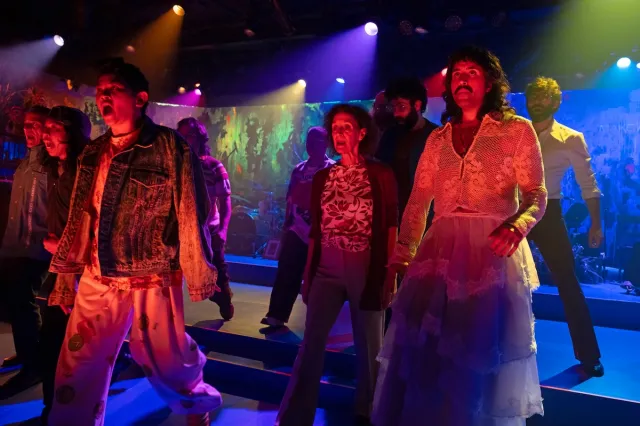
(© Julieta Cervantes)
On November 3, 1979, a caravan of cars occupied by members of the KKK and the American Nazi Party drove through an anti-Klan rally in Greensboro, North Carolina, organized by the Communist Workers Party. Words were exchanged, blows were struck, firearms were discharged, and by the time the smoke cleared, five CWP members lay dead or dying. While multiple klansmen were charged with murder, an all-white jury acquitted them.
It’s a dark story unlikely to be highlighted in a timeline of notable historical events marking the semiquincentennial. It offers no glory for the American justice system, nor the martyrs who fit awkwardly in this country’s story. But in this age of radically diverging politics and dueling street demonstrations, Greensboro offers important insight about where we’re headed. It’s a story that must be told—but as a musical?
César Alvarez (they/them) seems unsure of the wisdom of this course, and they wrote the damn thing. They’re so doubtful, in fact, that they have written themself as the main character (played with marvelous flair by Anthony Alfaro), partially to defend the unfocused and underwhelming new musical The Potluck, now making its world premiere with Soho Rep and INTAR at Playwrights Horizons.
“I didn’t want to write a musical about the murders,” César explains in an opening monologue describing the process of pitching a new musical to a not-for-profit theater. “I sent the entertainment company SIX entertaining ideas for musicals.” This is the one they chose. “The literal system that is forcing me into the situation where I have to do this painful thing that I don’t want to do, is the system that they were trying to destroy.” That would be liberal capitalism, a system we are regularly told is in its late stage yet still seems to have a remarkable ability to subsume its discontents, as evidenced by The Potluck and really the entirety of American institutional theater.

(© Julieta Cervantes)
This kind of authorial throat-clearing is meant to appear real, to disarm us with radical honesty. And while it has clearly cowed patrons into funding The Potluck through nearly a decade of workshops, it doesn’t bode well for audiences embarking on a two-hour, 30-minute musical that the writer isn’t even that interested in.
In one of the most bracing scenes, we have the opportunity to see actual video of the murders, though the audience is also given the option to observe a ceremony for the dead in the lobby during the film. It offers an immediate sense of the circumstances that led to the massacre—high emotions, life-or-death stakes, and a conspicuous lack of police. It’s hard not to conclude that this was an avoidable tragedy that the authorities allowed happen. The state’s complicity, later affirmed by jury nullification, might have offered fertile ground for an extraordinary musical, the kind of thing Michael Friedman once wrote.
Unfortunately, much of The Potluck is a dramatization of writerly procrastination. We witness phone calls to César’s mom (Barbara Walsh) and dad (Rubén Flores), who personally knew the victims and think César’s work amounts to a lot of navel-gazing (I second the motion). We watch César attend YouTube yoga classes with Jaime (a very funny El Beh) and commiserate with Moss (Jasmine Rafael), the unpaid intern assisting César on this musical (many of our latter-day communists in the theater also thrive on free labor). Alvarez is also disturbed by the CWP’s homophobia (they felt that gayness was a bourgeois distraction). It’s only when César and Moss have the brilliant idea to conduct a séance that the voices of the Greensboro five finally come to life.
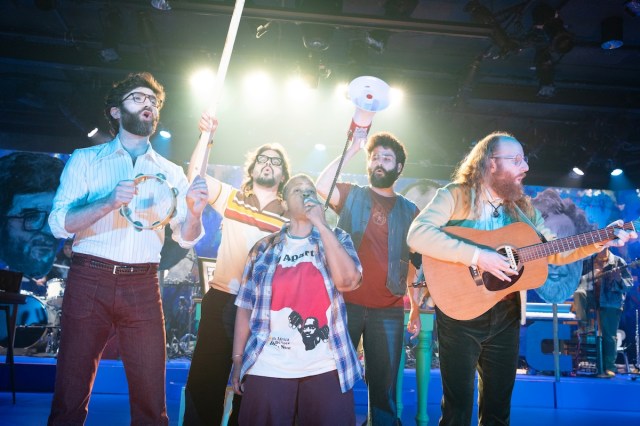
(© Julieta Cervantes)
Andrew R. Butler, who was born to bridge the gap between Bertolt Brecht and Woody Guthrie, leads his fellow ghosts (Jacob Brandt, Gían Pérez, Zack Segel, and Dionne McClain-Freeney) in “The Ballad of the Greensboro 5,” a rousing retelling and call to arms.
Director Sarah Benson marks the transcendence of the dead with one of her signature big reveals, with a cloth dropping from the upstage wall of Emily Orling’s set, surrounding the stage with neon paint. We’re in another dimension, illuminated by Mextly Couzin’s ethereal lighting and aurally enhanced by Eamon Goodman’s supernatural sound. Clad in Qween Jean’s scrupulously well-selected period costumes, the actors really do look like ghosts from the late 70s. It’s the closest this musical gets to a truly electrifying moment—and then it’s intermission.
The second act fails to build on the energy of that first act finale (musicals rarely do), with songs about César’s rayon lavender shirt (a sensitive exploration of the author’s still unsettled gender identity) and a truly bizarre production number in which our protagonist is flanked by a chorus of glow-in-the-dark mops (wrong musical).

(© Julieta Cervantes)
Alfaro is magnetic in these numbers, bringing the kind of irresistible glam rock energy he has long exuded as lead singer of Tony & the Kiki. The song are getting their very best hearing, but it’s not enough to dazzle us into believing they have anything to do with the subject at hand. At every step, we can feel Alvarez swerving away from the political violence of Greensboro and toward more comfortable territory—matters of identity and self-discovery that represent the increasingly brittle backbone of the American theater.
If it succeeds at anything, The Potluck is a perfect illustration of why the Left consistently fails to gain and hold power in this country. Why organize a general strike and seize the means of production when you can engage in the narcissistic and consumer-friendly pursuit of the self, in which one longs for an identity that American retailers and cosmetic surgeons are more than happy to furnish? The theater is just a small part of this dastardly equation. But recognizing that, which Alvarez obviously does, is a far cry from overcoming it.




source on Google
Featured In This Story
Latest Reviews
See all





Latest Videos
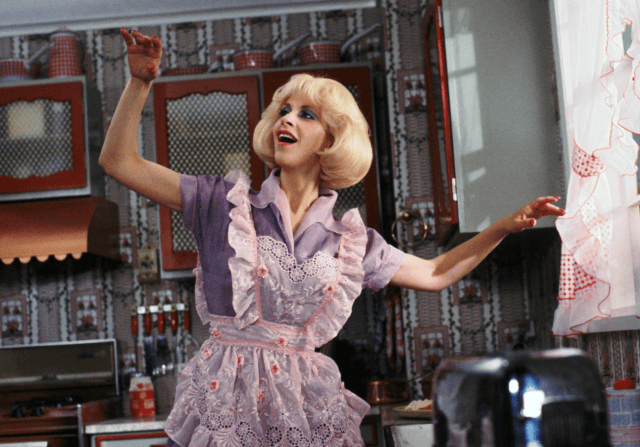
Watch: Ellen Greene Reflects on the Enduring Legacy of Little Shop of Horrors
Frank Oz’s cult classic movie-musical has gotten a new 4K restoration in celebration of its 40th anniversary.