
Review: Maybe Happy Ending, a Reminder That Broadway Can Be Great
Zachary Noah Piser and Hannah Kevitt step into the central roles of the Tony-winning musical rom-com about robots.
 |
Broadway
|
|
Broadway
|
July 17, 2026
(© Evan Zimmerman for MurphyMade)
It’s easy to feel down about Broadway right now, following a lackluster season and the closing notice of the most innovative revival of the year. It makes me wonder if we’re past the point where Broadway can meaningfully contribute to our culture. Is it destined to become a tourist attraction propped up by three old shows?
But then I remember that it was just last year that Maybe Happy Ending won the Tony Award for Best Musical. Will Aronson and Hue Park’s magnificently imaginative show about robots in love is living proof that Broadway still has room for daring new musicals that wrestle with some of the most difficult questions arising from our sprint into the future. It is still running strong at the Belasco Theatre, where two new actors have recently taken over the central roles.
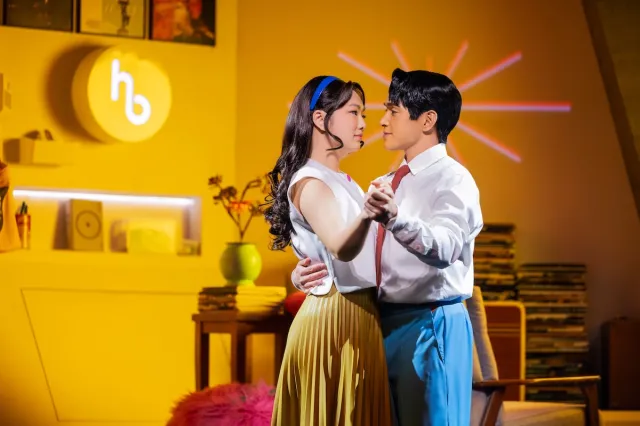
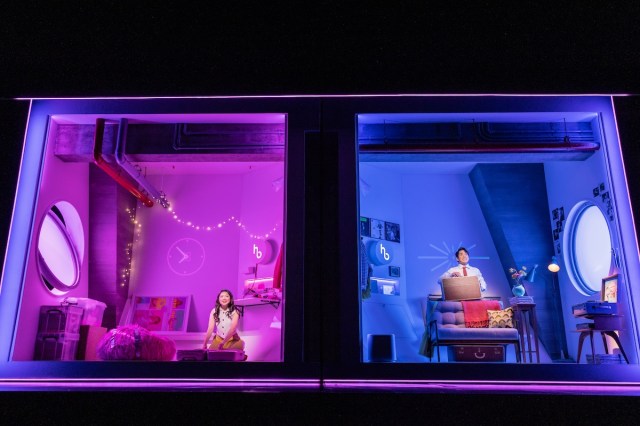
Zachary Noah Piser plays Oliver, a series three helperbot quietly persisting in a Seoul residence for retired robots. He waters his plant, reads Jazz Monthly, and eagerly awaits the delivery of replacement parts. But his routine is disrupted when his across-the-hall neighbor, Claire (Hannah Kevitt), knocks on his door begging to use his charger. Hers no longer works because the company has stopped making them. Oliver deigns to help this more advanced model, though Claire reminds him that they’re both obsolete.
But Oliver doesn’t identify as retired. He is convinced that his owner, James (Marcus Choi), will one day call him back. In fact, he has been illicitly accumulating money for a trip to James’s home on Jeju Island. Uncomfortably aware of her failing battery, Claire knows that she doesn’t have much more time for an adventure. Also, her owner left her a car. She offers to accompany Oliver to Jeju, the last place on earth to see fireflies in the summer. It proves to be a trip that changes them forever.
(© Evan Zimmerman for MurphyMade)
Each time I see Maybe Happy Ending I notice something new in Aronson and Park’s extraordinary book, which uses an imagined future to explore timeless themes of mortality and love. Through our robot protagonists, Aronson and Park stealthily distill the essence of humanity; they also ask what responsibility we have to these new being created in our image.
Composer Aronson wraps that story in the gentle embrace of his music—driving “I want” songs, contemplative ballads, and swinging jazz numbers that create an analog Broadway sound for this futuristic story. No writing team currently working has more successfully built a bridge from Broadway’s glorious past to its potential future than Aronson and Park, who collaborated on the lyrics, sharp little arrows of insight that fly through the air and hit you right in the chest.
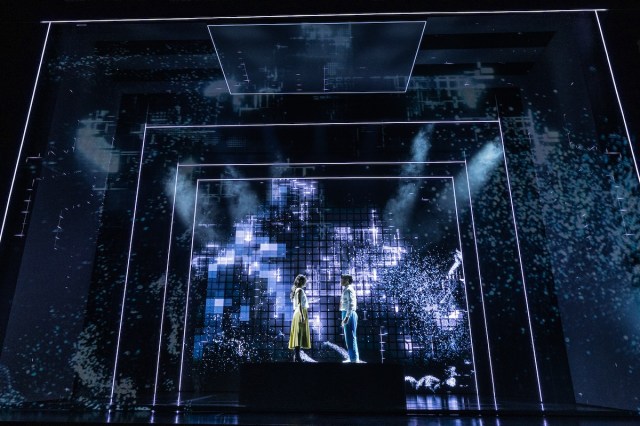
Director Michael Arden’s production is perfectly tailored to the book and score, flowing seamlessly from scene to song to flashback thanks to Dane Laffrey’s cutting-edge set and George Reeve’s video design, which feels like something you’d encounter of the holodeck of the Starship Enterprise. Visions of the past emerge from the shadows of Ben Stanton’s gorgeous lighting. And unlike so many new musicals in which the orchestra drowns the vocals, each lyric is pristine under Peter Hylenski’s finely calibrated sound design. As Maybe Happy Ending approaches its two-year anniversary this fall, it still feels like a brand-new production.
Some of that luster surely derives from the two new stars. Piser, who stole the show in the short Broadway run of Redwood, seems to have grown as a vocalist since then, bringing a level of sensitivity to his lyrical interpretation that gave me chills. His rendition of “Where You Belong” overflows with puppy dog sweetness. It’s the song of someone who needs to feel useful and just wants to be loved. Piser’s megawatt smile could power this town in a blackout.
Kevitt, who has been with this production since the beginning as an understudy, proves to be a star in her own right. Her Claire is clear-eyed about her own rapidly approaching expiration, as well as the elusive promise of love, so hastily made and broken by her human creators. But she never allows that knowledge to curdle into cynicism. She holds a candle for her own happy ending, and that makes us love her.
Original cast members Choi and Dez Duron are both giving performances that feel opening-night fresh. Duron inhabits the parasocial role of jazz singer Gil Brently with ultimate cool; his silky vocals will send you straight to the cast recording when you get home.
Playing every other live role in the script, Choi proves to be a great chameleon of the stage (with an assist from costume designer Clint Ramos and wig designer Craig Franklin Miller). His comic beats are hilarious, but his dramatic turns are even more memorable. Playing the role of James’s son, Junseo, he momentarily abandons his hipster chill to tell Oliver why he didn’t want him to join James on Jeju: “Because it was hard enough for us to talk without him having his perfect, fake son around.” It’s the line that most haunts me for the way it succinctly captures how our consumer expectations are warping our humanity, giving us the false sense that every relationship should be free of discomfort or friction.
Maybe Happy Ending is the first Broadway musical to really address how the forthcoming revolutions in AI and robotics will change us and are already changing us. But it does so with classic Broadway magic and confidence that love will find a way to grow, even in the most mechanical of gardens. It remains an astounding achievement.
(© Evan Zimmerman for MurphyMade)




source on Google
Featured In This Story
Latest Reviews
See all


Latest Videos
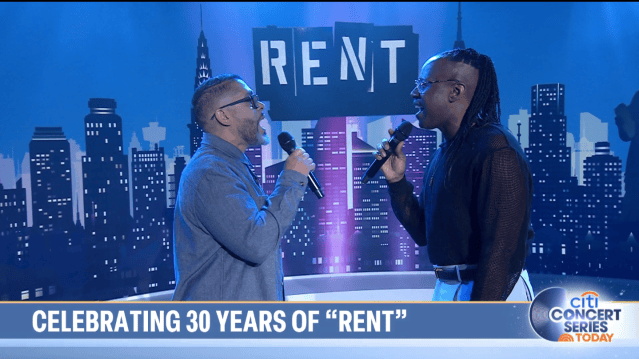
Watch Rent Original Cast Members Wilson Jermaine Heredia and Marcus Paul James Perform "I'll Cover You"
The Rent 30th anniversary benefit concert is tonight.