
Review: North by Northwest, an All Over the Map Hitchcock Adaptation
Emma Rice Company’s stage version of the 1959 thriller opens at the Old Globe.
 |
San Diego
|
|
San Diego
|
July 15, 2026
(© Rich Soublet II)
North by Northwest is my all-time favorite movie. Alfred Hitchcock’s 1959 spy caper is a perfect film, one that helped lay the groundwork for the James Bond franchise. The breezy thriller pairs Hitchcock with one of his favorite leading men, Cary Grant, on a cross-country chase that culminates atop Mount Rushmore. So, my anticipation for the North American premiere of the Emma Rice Company’s stage adaptation of North by Northwest at the Old Globe was considerable. The production conjures inventive visual comedy and transforms Hitchcock’s thriller into a swinging ’60s sex farce, but it ultimately succeeds as neither a worthy reimagining of the classic film nor as a meaningful exploration of Cold War anxieties.
Madison Avenue advertising executive Roger O. Thornhill (Danny Collins) is mistakenly identified as a government agent by a ring of foreign spies engaged in industrial espionage. After attempting to kill him and framing him for murder, they force Roger into a desperate flight across the country. Boarding the 20th Century Limited from New York to Chicago, he searches for the mysterious operative for whom he has been mistaken and encounters the impossibly cool Eve Kendall (Patrycja Kujawska), who helps him stay one step ahead of both the authorities and his would-be killers. But in a Hitchcock story—or a play based on one—can an icy blonde ever really be trusted?
(© Rich Soublet II)
North by Northwest retains much of Ernest Lehman’s original dialogue while saddling the action with commentary from the Professor (Katy Owen), a character played in the film by Leo G. Carroll. The effect is a dramaturgical crutch that adapter Emma Rice should have discarded long before opening night. Much of the Professor’s narration exists solely to explain what the audience has already understood. In the process, Rice inadvertently highlights the central challenge of adapting an action thriller for the stage. Hitchcock was a master of visual storytelling, a filmmaker who trusted audiences to connect the dots. Rice, by contrast, repeatedly feels the need to draw the picture for them. Where Hitchcock showed, Rice explains.
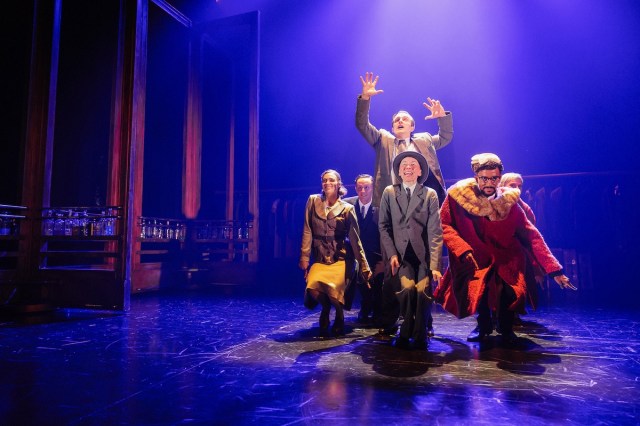
When the production abandons the source material, the results are mixed, yet Rice’s instincts prove considerably stronger in the show’s musical interludes. Characters suddenly break into lip-synced performances of Betty Hutton’s “Orange Colored Sky” and Nina Simone’s “Don’t Let Me Be Misunderstood,” while performing choreographer Etta Murfitt’s variations on the Watusi, the Frug, and the Monkey. The sequences evoke a cocktail lounge filled with martinis, cigarette smoke, and mid-century glamour, giving the evening an infectious sense of fun that is often missing from the storytelling.
Seemingly determined to avoid any resemblance to Hitchcock’s film, Rice pushes many of the actors toward broad caricature. The film lives and dies on the mystique of Cary Grant, but Collins approaches Roger from the opposite direction, playing him as frantic, nasal, and perpetually on edge. Even at his most exasperated, Grant never surrendered his effortless cool. Collins rarely finds it. Kujawska, meanwhile, takes the quintessential femme fatale in an unexpectedly peculiar direction that never completely lands. As the chief villain, Karl Queensborough lacks the menace and dry amusement that James Mason brought so effortlessly to the role. Despite the limitations of the Professor as a dramatic device, Owen proves an energetic and immensely likable master of ceremonies, throwing herself into the production’s acrobatic demands with infectious enthusiasm.
(© Rich Soublet II)
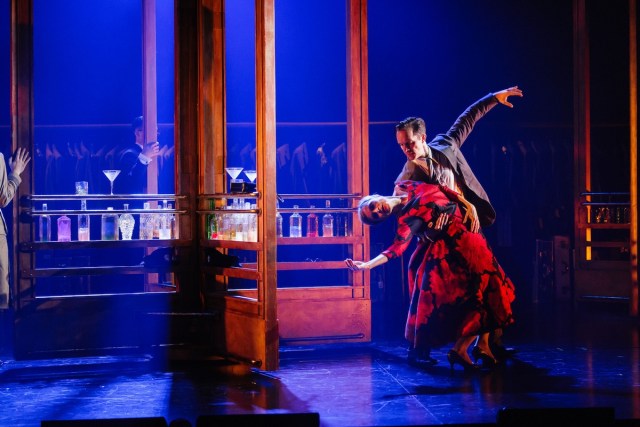
The production is at its most exhilarating when stagecraft takes center stage. Rob Howell’s set features enormous revolving doors lined with liquor bottles, transforming into trains, automobiles, and the sleek architecture of the villain’s lair. His costumes are equally imaginative, balancing period elegance with practical designs that facilitate rapid onstage transformations. Eve’s striking black dress accented with red patterns is particularly memorable. Simon Baker’s jazzy score establishes a vibrant mid-century mood, while lighting designer Malcolm Rippeth bathes the stage in rich reds, oranges, and blues that lend the production the atmosphere of a vintage nightclub.
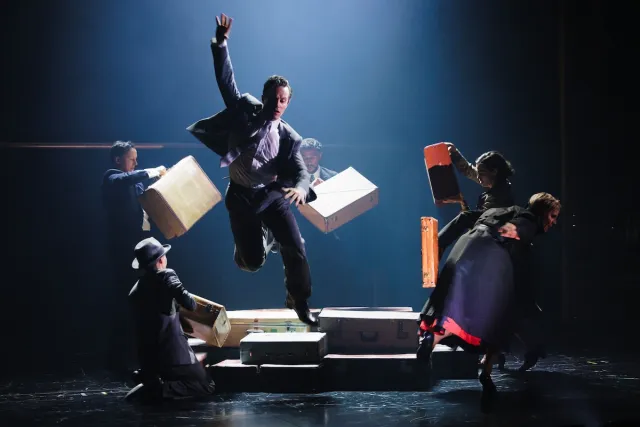
Most ingenious is Rice’s recurring use of suitcases, which become everything from showers and ticket booths to pieces of microfilm. The crop-duster sequence is especially clever, using kites and physical comedy to generate both laughter and suspense. However, what should be the production’s crowning achievement becomes one of its weakest passages, reducing the scaling of Mount Rushmore to a collection of suitcases and simple sketches of the presidents’ heads that bring the momentum to a standstill.
North by Northwest is exuberant, inventive, and frequently entertaining, but its justification remains elusive. It adds little to Hitchcock’s original film or to The 39 Steps, the stage spoof that reached Broadway in 2008 and already mined much of the same comic potential. Had that earlier adaptation not mulled the same basic territory, Rice’s approach might have felt fresher.




source on Google
Featured In This Story
Latest Reviews
See all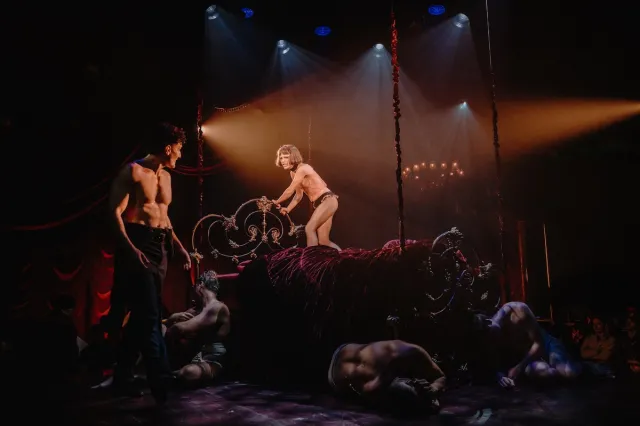


Latest Videos
Watch: Ellen Greene Reflects on the Enduring Legacy of Little Shop of Horrors
Frank Oz’s cult classic movie-musical has gotten a new 4K restoration in celebration of its 40th anniversary.