
Review: A Few Good Men Introduces Us to Aaron Sorkin Before He was a Brand
Lincoln Center Theater revives Sorkin’s early-career drama in a Michael Arden production.
 |
Broadway
|
October 29, 2026
(© Emilio Madrid)
Before his surname became screenwriting shorthand, Aaron Sorkin was a bartender at the Palace, scribbling dialogue on napkins during the run of La Cage. Those notes eventually became A Few Good Men, the military murder mystery that served as Sorkin’s calling card to the industry. The play ran for 500 performances on Broadway in the early 1990s, but its eminently quotable film adaptation, particularly Jack Nicholson’s now-iconic delivery of the line “You can’t handle the truth,” is what people remember.
Is A Few Good Men a good play? Frank Rich didn’t seem to think so. “Mr. Sorkin never does reward one’s expectations,” Rich said in his New York Times review when the show opened at the Music Box. Roger Ebert concurred about the screen version: “A Few Good Men is one of those movies that tells you what it’s going to do, does it, and then tells you what it did,” he wrote. Perhaps owing to its cinematic legacy, A Few Good Men has never returned to Broadway. Now, Lincoln Center Theater is offering a perfectly honorable revival directed by Michel Arden. It doesn’t reinvent the wheel, but it’s nice to see where Sorkin began.
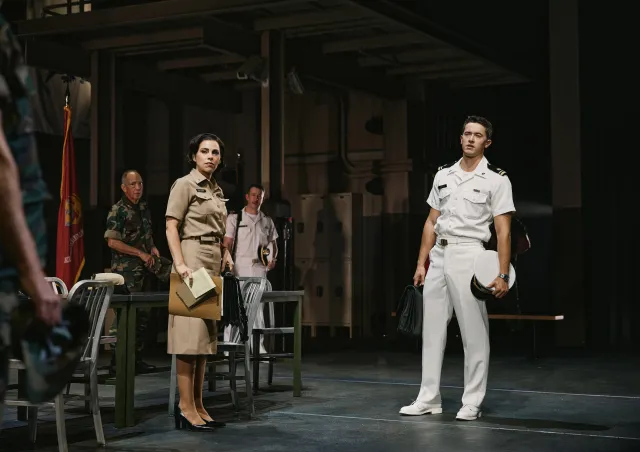
The inciting incident of A Few Good Men is the death of a young Marine at the hands of two fellow servicemen (Lavel Schley and Collin Kelly-Sordelet, who embody stock traits as the heavy and the hick). For their defense attorneys, lackadaisical Lt. Daniel Kaffee (Tom Blyth) and annoyed Lt. Sam Weinberg (Nick Blaemire), it seems open-and-shut. But principled co-counsel Lt. Commander Joanne Galloway (Krysta Rodriguez) isn’t convinced. Only when they meet venomous Lt. Col. Nathan Jessep (Bradley Whitford) do they begin to unravel the web of fabrications designed to keep the truth from leaking.
Like The West Wing, A Few Good Men airs its morality proudly, and there’s an innocence to its structure that could only come from a writer who was still figuring out how to tell stories. A thrilling production, the kind that leaves you hanging on every word, could mask the plot machinations you can guess five minutes before they occur. Arden’s customarily luxurious staging isn’t commanding enough to make that happen.
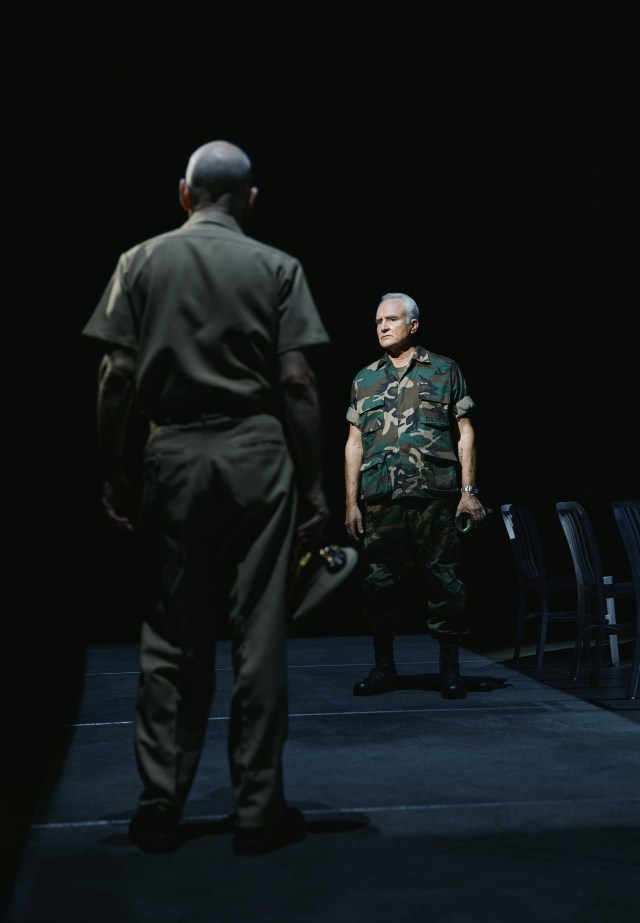
The veteran character actors fare best. Rodriguez and Blaemire provide charming grace notes for underwritten roles. Thom Sesma and Michael Oberholtzer are persuasive as results-driven military officials. Stephanie Berry drolly supervises the trial that takes up the second act. John Zdrojeski’s feral intensity as the commander of the platoon where the incident took place is so convincing that, had I not seen him in other shows, I’d assume he was plucked right off an actual military base. His endlessly fascinating performance outshines pretty much everyone else onstage.
(© Emilio Madrid)
That’s bad news for Blyth, who is practically monochromatic by comparison, and Whitford—though there is an earned satisfaction in the way they play that famous moment (you know the one). When you finally hear the sentence you came for, you can breathe a little easier.
Whitford, who shot to fame as hotshot politico Josh Lyman in Sorkin’s West Wing, doesn’t seem comfortable in Alejo Vietti’s fatigues here, and he lacks the bite that makes Jessep such a malevolent force. He naturally projects a witty intellectualism, which doesn’t jibe with the fearless machismo the part requires.
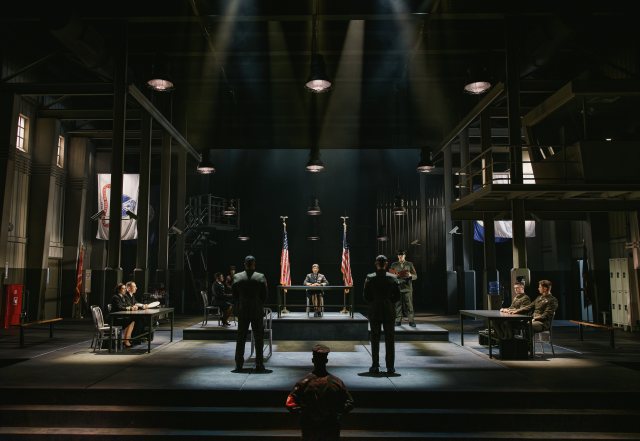
In collaboration with longtime scenic collaborator Dane Laffrey and lighting designer Japhy Weideman, Arden creates some magnificent stage pictures. Laffrey’s set, a naval base on the scale of an airplane hangar, has an immensity not seen at the Beaumont since the heyday of Bartlett Sher’s Rodgers & Hammerstein revivals. Weideman sculpts light and shadow in such a way that turns the play into a noir, all while creating a subtext that doesn’t exist anywhere else.
But it’s A Few Good Men itself that makes it clear why the play hasn’t become one of those dramas that receives annual mountings. It’s an artifact rather than a masterwork, an impressive piece of juvenilia that is less sophisticated than the work Sorkin would go on to create less than a decade later. If nothing else, it’s a fascinating exercise in theatrical cultural anthropology: a rare opportunity to revisit an early work by a now brand-name writer and see just how thoroughly he fulfilled the promise he showed when he was still slinging cocktails at a musical.
(© Emilio Madrid)




source on Google
Featured In This Story

Latest Reviews
See all






Latest Videos

Watch Original Rent Cast Members Sing "Seasons of Love" at 30th Anniversary Concert
The performance features Idina Menzel, Adam Pascal, Anthony Rapp, and more.