
Review: The Hairy Ape, Eugene O’Neill’s Century-Old Prophecy of America’s Coming Identity Crisis
Jon Beavers stars in a thrilling revival of this 1922 expressionist comedy at Irish Rep.
 |
Off-Broadway
|
|
Off-Broadway
|
October 4, 2026
(© Carol Rosegg)
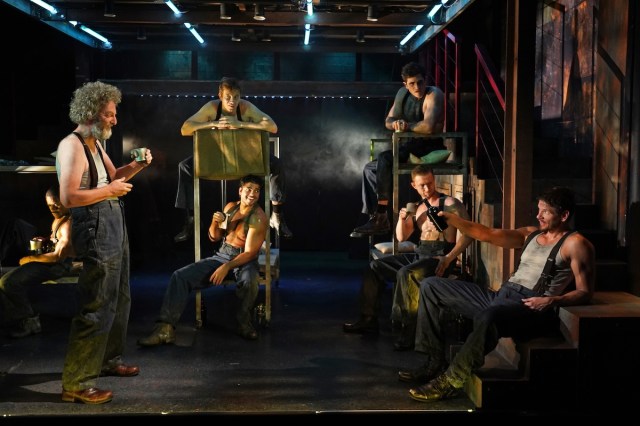
Speed is in Yank’s blood. It’s part of his identity. He shovels coal into the belly of an ocean liner, propelling the mass of steel across the Atlantic at 25 knots an hour, carrying passengers from one continent to another with unprecedented velocity. A journey that once took an entire month can now be completed in under a week. Yank knows none of it would be possible without guys like him. “Who makes dis old tub run? Ain’t it us guys? Well den, we belong, don’t we?” he asks a berth full of men just like him in the opening scene of Eugene O’Neill’s The Hairy Ape.
The stage radiates testosterone, glistening muscle to be sacrificed to the God of capital in director Ciarán O’Reilly’s powerful new revival at the Irish Repertory Theatre. Through stunning period design, brutally efficient staging, and memorable performances, O’Reilly and company show how this 1922 “comedy of ancient and modern life” is, in fact, an ongoing tragedy in 2026, as the world spins faster and we hang on for dear life.
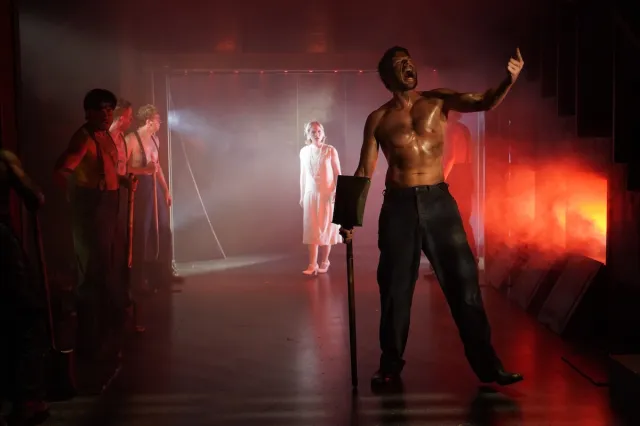
For Yank (Jon Beavers), the tumble off begins when first class passenger Mildred (Elizabeth Teeter, looking like a dead flapper and behaving like Bravo’s latest sociopath) descends into the bowels of the ship to “discover how the other half lives.” She gets one look at Yank’s stripped down and sweaty form, one whiff of his animal musk, one earful of his colorful vulgarity…and promptly faints. The ship’s second engineer (Nayib Felix) whisks her back above deck, slamming the metal door shut right before Yank’s shovel crashes into it with a great clang.
(© Carol Rosegg)
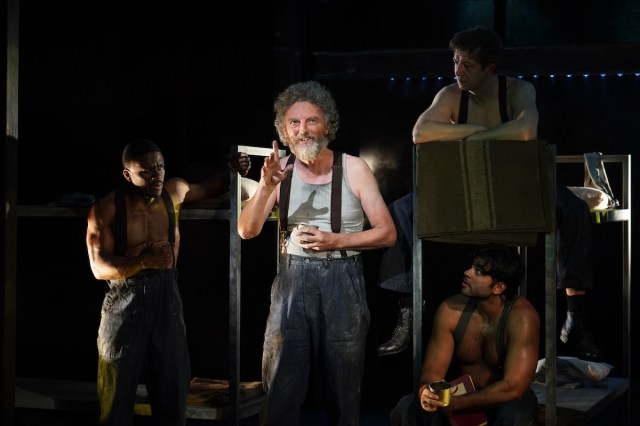
“’Twas as if she’d seen a great hairy ape escaped from the Zoo,” remarks Paddy (John Keating), an “old harp” still toiling in the stokehold. It disturbs Yank that Mildred (not just any rich girl, but the daughter of the president of a great steel trust) doesn’t see him as he sees himself—not as the best of men, but a filthy animal. This sends him on a quest to find somewhere he belongs: Fifth Avenue, a jail cell, a meeting of communists, and finally, a cage in the Bronx Zoo.
Charlie Corcoran’s set, a metal box with an upper platform that rises and falls, suggests that destination from the beginning, setting O’Neill’s expressionist drama in the cage only a select few of us ever escape, and which will ultimately press us to death. Orla Long’s costumes accentuate the theater of class, with pristine white for Mildred and her guard, distressed denim for Yank and his comrades. The stage looks like a rich oil painting of the industrial West, fearsome and gothic, under Michael Gottlieb’s dramatic lighting. With deep reds and melancholy blues, it pulls us insistently from one scene to the next in beautifully choreographed transitions (the movement is by Barry McNabb) tensely underscored by sound designers Florian Staab and Ryan Rumery.
(© Carol Rosegg)
Keating, the most consistent star of the Irish Rep for over a decade, is perfectly capable of capturing our imaginations on his own, but Rumery does him a solid by underscoring his opening monologue. “A warm sun on the clean decks,” he practically sings in his elegy of a sailor’s life before the age of steam, a mournful pipe heard faintly in the distance. “Sun warming the blood of you, and wind over the miles of shiny green ocean like strong drink to your lungs. Work–aye, hard work–but who’d mind that at all?” It’s Irish theatrical magic.
The production benefits from excellent performances all around. Ariyan Kassam is a fire-breathing labor evangelist as Long. Joanna Glushak feels like an intruder from Wilde world as Mildred’s snobbish (and clear-eyed) aunt. Adam Petherbridge brings an outrageously smug grin to his portrayal of the secretary of the IWW. And Hassiem Muhammad slathers on cheeky disdain as a prisoner reading an anti-labor speech from a certain Senator Queen.
(© Carol Rosegg)
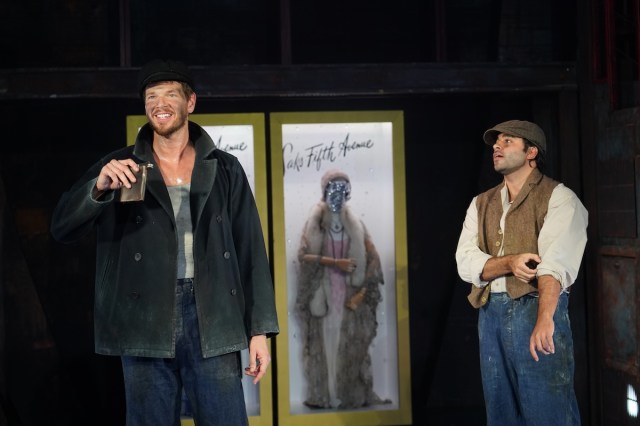
Beavers makes a heroic New York debut, embodying Yank’s gruff, uncompromising masculinity, but also revealing his softer side with a boyish smile and a spark of wonder in his eyes. He easily wraps his tongue around Yank’s antique Brooklynese, so it sound neither cartoonish nor forced. We never lose sight of the human beneath the hairy ape, even as Yank loses the thing he holds most dear: his sense of self and where he belongs.
In O’Neill’s day, an older generation could, on its way out the door, mourn a world swept away by the creative destruction of capitalist modernity. A century later, one need not have reached the age of 40 to begin sounding like an old harp. How many of us will be singing Paddy’s song when artificial intelligence obliterates the jobs that offer so many Americans not just sustenance, but purpose and community? To the proponents of so-called superintelligence, we are all hairy apes, to be caged or crushed.




source on Google
Featured In This Story
Latest Reviews
See all






#/media/File:Adolph_Menzel_-_Eisenwalzwerk_-_Google_Art_Project.jpg)

Latest Videos

Watch the Trailer for Elsinore Starring Andrew Scott
The film is based on the true story of Ian Charleson, who played Hamlet at London’s National Theatre after being diagnosed with AIDS.