
Reviews
Review: National Tour of The Who's Tommy Loses Its Pinball Magic at the Hollywood Pantages
Des McAnuff’s trimmed, one-act road version leaves the rock opera incoherent.
 |
Los Angeles
|
November 10, 2026
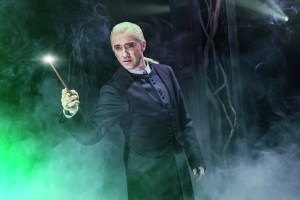
(© Evan Zimmerman/MurphyMade)
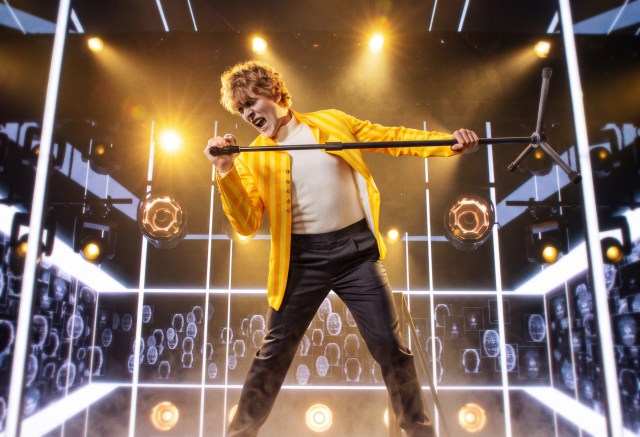
In 2024, Des McAnuff took his Tony-winning direction for the original The Who’s Tommy and reimagined it for modern times. The current tour, recently at the Hollywood Pantages, has made further alterations, shavings, and casting choices to meet the demands of the road. It’s impossible to gauge the quality of the ’24 Broadway production from this road version, because the choices made along the way have stripped the show of passion or coherence. By rushing the pacing, trimming roughly 15 minutes of breathing room, and shoehorning it into one act, The Who’s Tommy has become the narrative equivalent of speed dating.
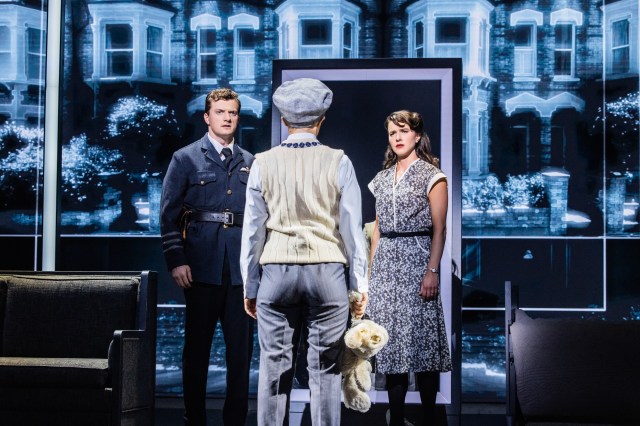
During WWII, a young British officer (Zach Fogel) meets and falls for a woman (Mia Bergstrom) before getting shot down behind enemy lines and declared dead. The “widow” Walker gives birth to the title character and continues her life with a new beau. Captain Walker returns and a fight leads to tragedy. In a panic, the Walkers scream at 4-year-old Tommy to ignore everything he saw, which instantly traumatizes him, leaving him deaf, mute, and blind. The parents attempt different religious cults and medical research to save Tommy, but nothing will snap him out of his damage. But by a miracle, despite hearing, seeing and saying nothing, Tommy masters pinball to become a sensation and a cult unto himself.
Pete Townshend’s score, based on the 1969 album by the Who, features timeless melodies like “Pinball Wizard,” “I’m Free,” and “Sensation.” Because the show is a rock opera with no spoken dialogue, the songs carry the whole story, and the book by Townshend and McAnuff always had a few oddities. The Walkers’ attack on their son that shuts him down never made much sense since the couple isn’t hiding their justifiable homicide of the violent boyfriend. The police come immediately and the parents are found not guilty. So why force Tommy to be silent if they’re hiding nothing?
Film anarchist Ken Russell found a credible solution in his insane 1975 movie adaptation by making the mother and the lover the killers, which turns them into villains, forcing Tommy to hide their secret. But the visual concepts McAnuff embedded into the original show distracted people from script issues by dazzling them.
(© Evan Zimmerman/MurphyMade)
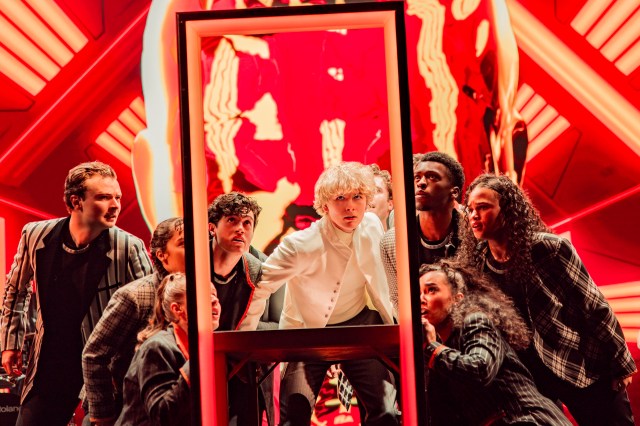
This latest stripped-down production makes the incongruities more apparent: the episodic nature of the parents taking Tommy through a conveyor belt of remedies, the powerlessness of both parents over their son’s welfare, and the lack of narrative clarity. This was the first version in which the show’s issues became handicaps.
The tour also takes away the two younger Tommys who, with adult Tommy (Collin Matthew Flanagan), form a cohesive main character, and instead inserts an adult female dressed like a boy (Mari Grossmann) to sub for Tommy from age 4 to teen. It visually ruins the conceit, and Grossmann looks like Veronica Lake did wearing boy drag in Sullivan’s Travels.
There’s also a Virtual Reality element: the show appears to take place in the future, and Tommy’s story is a simulation. People wear VR helmets and the show has a confusing space-age motif, including green exposure lamps and dot-matrix monitor screens.
The biggest issue is that the mise-en-scène is drab, with Peter Nigrini’s projections and Sarafina Bush’s costumes of mostly laser greens, muted clothing, and splashes of bright yellow in the final scenes. It’s very dulling on the eyes and reminds one of early ’80s MTV music videos before huge budgets were infused.
What does work is Lorin Latarro’s innovative choreography. There are regimented movements that hint the kids will eventually become fascists with Tommy as their leader, and a concentration on the cast’s forearms when they dance, to represent the pinball machine flippers. Latarro’s dances are performed with precision by the excellent ensemble, who also handle Townshend’s score adeptly.
None of the cast hurts the production. Everyone does what they can. Fogel, Flanagan, and Bergstrom are given little to do and almost perform their roles statically as if they’re in a concert. The two standouts are Peyton Cassity, as the dipsomaniacal, molesting Uncle Ernie who, without being anywhere near the young Tommy, cackles his “Fiddle About.” The other is Kyle McFalls as the thuggish Cousin Kevin, who gleefully crows about physically torturing his cousin.
The Who’s Tommy is usually an invigorating, psychedelic romp on the pitfalls of using religion and quack science to heal emotional wounds. The latest tour gives the show an incoherency that leaves even fans lost and unaffected. It’s a shame that tour audiences are unable to see what McAnuff had envisioned on Broadway in 2024 and judge it on those merits.
(© Evan Zimmerman/MurphyMade)




source on Google
Latest Reviews
See all



Latest Videos
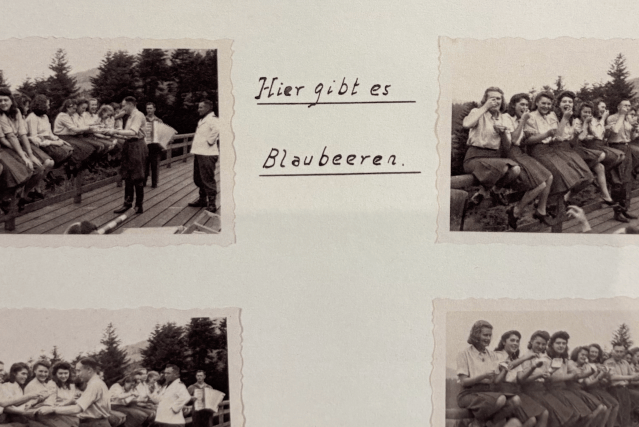
Find Out the Real Story Behind Broadway's Here There Are Blueberries
Writers Moisés Kaufman and Amanda Gronich discuss the new drama alongside their cast.