
Review: Here There Are Blueberries Takes a Snapshot of the Banality of Evil
Moisés Kaufman and Amanda Gronich’s Pulitzer Prize-nominated documentary play opens on Broadway at the Barrymore Theatre.
 |
Broadway
|
November 9, 2026
(© Matthew Murphy)
Museums rank among the most trusted institutions in America, we’re told in Here There Are Blueberries. The reason? Anyone can massage a fact, but there’s no quibbling with an artifact. See those children holding a Sieg Heil for the camera? Catch the Nazi flag backdropping a carefree day at the beach? How mundane. How grotesque.
The academic precision and only occasional indulgence in theatricality are what make Moisés Kaufman and Amanda Gronich’s documentary play Here There Are Blueberries a powerful piece of historical drama. Conceived and directed by Kaufman, it comes to Broadway fully settled following developmental productions (including the 2024 off-Broadway premiere at New York Theatre Workshop) that made it a Pulitzer Prize finalist.
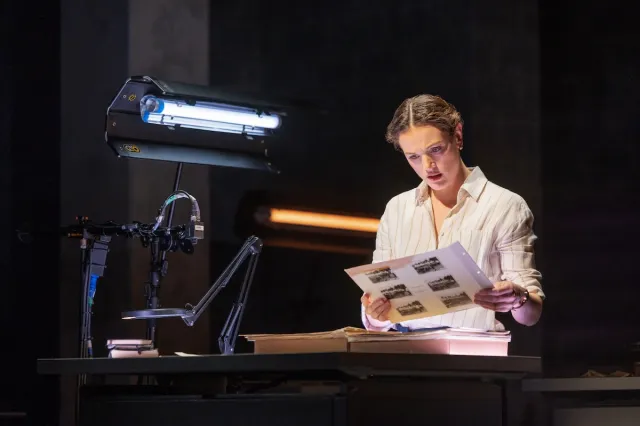
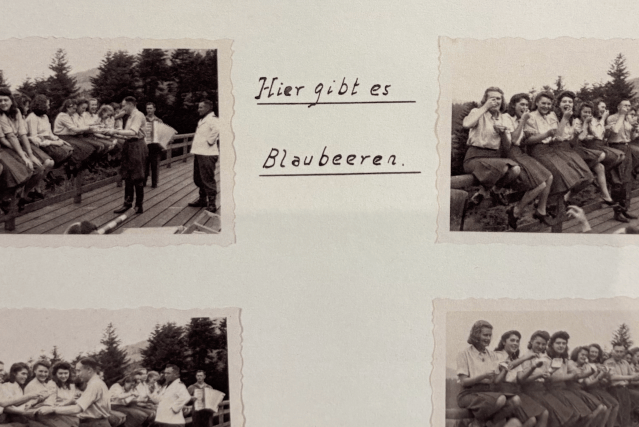
The piece sets us alongside US Holocaust Memorial Museum archivist Rebecca Erbelding (Delia Cunningham) in 2007 as she receives a rare album of photos that were taken inside Auschwitz, the largest extermination camp constructed during the Nazi regime. What’s unusual is that the subjects of the photos aren’t the victims, but rather the smiling men and women pulling the levers of the killing machine that’s just out of frame.
(© Matthew Murphy)
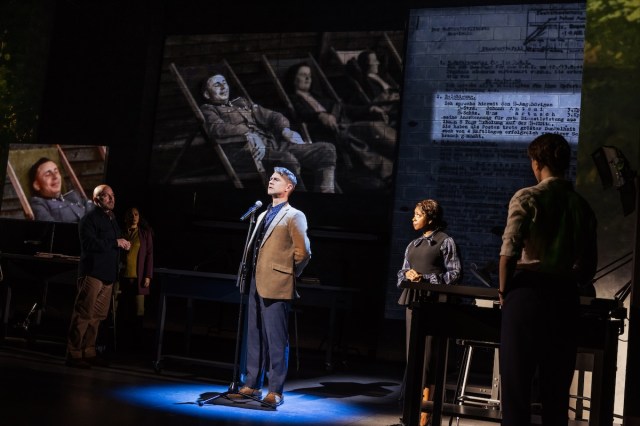
Never elevate the Nazi platform—that’s the museum’s ethical commitment, and they won’t waver from it, even if it means burying this rare photo collection. But Erbelding manages to convince her colleagues that the album fills in important historical blanks (one of Kathleen Chalfant’s several poised performances is as a museum volunteer and Holocaust survivor whose endorsement goes a long way).
Sure, political theorist Hannah Arendt explained the “banality of evil” way back in the 1960s. Memoirists like Melita Maschmann (played here by Montego Glover) have even let us inside the convoluted mind of a Nazi propagandist. But seeing Auschwitz architect Rudolf Höss enjoy a family retreat on camp property, his son paddling a toy boat built by prisoners—suddenly the theoretical becomes visceral.
The album, these historians determine, was the property of Karl Höcker (embodied onstage by Scott Barrow), bank teller turned German commander and primary administrator for Auschwitz commandant Richard Baer. Piecing together the details of Höcker’s life is an oddly satisfying project to track, adding the propulsion of a mystery novel to an exceptionally engaging history seminar.
(© Matthew Murphy)
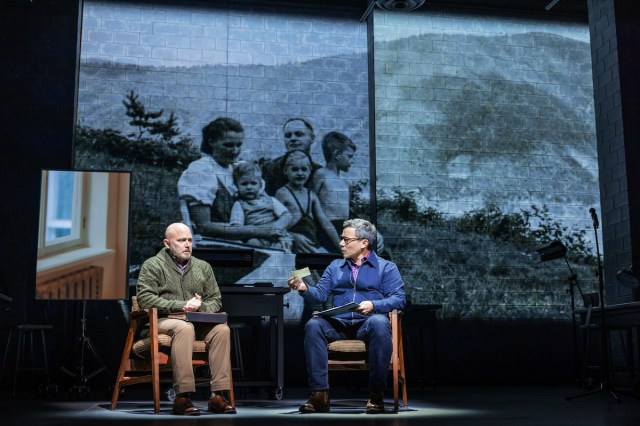
Conrad Ricamora, as Tilman Taube, a German man who spots his grandfather in the Höcker photos, leads a side quest to compel other Nazi descendants to come forward with identifying information. To that end, we see him meet with a man named Peter Wirths (Michael Cerveris, in a gripping scene with Ricamora) who details his father’s time as Auschwitz’s chief medical officer.
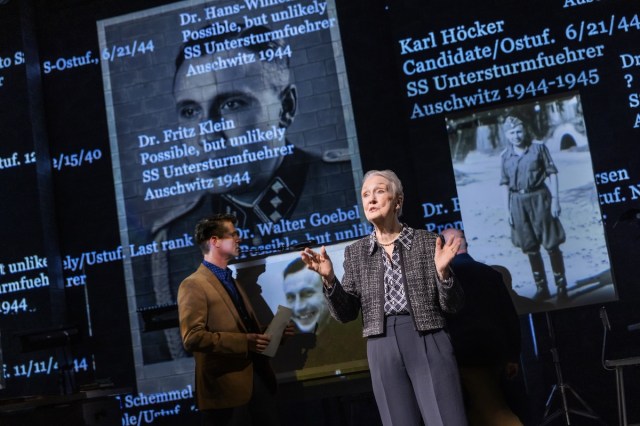
The play visually centers around David Bengali’s projections, which, for the sake of clarity, manipulate images to illuminate certain details or people (there are audible gasps when “Angel of Death” Josef Mengele surfaces). But to describe the aesthetic in a single word, it would be “unobtrusive”—from the way set designer Derek McLane’s anodyne workspace efficiently rearranges for scene changes, to the way lighting designer David Lander provides a gentle guiding hand with spotlights and shadows, to the way costume designer Dede Ayite’s combination of street clothes and business casual quashes any potential for melodrama.
We even get some subtle but effective live Foley effects from sound designer Bobby McElver—an eerie clinking of dishware as the Helferinnen giggle over blueberries (Michelle Beck later voices damning testimony from one of these women). This is a project about allowing images to speak for themselves, and Kaufman remains faithful to that mission.
(© Matthew Murphy)
Only a handful of times do actors even step out of their antiseptic recitations of facts or court transcripts to share their human experiences (a bit of a tease with such a deep bench of top-tier actors). Brandon Flynn delivers a choleric monologue as Rainer Höss, grandson of Rudolph Höss, who struggled with the discovery of his grandfather’s role during the war (Rainer’s 2020 fraud conviction may color your experience of his testimony, but Flynn is a compelling interpreter). Cunningham also gets to briefly set aside her academic composure as our primary narrator for a monologue as Lili Jacob, an Auschwitz survivor who, after the Nazis fled the camp, discovered photos they captured of the day she and her family were processed.
It’s the show’s only detour into the more familiar form of a Holocaust narrative—the version where we rely exclusively on images of suffering to communicate the extent of the horrors at play. But that still lets us dream up the devil pulling the strings from behind the camera. The real horror comes when the camera flips around and the person standing there looks just like you.




source on Google
Featured In This Story
Latest Reviews
See all


Latest Videos
Find Out the Real Story Behind Broadway's Here There Are Blueberries
Writers Moisés Kaufman and Amanda Gronich discuss the new drama alongside their cast.