
Review: Quirky New Musical Soon Explores Global and Personal Apocalypses
Out of the Box Theatrics presents Nick Blaemire’s show in an immersive loft staging.
 |
Off-Broadway
|
|
Off-Broadway
|
October 6, 2026
(© Valerie Terranova)
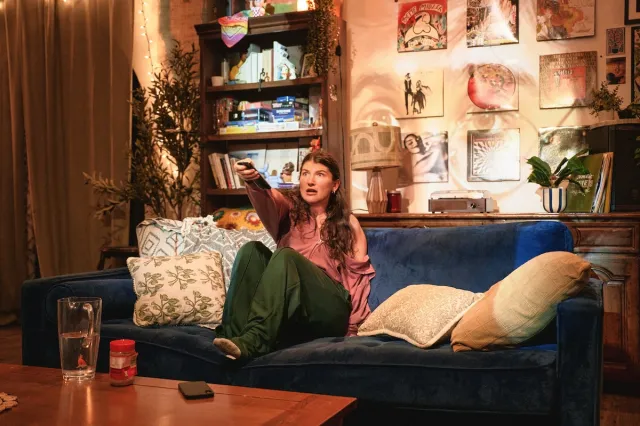
Nick Blaemire’s Soon, being presented by Out of the Box Theatrics in an extended off-Broadway run after a shorter two-week run at East Village Basement last year, starts from a genuinely fascinating premise. The end of the world is raging outside the two-bedroom East Village apartment in which the show is entirely set, but Blaemire (composer, lyricist, and book writer) is less interested in the apocalypse itself than in how human beings process the knowledge of impending doom. Is it worth living anymore if you know the end is coming sooner rather than later?
No, according to Charlie (Ava Delaney). During the show’s opening moments, she’s seen sitting on a couch in her apartment obsessively watching television, including news reports anchored by Wolf Blitzer (voiced by Max Spitulnik) of the catastrophe unfolding outside her apartment. We soon discover she hasn’t left her apartment in months, paralyzed by the knowledge that, thanks to accelerating global warming, life on Earth will become unsustainable much sooner than everyone thought. Other than her roommate, Steven (Mike Millan), her only steady companion is her goldfish, Herschel, to whom she talks frequently.
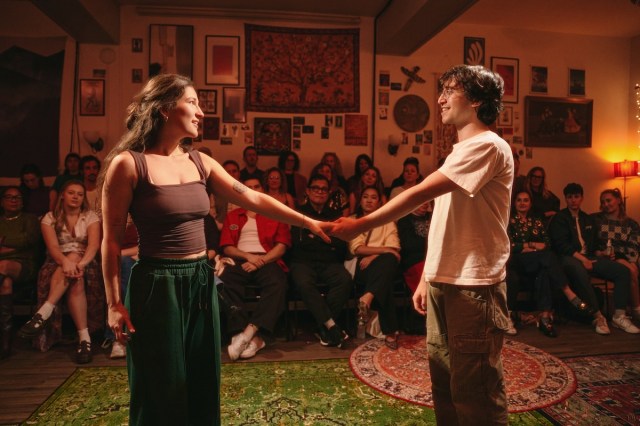
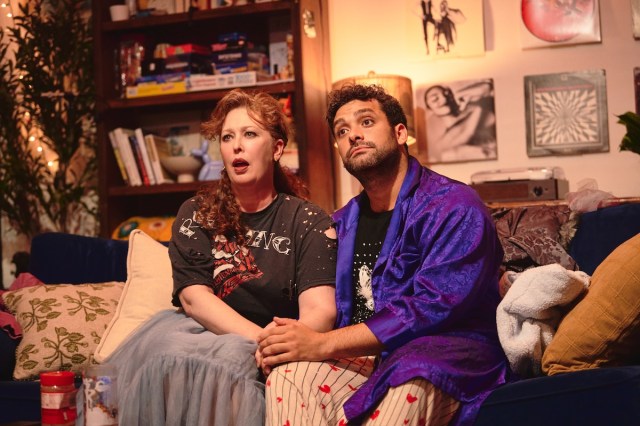
Into this self-imposed isolation comes Jonah (Oliver Richman), a grocery delivery person with whom she tentatively strikes up a relationship. Despite Jonah’s best efforts to encourage her to, among other things, dive more into her fondness for baking, Charlie’s apocalypse-induced anxiety eventually hampers their romance as well. That kind of emotional reticence also characterizes Charlie’s arm’s-length relationship with her mother, Adrienne (Mylinda Hull), a Connecticut-residing hot mess who makes clumsy attempts to reach out to her daughter.
(© Valerie Terranova)
Dramatically speaking, Soon is a tug of war between two approaches of living amid the knowledge of certain death, with Jonah, Steven, and Adrienne all functioning as spokespeople for making the best of the time we all have left. Though it was first produced at the Signature Theatre in Washington, DC, in 2015, Blaemire’s show has gained in resonance. Not only has global warming become an even greater environmental danger in the ensuing decade, but forces like artificial intelligence have put the survival of our species into further jeopardy. And Charlie’s shut-in lifestyle will remind us of our similar experiences stuck in our homes during Covid lockdown.
In Blaemire’s hands, this eccentric concept gives a firm emotional grounding to even his most whimsical ideas. Charlie sings an ode to peanut butter, for instance, that becomes an expression of her psychological paralysis; while Jonah and Steven’s goofy “Bar Mitzvah for the First Jewish Fish” courses with their desire for Charlie to break out of her agoraphobic shell. Blaemire infuses his music with a refreshing sense of variety, with Wiley DeWeese’s orchestrations for a three-piece band lending the songs an extra feeling of intimacy. And Blaemire’s book finds creative ways to build characterizations and hint at relationship dynamics without bogging down in exposition.
(© Valerie Terranova)
For its first two-thirds, then, Soon seems like one of the more intriguing and original new musicals in quite a while. So it’s disappointing that, in the final third, Blaemire seems to distrust the inherent strength of his dystopian metaphysical premise. Without spoiling too much, a flashback not only reveals that Charlie’s psychological freefall stems from something much more mundane than worsening climate change, but also recasts the previous two-thirds in a light that I’m not entirely convinced holds up under retrospective scrutiny. Worse, this revelation diminishes what had been an idiosyncratic yet serious exploration of topical unease into little more than a gimmick.
This is a shame, especially given the solid production and the strength of some of the performances. Staged in a loft filled with wall decorations—movie posters, show programs, album covers, and so on—that express Charlie’s personality (Sean Frank is the scenic designer), director Will Blum uses Paige Seber’s imaginative lighting design in particular to indicate jumps in time and shifts in reality. Among the four-person cast, Hull stands out, bringing scene-stealing torch-singer energy as Adrienne. Millan plays the prototypical gay best friend without overdoing it. Richman exudes genuinely affecting desperation as he tries to help Charlie break out of her shell; that said, as a vocalist, he could occasionally stand to project more. By contrast, Delaney, as Charlie, sings quite well throughout but ultimately comes off as too lightweight for the psychological burden she’s meant to bear. A stronger lead might have helped paper over the cracks that this near-miss of a musical’s rather cheap 11th-hour twist exposes.




source on Google
Featured In This Story

Latest Reviews
See all






Latest Videos
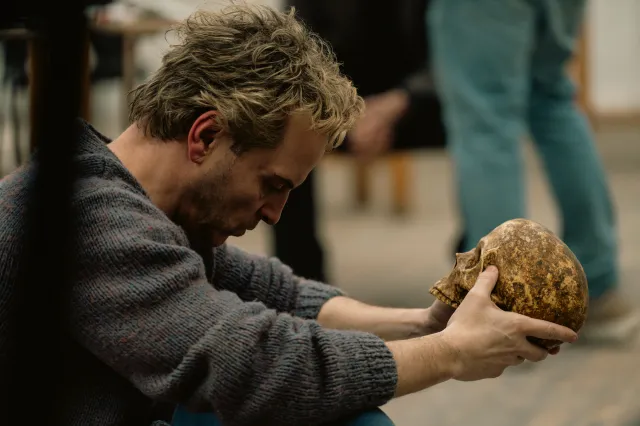
Watch the Trailer for Elsinore Starring Andrew Scott
The film is based on the true story of Ian Charleson, who played Hamlet at London’s National Theatre after being diagnosed with AIDS.