
Review: Fish, a Coming-of-Age Comedy About ISIS
Melis Aker’s new play makes its debut at WP Theater.
 |
Off-Broadway
|
|
Off-Broadway
|
October 11, 2026
(© Joan Marcus)
Teenagers have always taken stupid risks, but the stakes feel so much higher in the Internet age. Your most embarrassing moment at 17 is no longer limited to an audience of high school gossips, but can now spread worldwide, with video evidence, to live forever online.
That’s a risk Karya (Yasmin Ranz-Lind) is willing to take (and then some) in Melis Aker’s outrageous new comedy Fish, now making its world premiere at WP Theater (in a co-production with Signature Theatre Company, in association with New Light Theater Project, with consulting producer Noor Theater Company).
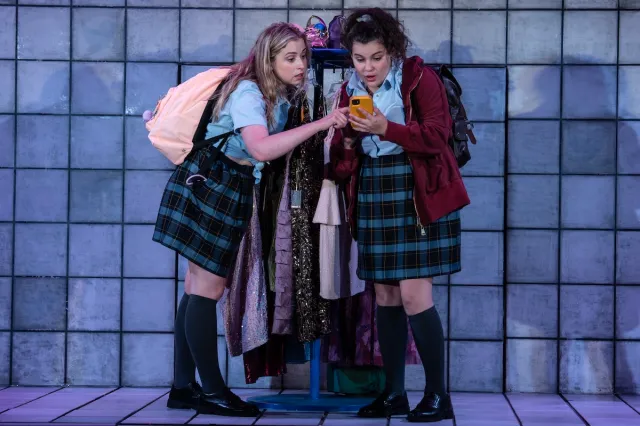
She starts out with relative caution, sending a veiled photo of herself to an ISIS fighter via Twitter DM (the play is set in the UK in 2016). Her friend Libby (Alyssa May Gold) encourages her, reasoning that the IS social media manager might have information about Karya’s missing brother, Emir. Her Turkish immigrant mother, Ceyda (Roxanna Hope Radja), is convinced he’s still alive and brainwashed by Islamic radicals.
But once Karya discovers that she can get these dudes to send her money with the false promise that she will use it to travel to Syria, her motives become a lot more mercenary, and she begins taking bigger risks with her online footprint. It’s the OnlyFans slippery slope, with a dash of Daesh.
(© Joan Marcus)
It’s a dark premise for a comedy, but Aker never allows the stakes of this story about toying with horny terrorists to overwhelm a script brimming with laughs. The deeper Karya swims, the funnier Fish becomes. She’s like Lucy, but the chocolate bon-bons are young jihadis with Bitcoin purses. Nom nom nom.
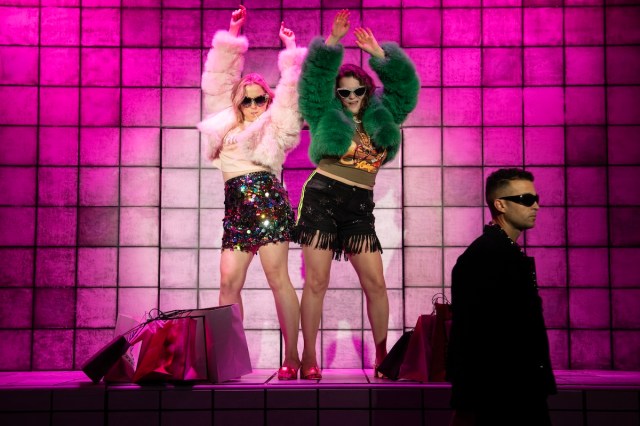
Ranz-Lind is not only a gifted comedian, but she sells us on Karya’s dramatic character arc. In under 90 minutes, she transforms from a shy girl in thrall to the opinions of her best friend into a mob girlboss, literally stealing from international terrorists for the thrill … and, of course, the money. As any reader of The Economist might tell you, financial independence is the major factor driving the liberation of women and girls. And it can also turn them into real monsters.
Under the sharp direction of Tatiana Pandiani, the other actors rise to the high bar Ranz-Lind sets. Gold gives us an instant impression of a bored mean girl, goading her bestie to bad decisions then throwing up her hands when Karya actually makes them. Sara Haider is elusive and prickly as Emir’s ex-girlfriend, Isha. We understand why Ceyda thinks she’s keeping a secret.
Radja gives a particularly powerful performance as Ceyda, making the audience feel in our bones the desperation of an immigrant single mom holding on to the hope that her son is a jihadi (because the alternative is that he’s probably dead). As Jon the swim instructor, Kario Marcel possesses the steady poise and terrified eyes of a man with personal experience in the service industry; his performance is positively method.

(© Joan Marcus)
Why is there a swim instructor in this play about coming-of-age through wire fraud?, you might ask. And this is undoubtedly Aker’s least convincing contrivance, as Karya returns throughout the play for regular swimming lessons with the hunky older man. It has something to do with learning new skills and swimming with the big boys and finding your sexual power as you literally fish for young dumb (but internationally wanted) marks to defraud on the Internet. It’s in the title, but it begins to smell like an old metaphor wrapped in newspaper.
Scenic designer Emmie Finckel gives that metaphor its best go with a set made of tiles. It is surprisingly versatile, with a piece that transforms into a kitchen island, a roll-out toilet that turns the space into a bathroom, and a downstage ditch that allows the actors to simulate swimming (Pandiani’s movement direction in these scenes is hilarious). It’s almost enough to keep us from wondering why the thrift shop also has tile walls.
Siena Zoë Allen convincingly costumes the characters, lucidly imagining what teenage girls might wear given unlimited funds. Sound designer G Clausen helps transform the space into a busy gymnasium pool with an echo off the walls. Clausen also works seamlessly with lighting designer Reza Behjat to vividly convey Karya’s online communication, distorted voices and a pulsing Twitter logo, making our skin crawl as we watch Karya paddle into a riptide of consequences.
Even if we cannot buy every twist and turn in Fish, it has the unmistakable whiff of truth in a world where we have all been released from our little tanks to swim with the sharks. With the advent of AI, it only gets worse from here.




source on Google
Featured In This Story

Latest Reviews
See all









Latest Videos

Watch the Trailer for Elsinore Starring Andrew Scott
The film is based on the true story of Ian Charleson, who played Hamlet at London’s National Theatre after being diagnosed with AIDS.