
Special Reports
Ars Nova Wants to Discover the Artists Theater Hasn't Found Yet
Artistic directors Anna Morton Stacey and Andrew Neisler are continuing the theater’s mission to serve as an incubator for the next generation of artists.
 |
Off-Broadway
|
|
Off-Broadway
|
October 9, 2026
At a time when theater is grappling with how to attract audiences, support artists, and rethink the economics of producing new work, Ars Nova is leaning into what it has always done best. Under the guidance of relatively new artistic directors Anna Morton Stacey and Andrew Neisler, the nonprofit is focusing on its longtime mission to discover, develop, and launch early-career artists in a variety of disciplines, from initial idea to full production.
For Stacey, a dramaturg and producer whose career has largely been rooted in institutional, nonprofit theater, and Neisler, a director who got his first off-Broadway opportunity at Ars Nova after years of making theater wherever he could, their contrasting backgrounds inform a shared philosophy. They don’t want an artist to arrive fully formed. They want to give them the resources to become something bigger.
This conversation has been condensed and edited for clarity.
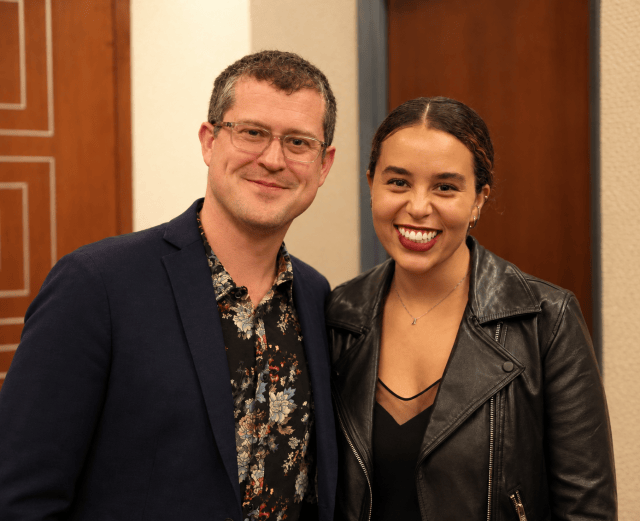
(© HanJie Chow)
For those reading this who have never been to Ars Nova, can you describe its mission and goals?
Anna Morton Stacey: The mission is to discover, develop, and launch early-career artists in music, theater, and comedy. We try to hold every one of our programs and every one of our choices to that mission and fit it into one of those verbs: discover, develop, launch.
Ars Nova feels like it is occupying this niche where we are an off-Broadway theater, but we also have this cabaret venue, and we can pull those two levers at different times. And we have a loft where we can rehearse and develop work. We’re excited to continue producing off-Broadway theater, as Ars Nova has been doing for a long time, but also to resource and invest in the discover and develop part of the mission, and to invest in the initial impulse of the artist by saying, “What do you need that a more traditional off-Broadway theater is not gonna help you find?”
You both come from very different professional backgrounds. How have those experiences shaped the way you approach Ars Nova‘s mission?
Anna: We come from totally different backgrounds, which is part of what has worked well. I am a dramaturg, producer, and former literary manager. I worked at Roundabout Theatre Company before coming to Ars Nova, and I was at McCarter Theatre Center in New Jersey before that. In my previous life before Ars Nova, I was reading a lot of scripts and going to see a lot of Broadway and off-Broadway theater, but firmly in that institutional space. I wasn’t super connected with downtown theater. Now, I oversee our commissioning pipeline and our artists-in-residence program. I have a lot of background in how to develop new work, and that is what I bring to the mix.
Andrew Neisler: The thing I bring to the table in our collaboration is more of a producorial and directorial vision. I was, and still am, a freelance director. My first off-Broadway directing opportunity was at Ars Nova. I directed a show called Charlatan in 2014 at Ars Nova. I am one of those artists who was scraping together enough money by throwing fundraisers with kegs and then producing theater in basements in Brooklyn for 20 years. Then Ars Nova was like, “This guy’s actually a legit director,” and that was kind of the beginning of my career.
When you’re looking for artists to discover and develop, what qualities are you looking for?
Andrew: When we’re scouting and reviewing applications, and when we have committees that do that for us, we always tell everyone the main thing you’re looking for is capital-P potential. It does not have to be polished. It doesn’t even necessarily need to be good. If you’re seeing somebody whose talent and skill is almost at a higher level than the space they’re in or the resources they’ve been given, or that they could be operating at such a higher potential, that’s the main thing we look for. We then bring them here and say, “What would you do if you had more time and more space and a lot of really nice equipment and a beautiful building?”
At a time when you hear so much about the challenges facing theater, what does it take for a nonprofit theatrical incubator like Ars Nova to succeed?
Andrew: You hear and you read a lot about how the industry is dying. The grand question in the industry is, “How are we making this thing work for audiences and for artists?” How are we not just doing the $800 Broadway ticket to see a celebrity? Part of why I want to be an artistic director at a nonprofit right now is to be one of the people who’s helping to figure that out. Theater that’s happening in comedy clubs and bars and music venues in Brooklyn, the Lower East Side, and in the middle of the night for 20 people — it’s electric.
Theater is actually thriving. Our first show together as co-artistic directors was called Heaux Church. The run of that show had a party in the loft almost every night afterward. A huge part of the ethos of the show was that the community gathered in those spaces every night. It felt safe and comfortable, and everyone had a great time. You’ve got to have a good bar with cheap drinks, you’ve got to have events, and you’ve got to have community and culture built around the play.
Anna: One of the things that makes us unique is that we are often a space for artists who have been turned away by other theaters because their work doesn’t fit in a particular box. They can come to us and say, “I don’t quite know how to make this,” or, “Other people have told me this is impossible because it’s straddling different genres, and Ars Nova seems like the only place where that’s not a scary thing, or a reason to say no.” When I hear that, I’m like, “Let’s do it.
Andrew: It’s constantly getting artists in the door and seeing who’s out there. You can expect a lot of that this season; actually, more this season than we’ve done in a long time.




source on Google
Latest Reviews
See all



Latest Videos
Watch the Trailer for Elsinore Starring Andrew Scott
The film is based on the true story of Ian Charleson, who played Hamlet at London’s National Theatre after being diagnosed with AIDS.