
Review: Abigail Onwunali Triumphs in Mfoniso Udofia’s Complex Creation Stories
Udofia’s surreal play delivers humor, heartbreak, and a memorable performance.
 |
Off-Broadway
|
|
Off-Broadway
|
October 1, 2026
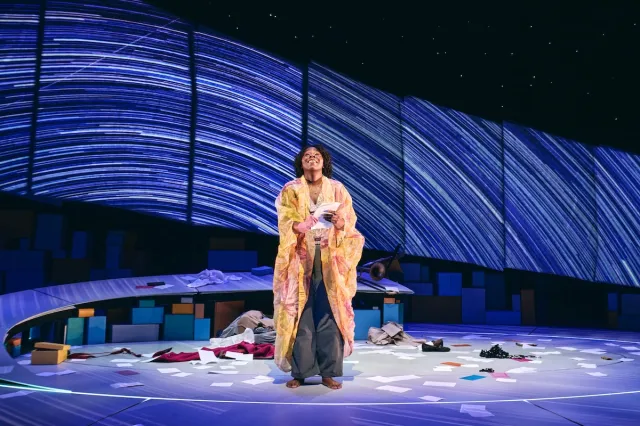
On her new album, Sara Bareilles writes in “Ladies in a Line” of the special, silent grief of the women “waiting for the fine-tipped needles / Craving just a tiny piece of good news” as they undergo IVF treatment. “I’m just swimming where they tell me to / Till I can’t swim no more,” she sings. And that’s the aching song, too, of “thegrownwoman” (Abigail Onwunali), the protagonist of playwright Mfoniso Udofia’s creation stories and all the important importants at LCT3.
Udofia’s an extraordinarily prolific playwright—the last of her nine-play Ufot Family Cycle, about the Nigerian-American experience premieres this fall—but this individual work has prolific ideas inside it, too. In the script, which is filled to the brim with footnotes and poetic stage directions, Udofia indicates that, “as you read, / know that this piece is incongruently fashioned from everything i am: / ancestrally, artistically, creatively, spiritually, bodily.” That’s a lot for one play to communicate in 90 minutes, and creation stories is clearest and most affecting when at its most legible.
Thegrownwoman narrates her day in third-person, a smile plastered on her face and a forced lilt in her voice. It becomes clear that the narration isn’t for us; it’s the engine she needs to barrel through her day, pushing aside the soul-breaking burden of trying to conceive on her own. Onwunali navigates Udofia’s complex text with marvelous lucidity and emotional range. Because thegrownwoman has perfected this performance for herself, we believe her too, and when she finally cracks open, releasing her despair, it’s wrenching.
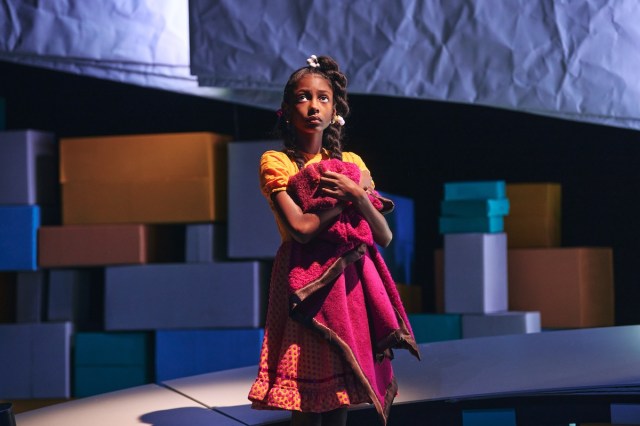
Unsurprisingly, the character is a playwright herself, and she finds herself quoting inadvertently from her dramatic influences when she sits down to try to write. “Oh my god,” she exclaims. “Underneath me is Beckett??” There’s quite a lot of Beckett in Udofia’s own writing, too, especially in the hazy opacity of dialogue between thegrownwoman and the Little Girl (the very young Savannah Commodore), a child self who emerges, in a striking image, from beneath thegrownwoman’s pile of dirty laundry. Onwunali and Commodore were terrific as mother and daughter in Joe Turner’s Come and Gone last season, and they’re well-paired here, too, as versions of the same character. We catch glimpses of Commodore’s ebullience in Onwunali; where once the Little Girl loved to play-act for her own pleasure, thegrownwoman now performs as an act of survival.
“The only place where the playwright is concerned with the ‘REAL’ is in the emotional realm,” Udofia insists in a preface to her script, but creation stories actually thrives emotionally in its most realistic moments, such as thegrownwoman’s feigningly cheery phone calls with her mother and her tense visit to the doctor’s office where she hopes to hear better news about her blood tests than the last cycle (and the cycle before). And, in steering a play that could easily drift away into abstraction, director Tamilla Woodard grounds her accessible staging in clear, varied movement across Jason Ardizzone-West’s colorful crescent moon-shaped set.
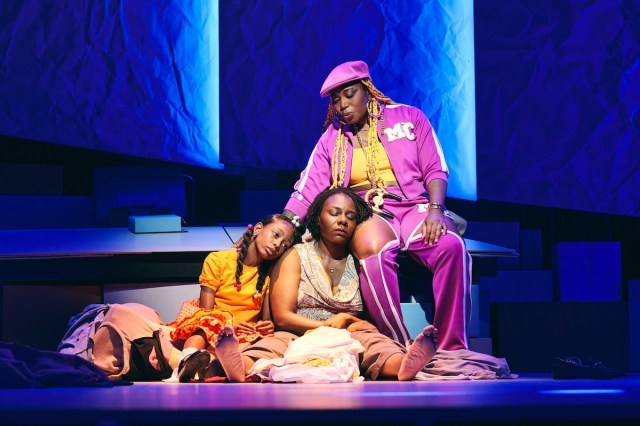
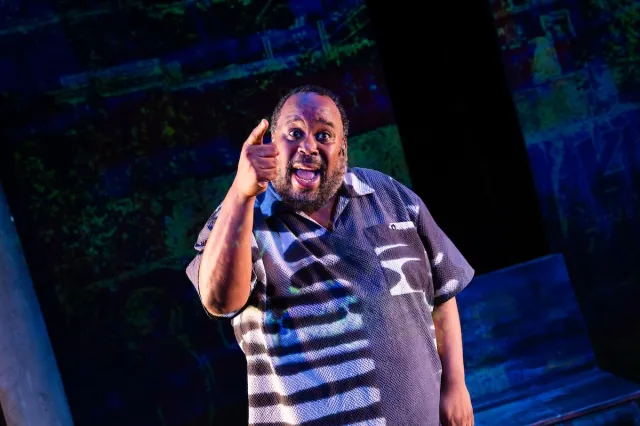
Thegrownwoman teaches a playwriting class, focused on a (fictional) Nigerian playwright known for throwing in devices that “hijack the narrative,” like a goat wandering in midway through a play. And though creation stories climaxes with the arrival of just such an unexpected “Chekhov’s pony,” an energetic, rapping horse (Donnetta Lavinia Grays) that cares for and consoles thegrownwoman, this lift-off into fantasy doesn’t feel like the intended hijacking. When the play’s already felt so surreal, structural surprise is hard to come by.
Her department chair tells thegrownwoman that the play she’s teaching is “too unruly for the syllabus,” and it’s clear that Udofia wants to channel a similar sort of boundary-smashing in her own writing. But the unruliness, if you can call it that, of creation stories’ structure and storytelling, isn’t what makes the central storyline persuasive and moving. Onwunali’s portrayal of a woman fighting to put on the proper face as she’s torn apart by corporeal grief would be just as potent and important, maybe even more so, without the rapping horse.




source on Google
Featured In This Story
Related Articles
See all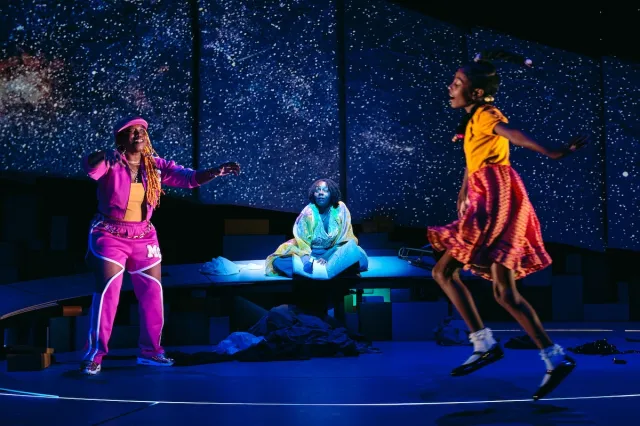
Latest Reviews
See all



Latest Videos
Watch the Trailer for Elsinore Starring Andrew Scott
The film is based on the true story of Ian Charleson, who played Hamlet at London’s National Theatre after being diagnosed with AIDS.