
Interview: Mfoniso Udofia on Writing Creation Stories as a Fairy Tale for “Exceptional” Women
Creation Stories and All the Important Importants, directed by Tamilla Woodard, is having its world premiere at Lincoln Center Theater.
 |
Off-Broadway
|
|
Off-Broadway
|
September 29, 2026
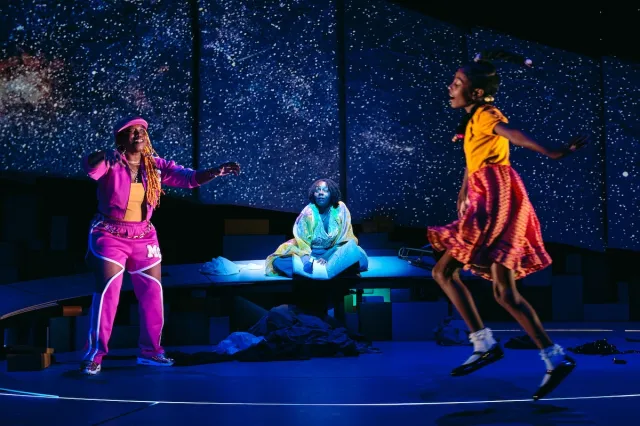
(© Valerie Terranova)
Mfoniso Udofia’s Creation Stories and All the Important Importants, now premiering at LCT3, straddles the distant worlds of mythology and biography. Her main character, The Grown Woman (who also shares her first name), is an artist, teacher, daughter, and hopeful future mother brawling with a cosmos of ticking clocks. Most of all, she’s an individual cursed with the mandate to be exceptional.
“Creation Stories is the play that I was writing to figure out the thing I needed,” says Udofia, whose own exceptionalism has landed her huge TV credits from the A League of Their Own series to 13 Reasons Why. It’s also manifested her monumental 9-play Ufot Family Cycle, produced in its entirety throughout the city of Boston for the past two years. See The Grown Woman drill her students on the elements of a properly structured narrative and you might glimpse the taskmaster that Udofia set out to shed with this piece about untethered creation.
“As somebody who is really interested in, and has taught, what it is to make a well-made play, it’s really scary,” she says. “But I cannot fall into the trap of writing something well-made.”
(© Tricia Baron)
The conversation has been condensed and edited for clarity.
You describe Creation Stories as a “fairy tale.” Why did that genre come to mind when the commission for this play gave you free rein to write whatever you wanted?
I have been obsessed with fairy tales since I was a young girl. When I was offered this commission, I think I went right back to the form that I’ve always loved. I knew it would be about a Black woman. I knew it would be a fairy tale for her. I thought it was going to be the happiest thing to ever happen like the first tales of my youth were. But because of some of the things that I was personally going through, what came out of me was the story of trying to build a life. And I was like, “All right, I guess that gets to be a kind of fairy tale too.”
You call your main character The Grown Woman, but she also shares your first name. How strong are the parallels between you two?
Strong enough that she can have a portion of my name. Now, the details aren’t all true. But the framework is me. I know what it is to go through an [IVF] cycle. I know what the heartbreak is. And I also know what it is to be a Black woman who has a dream for herself and knew that she would be able to make things work out if she just tried hard enough.
In your program notes, you say that this play asks the question, “What happens when an exceptional woman cannot exceptional her way through?” How much are the women in your audiences relating to that?
Women have been coming up and finding me after this play to talk about everything from IVF to feeling like you have to be the best in the room—there is an understanding I think with the women in the audience about clocks in a different way. It feels like it’s affecting the people that I’m hoping it will reach. It’s for anybody who is kind of trapped by that word “exceptional” to maybe consider that there are so many kinds of dreaming.
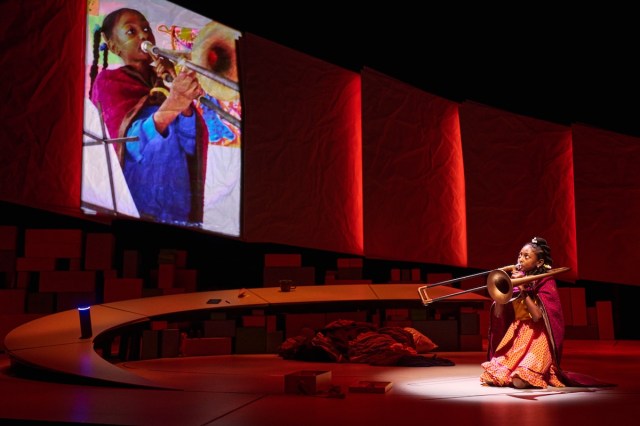
(© Valerie Terranova)
How would you say that word specifically burdens Black women?
I’m gonna talk from my own personal experience. To come up in this country and know you were meant for great things and also knowing that you have to work twice as hard. And that doesn’t mean you have 48 hours in a day. You still have 24. So you’ve just made yourself hyper-productive. I’m just offering an “I see you, I know you, I am you.”
Going back to your title, your play shows all different kinds of “creation,” from reproduction to art to the cosmos. Do you see them all as intertwined?
I absolutely do. I say in the beginning that this grown woman is powered by a spirit of creation. It’s why I start off with something really Nigerian, which is what I am. I take parts of our cosmology and pull them towards a framework for a woman who sees herself as not just a creator in the body, but artistically—a creator in the way that a Nigerian girl is like, “I am going to help in the creation of family.” In every way, she is a creator. So yes, for me all of these creations are intertwined. And all of them have really sticky blockages.
A lot of the creation we see onstage is classic make-believe play thanks to your Little Girl character. Did you always know you wanted the presence of a child onstage?
There was a while where we were considering whether The Little Girl could be played by a grown-up, and that might happen in a future production. But there is just something about little humans, especially around 8 to 12 years old, where you can feel their grown-up self sliding into view. I wanted that energy. And Savannah [Commodore] is exceptional.
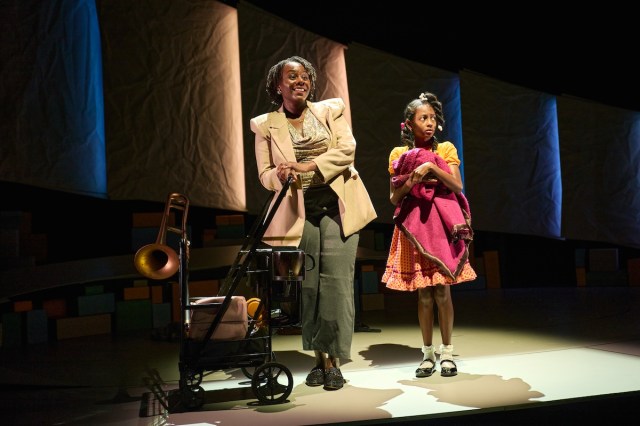
(© Valerie Terranova)
As are your other two actresses.
Abigail [Onwunali] has done the majority of my work. She knows my language and the way my words kick really, really well. And Donnetta [Lavinia Grays] is my heart. What is beautiful about Abigail and Donnetta is they’re also both playwrights and actors. I’m also a playwright and actor, so there’s a real understanding. And I tell you, Savannah’s probably gonna be somebody’s playwright-actor—and also doctor, because I know she wants to be a doctor.
While Creation Stories is premiering, you’re also in the middle of the massive two-year-long presentation of your entire nine-play Ufot Family Cycle across the Boston area. Speaking of hyper-productivity, how does it feel to see something this huge come to fruition?
It has been extraordinary. This Lincoln Center show is slotting in right at my down time before I have to run and do the last one, Adia & Clora Snatch Joy. I have said this so much to members of the Boston press, but living playwrights don’t usually get to see this at this scale. And now in Boston I walk into like my local CVS and people are like, “I just caught the show!” It has become a community event. I haven’t been able to sit in the excitement of it because I’ve been in the build, but I suspect that after Adia & Clora goes down, I’m gonna have a huge cry.
How are you at being still and taking time to pause and reflect? That’s one of the lessons I took from Creation Stories, but have you taken that lesson for yourself?
I am admittedly not good at it. I cannot lie, because I know that this is gonna hit the press and when people are reading it and I go, “Yes I have,” they’re gonna call me and be like “Yo, not true.” [laughs] What has happened though, is I have started cutting portholes for myself and one major one is gonna be happening after Adia & Clora. I’ve decided to go away for a couple of months and just not focus on production. I’ll see if I can do the very thing I am asking us all to do in Creation Stories.




source on Google
Featured In This Story
Latest Reviews
See all


Latest Videos
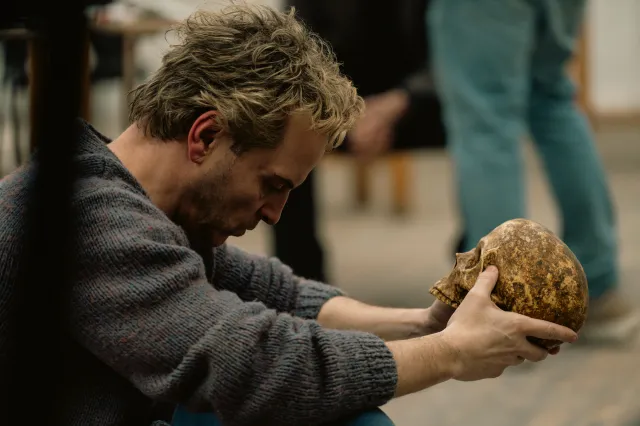
Watch the Trailer for Elsinore Starring Andrew Scott
The film is based on the true story of Ian Charleson, who played Hamlet at London’s National Theatre after being diagnosed with AIDS.