
Review: In Joe Turner's Come and Gone, Ruben Santiago-Hudson Casts His Eternal Spell
Debbie Allen directs August Wilson’s 1988 drama, which also stars Taraji P. Henson and Cedric the Entertainer.
 |
Broadway
|
|
Broadway
|
April 25, 2026

(© Julieta Cervantes)
In August Wilson’s published intro to Joe Turner’s Come and Gone, the play representing the 1910s in his century-spanning Pittsburgh Cycle, he sets the scene for “the sons and daughters of newly freed African slaves” who “wander into the city…cut off from memory…dazed and stunned, their heart kicking in their chest with a song worth singing.”
There’s a spiritual restlessness, the play argues, that plagues you until you can find your very own song, unburdened by the lingering melodies of the harrowing past. It’s that pursuit of a song, Wilson’s apt metaphor for the diaspora of the enslaved — some born into freedom in the north, some recently migrated, some still pursued by memories of childhoods on plantations — that resonates most in Debbie Allen’s heartfelt but inconsistent revival at the Barrymore Theatre.
Joe Turner’s Come and Gone, which premiered in 1988, is one of Wilson’s more observational plays: he watches the residents of the Hollys’ Pittsburgh boarding house at a bit of a remove. Fleeting are the moments with only two characters onstage. More often, everyone’s in each other’s business, taking note of private conversations from across the parlor and kitchen. As a result, it’s up to each production to redetermine who in this ensemble carries the aura of main character.
It could be Seth (Cedric the Entertainer) and Bertha (Taraji P. Henson), the lord and lady of the boarding house, whose gentle sparring starts several scenes. It could also be Herald Loomis (Joshua Boone), the enigmatic preacher searching with his young daughter (Savannah Commodore) for the wife (Abigail Onwunali) who vanished while he was kidnapped and sold onto a chain gang by the convict-leasing Joe Turner— a part-historical, part-mythical figure who would illegally capture Black men around the turn of the last century.
In this case, though, Allen’s production sings most through Bynum Walker (Ruben Santiago-Hudson), the “conjure-man” who specializes in binding souls together. What’s particularly magical about Santiago-Hudson’s performance is how he manages to flip the audience’s relationship to Bynum as it exists on the page. Wilson opens the play with Seth and Bertha spying from their kitchen as Bynum performs a ritual across the way. Seth is convinced that Bynum’s drinking pigeon blood. We meet Bynum very fully, then, through the perspective of cynical, earthbound Seth and his skepticism about Bynum’s beliefs.
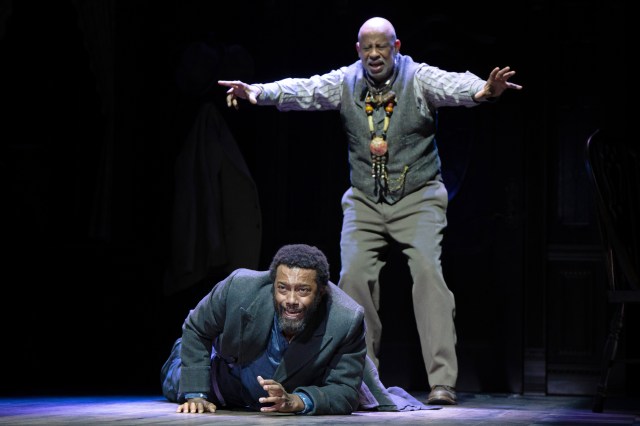
(© Julieta Cervantes)
But Santiago-Hudson renders the conjure-man with so much grounding, warmth towards his neighbors, and, in his retelling of his own long search for self-knowledge, unexpected vulnerability, that he swiftly becomes the character whose point of view anchors the production. Through his performance, Bynum’s mythical lexicon — spiritually binding people together, seeking “shiny men” who know the secret of life, and finding songs with the power to heal — becomes the play’s native language, the logic through which we can understand the story’s unearthly unspooling.
With that setup, Allen’s production is a letdown in the moments when we’re most meant to experience Loomis’ spiritual torture and transcendence through the lens of Bynum’s beliefs. At the end of the first act, as Bynum guides a seizing Loomis through describing his visions of bones walking on the water, Allen choreographs the rest of the cast to move together in slow-motion, a quasi-interpretive dance occasionally accompanied by flashes of lightning. But breaking the verisimilitude by using the actors as an abstract ensemble rather than allowing the characters to react to the scene as individuals dilutes the impact of this surreal turning point. David Gallo’s set, with its wall-less house, free-floating windows, and precisely-rendered kitchen, seems similarly to exist between reality and myth.
More consistently challenging is Boone’s writhing performance as Loomis, an interpretation that never aligns with Wilson’s description of “a man driven not by the hellhounds that seemingly bay at his heels, but by his search for a world that speaks to something about himself.” He seems violently haunted by the past at all times, his trauma manifesting as something closer to demonic possession. It’s hard to buy that even sweet, susceptible boarder Mattie (Nimene Sierra Wureh) sees something solid enough inside him to feel attracted. And since Loomis’s last shocking act seems motivated here by distorting madness rather than clarifying epiphany, Wilson’s finale loses much of its liftoff towards otherworldly enlightenment.
Regardless, there’s plenty here to ensure that audiences will recognize the preeminence of Wilson’s writing, even without flawless execution of the play’s slow-burn tension. Cedric and Henson each bring the right mix of salty edge and tender gravity to their scenes together. While Seth and Bertha don’t have much room to grow in the play, Henson is especially gifted at suggesting the emotional history of a woman who’s learned to balance strategic self-effacement with wistfulness.
Allen is canny in her casting of some smaller roles. Wureh is a particular triumph as the lovelorn Mattie, boiling a seemingly infinite youthful capacity for love and a hard-earned sadness in the same pot. Tripp Taylor offers coy fun as the friendly young flirt with philandering, wandering eyes. Commodore turns truly moving in the final scene,
And then there’s Santiago-Hudson, whose richly rendered Bynum instantly persuades us of the power of belief, of ritual, and of song. In doing so, this August Wilson veteran also makes the case for the transformational power of theater, too.

(© Julieta Cervantes)




source on Google
Featured In This Story

Latest Reviews
See all









Latest Videos

Watch: Ellen Greene Reflects on the Enduring Legacy of Little Shop of Horrors
Frank Oz’s cult classic movie-musical has gotten a new 4K restoration in celebration of its 40th anniversary.