
Review: The Wedding March Is More Tone Poem Than Play, but It’s Still Seductive
Rosalba Rolón’s adaptation of Judith Ortiz Cofer’s collection of stories runs at the Puerto Rican Traveling Theater.
 |
Off-Broadway
|
|
Off-Broadway
|
April 21, 2026
(© Krystal Pagán)
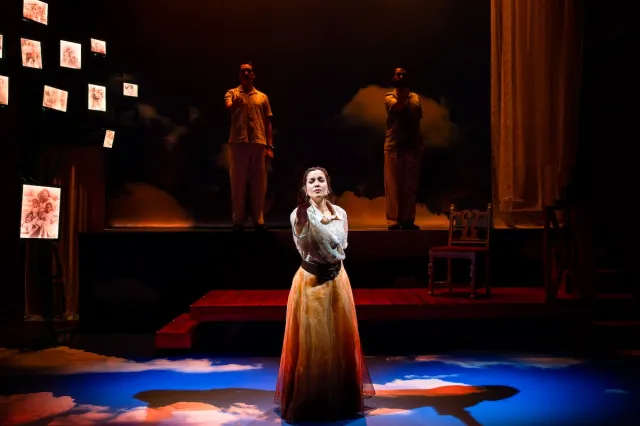
Thirty-five years ago Judith Ortiz Cofer’s PEN-awarded 1990 memoir Silent Dancing: A Partial Remembrance of a Puerto Rican Childhood provided rich source material for the Puerto Rican Traveling Theater (now allied with the company Pregones and housed in 1888 firehouse turned jewel box theater). As adapted by company founder Rosalba Rolón and revived by director Rosal Colón, this dramatization titled The Wedding March is a bit of a patchwork but engaging from word one, thanks to a trio of polished actors and the celestial assistance of a string quartet sequestered behind a cloud-dotted sky-blue scrim provided by set designer Omayra Garriga Casiano.
The first element to catch the eye is a green tower of small video screens displaying black-and-white portraits—a family tree alluded to in the text as “The Tree of Life.” Upstage right, a rocking chair awaits, auguring the arrival of a storyteller of some sort—an elder with lore to hand down, most likely. Instead, we get young and vibrant Jenyvette Vega, who’s too busy enacting folk tales and wisps of memoir ever to settle in. Costumed by Eliana Yost like a campesina in long, belt-cinched culottes and a lace blouse, Mujer (“Woman”) could be a time traveler from any era and she will explore a few.
When the photo lowest on the tree lights up, Mujer introduces her parents, who “look like children”: her mother, two weeks shy of fifteen, “has a slightly stunned expression.” Young Mujer wouldn’t get to know her father (“this solemn stranger”) until age three. With few other options on the impoverished island, he joined the Navy in 1951 to support his family.
The script skips to the mid-‘60s: high school. Woman’s Father (Fernando Contreras, filling in various roles as “Man”) briefly takes over as narrator, lamenting the fact that she has “in the great tradition of tragic romance, chosen to love a boy who is totally out of her reach.” Rendered starry-eyed by a fleeting kiss bestowed by the object of her adoration (Fernando Contreras as “Hombre”), she eventually comes down to earth, reassessing the moment as a mere “trophy for his ego.” She chafes against a culture in which “an adolescent girl was watched every minute…as if you carried some kind of time-bomb in your body.”
So far, relatively generic. It’s in the second half of the program that the script sparks to life. Mujer edges into a series of reminiscences and folk tales that really crackle.
(© Krystal Pagán)
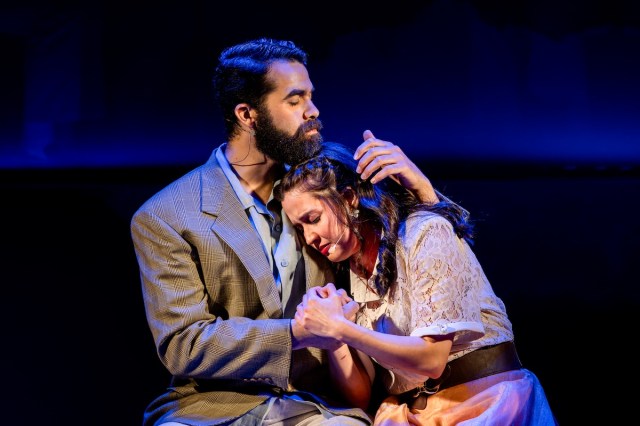
The first involves a turn in the sacred Rio Rojo reserved for young women, two of whom fall in love—pretty adventurous material for three decades ago, and the story turns out to have a decidedly contemporary twist. Vega, a strong singer, accompanies the girls’ tryst with a lovely traditional borinqueño ballad, “Un cielo azul” (songs aside, the play is performed 99% in English, with a side panel showing the text in Spanish).
The following section, starting with “Había una vez” (“Once upon a time”), introduces a classic Puerto Rican cuento reminiscent of the Brothers Grimm. Folk heroine María Sabida (Vega) sets out to bring down a murderous local marauder (I could swear that Gabriel Leyva, as “Ladron,” starts out subtly channeling Trump). Gaining the outlaw’s trust, she not only triumphs but tames him, via trickery. “It’s better to conquer than to kill,” Maria observes, giving her breasts a proud hoist.
This moment of smart female supremacy makes for an interesting segue to a section examining how young country girls can fall for false suitors, swallowing their lies right up to an empty altar. The story of “María La Loca,” rendered permanently addled, is a heartbreaker: Though she has “the thick body and wrinkled face of an old woman,” she skips about town peddling pasteles “like a grotesque Little Red Riding Hood.” The moral: She “allowed love to defeat her.”
So let that be a lesson. The brief (65-minute) program would make good family fare for adolescents on up, despite (or even because of) this haunting, cautionary finale. There’s a reason the viejas spent their relatively quiet afternoons—men at work, boys busy at sports—passing down stories whose warnings still hold water.




Featured In This Story

Latest Reviews
See all

Latest Videos

Watch: Zachary Noah Piser Performs "Where You Belong" From Maybe Happy Ending
This record is going right next to Gil Brentley Jazz Orchestra 1957.