
Review: Kelli O’Hara and Rose Byrne Are a Great Slapstick Duo in Fallen Angels
They both star in Roundabout Theatre Company’s excellent revival of an early Noël Coward play.
 |
Broadway
|
|
Broadway
|
April 19, 2026
(© Joan Marcus)
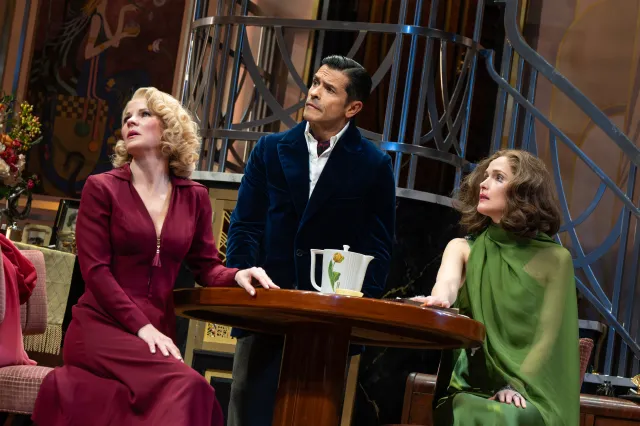
Among the many pleasures of Roundabout Theatre Company’s new revival of Noël Coward’s Fallen Angels is seeing a relatively unfamiliar side of a veteran performer you thought you knew. Kelli O’Hara, one of the production’s two headliners, has at this point become something of a grand dame of musical theater, her soaring soprano associated with deluxe revivals, new musicals on serious subjects, and opera. Though O’Hara is no stranger to comedy (her turn as Lili Vanessi in a revival of Kiss Me, Kate was only seven years ago), it certainly feels like a long while since we’ve seen this singing diva cut loose to the degree she does in Fallen Angels.
It helps that she not only has a great scene partner in co-star Rose Byrne but is also working with terrific material. Fallen Angels is one of Coward’s earliest plays (1925), but the wit and wisdom that mark the great British playwright’s more popular later work are already evident. The plot revolves around the conflicted emotions that develop between longtime friends Julia Sterroll (O’Hara) and Jane Banbury (Byrne) when they get wind of an old flame of theirs, Frenchman Maurice Duclos (Mark Consuelos), coming to London nine years after they both had affairs with him.
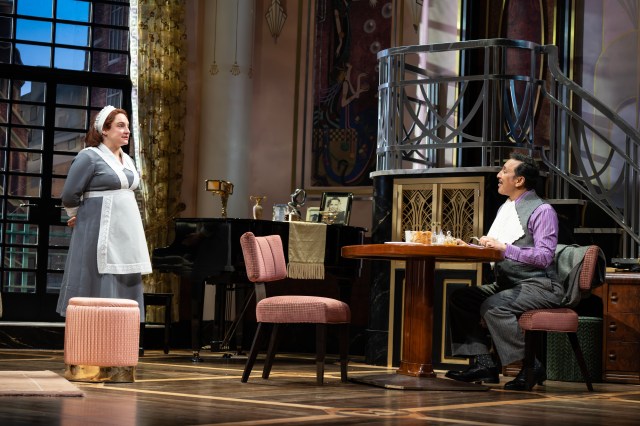
As with all of Coward’s best comedies, deeper truths course beneath the frothy surface. Both having settled into quiet lives with their husbands, Fred (Aasif Mandvi) and Willy (Christopher Fitzgerald) respectively, Maurice’s return suggests the reawakening of long-dormant youthful passion. Its progressive-for-its-time depiction of women talking frankly about their sexual desires remains as fresh as ever today, as does its lampooning of male fragility when confronted with such forthrightness in a society that prizes good manners above all. Speaking of the upper class, there’s also the Sterrolls’ new maid, Saunders (Tracee Chimo), whose well-traveled nature becomes a running joke while offering a pointed contrast to the insularity of the high society she serves.
Coward’s attention to character detail is just as well-honed as his satirical precision. Both Julia and Jane are given distinctive personalities, with Julia the more practical of the two, and Jane relatively more free-spirited and willing to give in to her immediate emotions. Or at least, these two characters feel distinct as Byrne and O’Hara play them under Scott Ellis’s sure-handed direction. Fallen Angels demands artists who can tap into a sense of controlled irrationality, of anarchy always threatening to break through a careful veneer. It’s a measure of how well this production conjures up that feeling throughout that even the occasional moments where Ellis’s control slightly falters—an overplayed gesture here, a too-carefully executed bit of slapstick there—don’t puncture the success of the whole.
(© Joan Marcus)
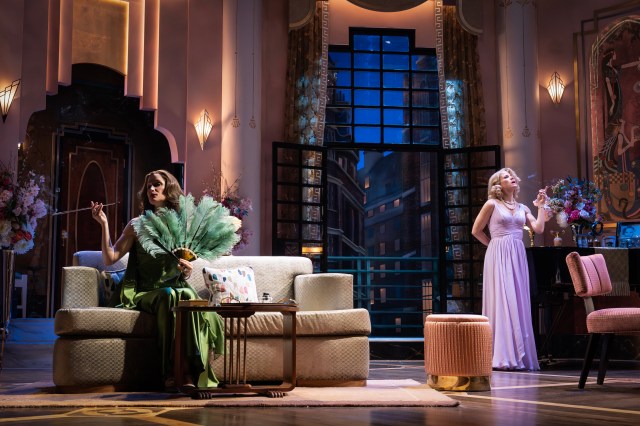
The comic pièce de resistance of this three-act play (presented in an uninterrupted 90-minute span in this production) comes in its second act, when Julia and Jane let their ids fly freely under the influence of one too many champagne refills. Beyond the hilarity of seeing these two classy ladies sink to the primal level of teenagers arguing over a love interest, there’s the spectacle of seeing Byrne and O’Hara tossing off bits of physical comedy as if they were coming up with them right on the spot. And yet, even as they find amusing ways to chug champagne or light their cigarettes from one flame, they stay meticulously in character. O’Hara remains unflappable even when slurring her words, while Byrne becomes so overwrought that she even makes an aural meal out of the way she uses her utensils to tackle a steak. (Fittingly, hair and wig designers David Brian Brown and Victoria Tinsman have given Byrne a wildly frazzled wig in the morning-after third act, while O’Hara’s hair remains immaculate as ever.)
There’s plenty more to enjoy in Fallen Angels. Chimo is a scene-stealing delight as Saunders, while Mandvi, Fitzgerald, and Consuelos take their male characters to the brink of caricature without falling into the pit. Scenic designer David Rockwell has housed the comic proceedings in an appropriately luxurious, well-appointed set, and Jeff Mahshie’s costume design is similarly intoxicating in its glamour.
But Byrne and O’Hara are the main reasons to see this excellent revival. In O’Hara’s case, one could even call this production revelatory, given not only how unexpected it is to see her tap into her inner farceur but how stellar she turns out to be at it.
(© Joan Marcus)




source on Google
Featured In This Story

Latest Reviews
See all


Latest Videos
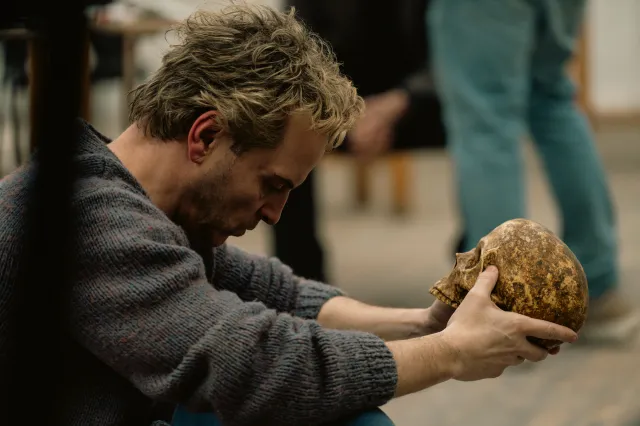
Watch the Trailer for Elsinore Starring Andrew Scott
The film is based on the true story of Ian Charleson, who played Hamlet at London’s National Theatre after being diagnosed with AIDS.