
Review: Girl, Interrupted Re-Enters the Mental Health Chat, This Time With Music
Martyna Majok and Aimee Mann ‘s musical adaptation premieres at the Public Theater.
 |
Off-Broadway
|
|
Off-Broadway
|
June 4, 2026
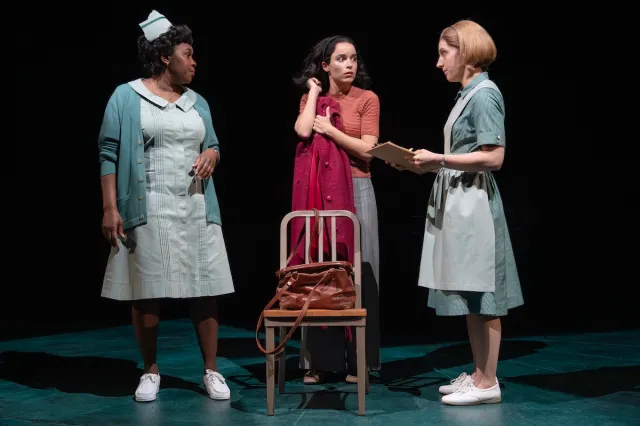
(© Joan Marcus)
When Girl, Interrupted (both Susanna Kaysen’s original memoir and its starry film adaptation) moved the needle of America’s mental health conversation in the 1990s, there was no anticipating the day when pop stars and influencers would be detailing their bipolar diagnoses on the same platform they use to share sunset beach selfies. Mental illness has become so ubiquitously pathologized, we’re left to wonder if there’s any room in today’s climate for it to be poeticized, or if there’s even an appetite for it. The recent Broadway revival of Proof, another relic of the turn of the century, bumped into that question, and now, Girl, Interrupted, in its new musical form premiering at the Public Theater, is visibly unsettled in its own answer.
For those new to Kaysen’s story, the piece looks back on the young women with whom she spent 18 months of the late 1960s at a psychiatric hospital. McLean Hospital to be exact, an important detail considering its history of treating tortured artists like Robert Lowell, Anne Sexton, and Sylvia Plath. Aimee Mann, who pens the songs in her recognizably earthy and haunting style, even writes one called “Robert Lowell and Sylvia Plath.” It’s one of the many songs for the show she released on her 2021 album Queens of the Summer Hotel, a title aptly pulled from the Anne Sexton poem “You, Doctor Martin.” (Sally Shaw, as the childlike Polly covered in self-inflicted scars, sings the album’s most memorable tune, “Burn It Out.”)
Mann’s contributions to the production certainly lean poetic and jell best with playwright Martyna Majok’s book when both are exploring the overlap between art and madness (the design collective dots fittingly builds the set around a cylindrical piece that stands in for the Frick museum, home to the memoir’s titular Vermeer painting). Susanna (Juliana Canfield) immediately claims her identity as a writer, as does her roommate Grace (Mia Pak). Grace is the one who sings “Robert Lowell and Sylvia Plath,” a too-clear-eyed analysis of bipolar disorder to convince us it belongs anywhere other than on a concept album (Pak performs it beautifully).
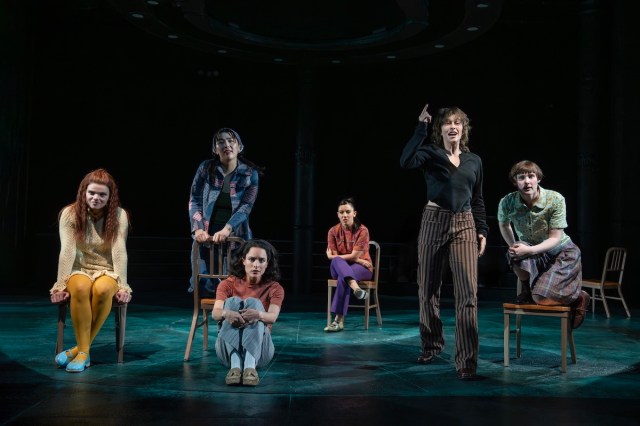
(© Joan Marcus)
Even so, it’s an interesting look at classic dichotomies: Insanity and brilliance. Pain and beauty. They give Majok permission to be her soft, expressive self without committing the cardinal sin of “romanticizing” mental illness. Meanwhile, she periodically reminds us of war, political assassinations, and the confounding gender politics ruling the female patients’ outside world as if to say, “What is sanity when the world is insane?” More than a few of us are wondering that right now.
But these are only shining moments in a muddled journey that works overtime to dodge any problematic trappings of glamour. Jo Bonney directs with a simplicity that rolls into monotony, not helped by a collection of songs that suffer from sameness (Heather Gilbert’s lighting design is similarly afflicted with a uniform dark moodiness). Canfield, who wowed in her Tony-nominated Broadway debut in Stereophonic, is a strong anchor as our narrator and protagonist Susanna. And yet, she and the machinations surrounding her lack the impression of something dangerous or inconceivable curdling beneath the surface.
Manoel Felciano and Lauren Jeanne Thomas add moments of dreaminess as onstage musicians (when they’re not in character as The Male Presence and Nurse Judy), but it’s only a half-measure in creating a metaphorical space. Brilliant choreographer Sonya Tayeh’s presence on the creative team also feels like a false promise of lyrical movement and visual storytelling, both of which are conspicuously missing from this stagnant production. What we’re left with is with a collection of fine performances, but ones that mostly live in their own separate bubbles—not what you want from a story that hinges on the curative power of female friendship in the unlikeliest of places.
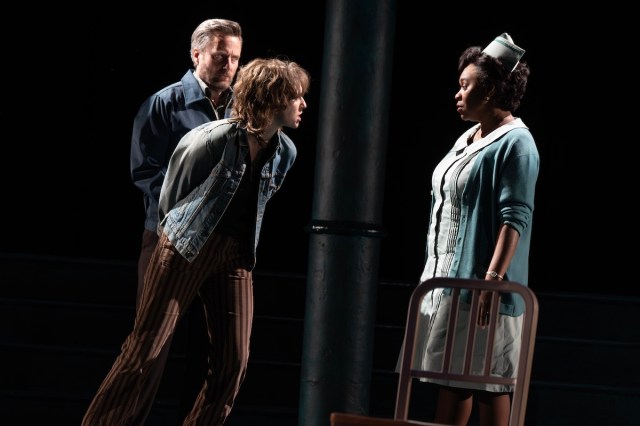
(© Joan Marcus)
King Princess (recently seen on screen with Hugh Jackman and Kate Hudson in Song Sung Blue) takes on the pivotal role of Lisa, the magnetic, jail-breaking antagonist that made an Oscar winner of Angelina Jolie. Princess plays Lisa, a proud sociopath, as harsh and volatile, but instead of using her air of mystery to play catch and release with people’s feelings, she just makes sure to always have them running scared. The highlight of her performance becomes her tender scene with Tori (an excellent Gabi Campo), a drug addict from Mexico prematurely yanked from the hospital. Meanwhile, her interactions with Daisy (Katherine Reis), the character who notoriously hordes chicken carcasses under her bed, are left toothless.
Then there’s the fact that actresses as wonderful as Ta’Rea Campbell (as the ward’s head nurse Valerie) and Emily Skinner (as elegant psychiatrist Dr. Wick) fade into the background—proof that narrative real estate is still being sorted in this early iteration of Girl, Interrupted. There’s plenty of beautiful, delicate, heartfelt work in the mix. But whatever the blend of complicating pathologies, this girl still feels fettered.




source on Google
Featured In This Story
Latest Reviews
See all


Latest Videos
Alden Ehrenreich Stars in New Carly Rae Jepsen Music Video, Directed by Jeremy O. Harris
“Don’t Leave Me on the Dance Floor” is the latest from the “Call Me Maybe” singer-songwriter.