
Review: Disruption Asks, Would AI Make Better Life Decisions Than You?
Andrew Stein’s drama makes its New York debut at Pershing Square Signature Center.
 |
Off-Broadway
|
|
Off-Broadway
|
August 3, 2026
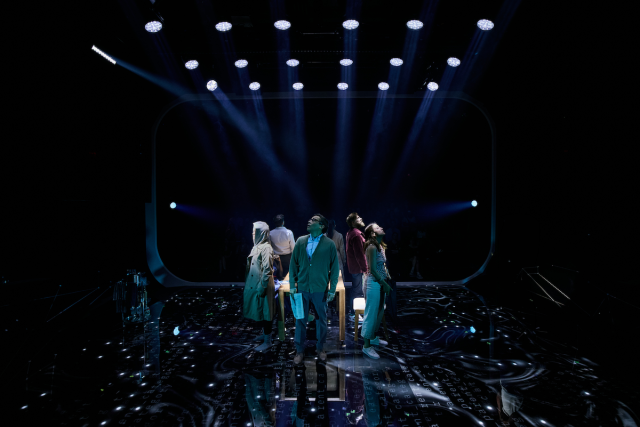
(© Emilio Madrid)
It’s by now uncontroversial to claim that the confluence of big data and artificial intelligence will radically change our lives. Intrepid playwrights are in a race to turn that development into the next great American drama by posing the big questions the theater is best suited to ask. Particularly successful examples of the budding techno-drama genre are Matthew Libby’s Data, Jordan Harrison’s The Antiquities, and Harrison’s Marjorie Prime (Harrison premiered this play in 2014, making him both a pioneer of the field and one of its most prolific contributors).
On a lesser tier is Andrew Stein’s Disruption, now making its off-Broadway debut at Pershing Square Signature Center (the world premiere was at London’s Park Theatre in 2023). The slick production from director Hersh Ellis and excellent performances from a cast of stage veterans do much to make this two-hour, 10-minute drama palatable. But they can only do so much to spruce up a script that is simultaneously too ambitious in scope and too timid in execution.
Stein introduces us to three married couples in quick succession: Columbia professor Ben (Conrad Ricamora) enters the kitchen of his Upper West Side apartment to tell psychoanalyst Suzie (Shaunette Renée Wilson) that he has canceled their evening plans in favor of a sudden dinner reunion with their old friend Nick (John David Washington), a wildly successful tech entrepreneur. “He’s kryptonite to marriage,” Suzie remarks bitterly, fondling a box of pastries.
All their friends will be there, including magazine art director Paul (Joe Tippett) and lawyer Jill (Elizabeth Stanley), even though they really should be focusing on their kid’s upcoming interview with Fieldston. Also attending are surgeon Barry (Jason Ralph) and his wife, Mia (Irene Sofia Lucio), who will bravely rip herself away from perusing Brooklyn real estate porn to hear Nick and his beautiful young business associate Raven (Emma Kikue) pitch an offer none of them will want to refuse—computer has foreseen it.
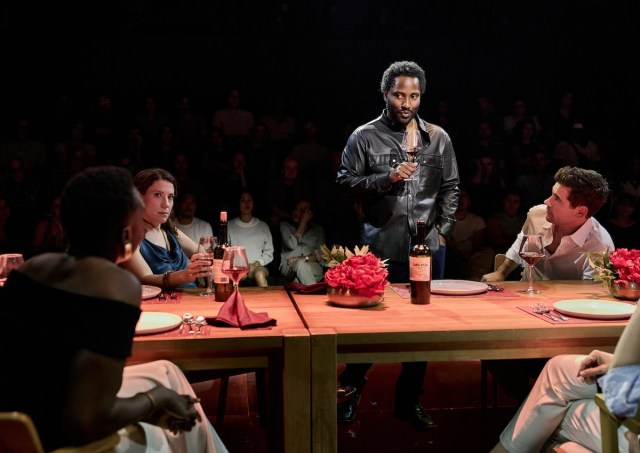
(© Emilio Madrid)
Nick and Raven have developed an algorithm that not only predicts how people will behave, but can determine the way they should behave, offering the most optimal decision-making for lifemaxxing. Nick ostensibly wants to let them into the next investment round (minimum investment: $500,000), promising that this technology will make them all rich. What he’s not telling them is that he and Raven are secretly using this racially diverse group of friends to beta-test their product, manipulating their personal lives in the name of science and commerce.
It’s not like we don’t willingly do this already, fracking our brains for value every time we fire up Instagram. Stein imagines the logical next step, in which we surrender independent decision-making to a being privy to trillions of data points and therefore theoretically more equipped to choose for us. This is also already happening: Friends with teenage children all report the ubiquity of AI companions that suggest media to consume, food to eat, and clothes to wear. “We’re losing the ability to think for ourselves,” Suzie ominously responds to Nick’s Silicon Valley optimism.
The problem is, Stein never really gives us a sense of the stakes of that outsourcing of thought. With one notable exception, all the decisions made are ones that these characters probably would have come around to on their own, that we the audience see coming from those first scenes. In lieu of disturbing questions about the cost of relinquishing control over our own lives, Disruption settles into the rhythm of something less dramatically satisfying: a soap opera.
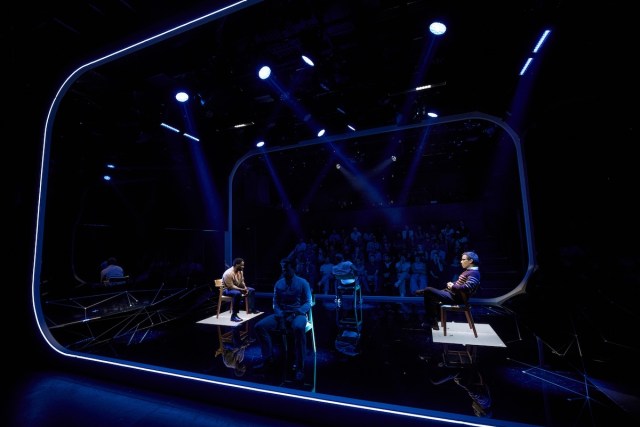
(© Emilio Madrid)
The performances keep us engaged. Wilson is especially fierce as Suzie, a powerful voice of dissent against a transformation that we’ve all been told is inevitable. I was ready to send her to Congress. Ricamora sensitively navigates a series of frustratingly inconsequential plot twists for Ben, selling them with warmth and humanity. Stanley and Tippett gave me genuine agita as a middle-aged couple holding on by a thread. And Washington artfully walks his charisma right up to the border of sociopathy. Revealing the depth of his data-mining to Suzie, he hisses, “We’re both genetically resistant to tooth decay,” his voice dripping with menace.
While certain beats necessarily give way to camp, Ellis directs an energetic staging that crams the hallmarks of an upper-middle-class issue play (so much drinking and fighting) into a sleek futuristic package. Zoë Hurwitz’s set resembles a giant ovular iPhone, a digital canvas for Yana Biryükova’s busy video design, which depicts the algorithm as a giant neural network, creates literal paths of light between characters as they connect, and bludgeons us with not-so-subliminal messaging (the word “yes” appears hundreds of times as Nick and his friends dance and do shots). It’s a fair physical manifestation of the vulgarity of persuasion in the TikTok age, garishly augmented by Reza Behjat’s aggressive lighting and Caroline Eng’s dopamine-stimulating sound. This is your brain on tech.
Unfortunately, Disruption is not the game-changing drama it wants to be. It’s The Big Chill for millennials, mistaking the midlife crises of a bunch of overprivileged New York professionals for the wider travails of an entire generation standing on the threshold of techno-serfdom. It’s true that those with significant investments in AI stand to hugely benefit—but don’t we hear from them enough? Disruption represents a missed opportunity to really examine what we’re trashing in our zeal to move fast and break things. In many cases, once they’re broken, they’re gone for good.




source on Google
Featured In This Story
Latest Reviews
See all
Latest Videos
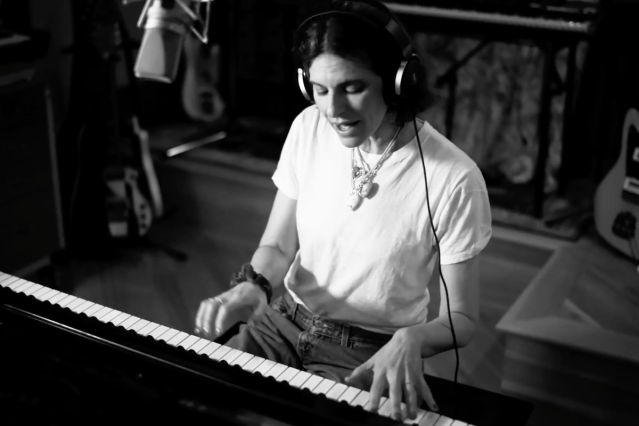
Watch Lindsey Kraft, Featuring Ben Folds, Sing "Beautiful Pain" From the Musical We've Been Here Before
We’ve Been Here Before starts performances on August 4 at SoHo Playhouse.