
Review: How to Put Down the Weight of Your Past, the Theater of Self-Help
Tommy Vines debuts her two-person play at the American Mime Theatre.
 |
Off-Off-Broadway
|
|
Off-Off-Broadway
|
July 27, 2026
(© Ken Yotsukura Photography, LLC)
Self-help is a major industry in America, with books like Atomic Habits regularly topping the bestseller list and motivational speakers like Tony Robbins charging thousands for premium tickets to his in-person events. It’s at a similar seminar that Tommy Vines sets her play, How to Put Down the Weight of Your Past, now premiering with Breaking Motion at the American Mime Theatre.
We can’t say she didn’t warn us. At the top of the show, we see a projection reading, “You really shouldn’t go to an ‘experimental immersive show’ in New York City.” And depending on your tolerance for uncomfortable audience interaction and inscrutable trauma dumping, you might just regret not heeding that cautionary note.
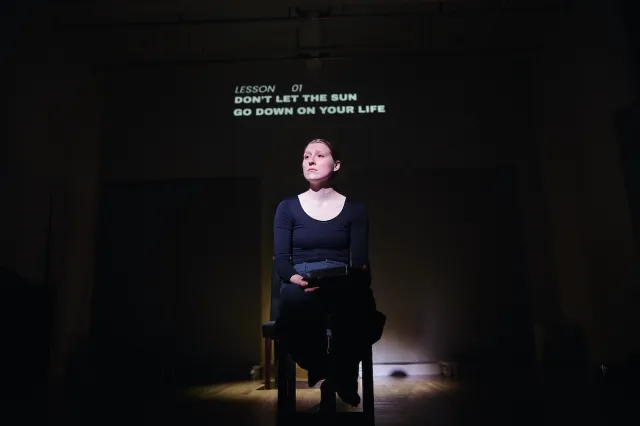
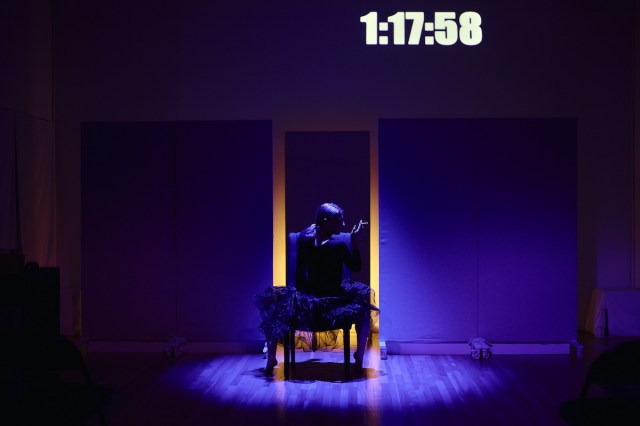
Vines performs the central role of “nameless,” leading us through a series of tongue-in-cheek “lessons” like “Master Your Emotions” and “Don’t Tell Anyone the Truth,” again projected on the upstage wall. There is also a timer counting down the 90-minute runtime, a flex that doesn’t work quite as well here as it did in the Broadway revival of Oedipus, partially because it (blessedly) only takes 60 minutes for this show to reach its baffling conclusion. Perhaps this is just to give us a visceral appreciation for lesson two: “Don’t trust anyone,” least of all a writer-performer.
(© Ken Yotsukura Photography, LLC)
Vines conscripts members of the audience (beware the first two rows) to play opposite her from their seats. “You took my virginity,” she said to an older woman seated behind me at the performance I attended. “Was it good? Did you like it?” Later, she sat knee-to-knee with a man in the front row, looked him dead in the eye, and said, “I’ll never forgive you for what you did.” It’s a bit like Every Brilliant Thing, except it leaves the audience more receptive to the idea of suicide.
As the show progresses, Vines seems to abandon the premise of a satirical self-help seminar for a multigenre format that feels a lot like a senior thesis project at drama school. She serves saltine crackers and a mysterious yellow liquid to the audience. Late in the show, she performs an underwhelming disappearing act (Jim Vines is the magic consultant). And she even treats us to that old chestnut of self-indulgent solo performance, a creepy marionette lip-sync to Peggy Lee’s “Is That All There Is?”
Vines is an undeniably gifted physical performer, with a ballet dancer’s control over her body and a clown’s ability to contort her face into any number of gruesome masks. And if this was her senior thesis at drama school, she would almost certainly pass with flying colors, having satisfyingly displayed all the ways she has mastered her craft.
But as an experimental play, How to Put Down the Weight of Your Past suffers from the deadly combination of a promising concept and a masturbatory execution, chock-full of scenes that seem that have a tremendous amount personal significance to the performer but fail to connect with the audience.
(© Ken Yotsukura Photography, LLC)
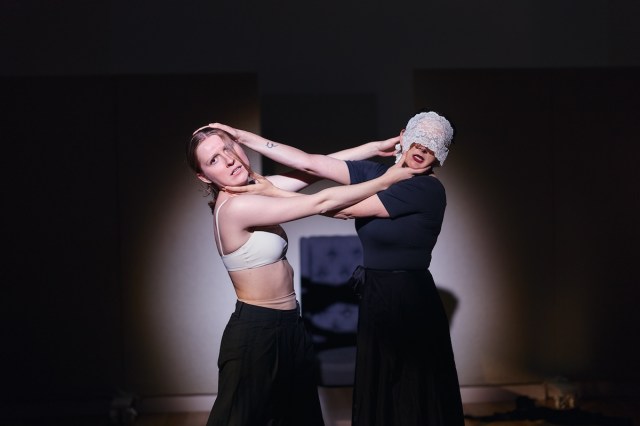
The addition of a second performer, Kirsten Kilburn as “the other one,” doesn’t do much to help matters, though it does take some pressure off the audience. As Kilburn incants a gushingly sincere voicemail into a microphone, Vines makes comments to the audience like, “God, what an insufferable bitch, right?” Later, as Vines seems to be having a mental breakdown, shouting incoherently at the audience, Kilburn sings “After You Get What You Want You Don’t Want It” into a bullhorn. It’s the kind of frenetic cacophony that is meant to feel profound in some unarticulated way the audience surely won’t question.
I’m not sure there’s much director Madeline Riddick-Seals could have done to clean up this mess, short of sending Vines back to write a new play. Also serving as set designer, she delivers an appropriately spartan production. The high-backed blue chair that is the one major set piece looks like something one might find in the dining room of a particularly humorless Westchester attorney. Lighting designer Gwen Trublood creates an impressive number of moods using only three LEDs and a scoop light. Sound designer Irene Wang has adequately rendered the requisite sound collages and competently executes the live voiceovers. It’s a decent production for a play that will leave you shrugging, unburdened by the weight of instantly forgettable theater.




source on Google
Featured In This Story

Latest Reviews
See all


Latest Videos

Watch Lindsey Kraft, Featuring Ben Folds, Sing "Beautiful Pain" From the Musical We've Been Here Before
We’ve Been Here Before starts performances on August 4 at SoHo Playhouse.