
Review: Ayo Edebiri and Don Cheadle Try to Solve a Precise but Passionless Proof
Jin Ha and Kara Young also star in David Auburn’s Pulitzer Prize-winning drama, directed by Thomas Kail.
 |
Broadway
|
|
Broadway
|
April 16, 2026

(© Matthew Murphy)
Twenty-six years on, David Auburn’s Pulitzer Prize-winning Proof hasn’t lost its ability to surprise. That first-act finale, the moment in which this good play becomes a great one, still lands as a genuine shock, the kind that can earn a gasp whether delivered by Mary-Louise Parker on Broadway or by my friend Alex at her community theater on Long Island. The power of the text simply endures, even when you’re just reading it.
Proof is so structurally sound that any production can have an impact, which is both a gift in theory and a potential liability in practice. Both sides of that equation are why Thomas Kail’s current Broadway revival at the Booth Theatre is generally effective, but rarely as emotionally charged as it should be. It is rock-solid in its competence, which is ideal for the newcomers in attendance to see stars Ayo Edebiri and Don Cheadle up close. But those who know how thrilling this play could be will find themselves wishing for Kail to have done anything to test the play’s mathematical precision.
Edebiri (an Emmy winner for her turn as ambitious chef Sydney on Hulu’s The Bear) plays Catherine, a 25-year-old who put her life on hold to care for her father, Robert (Golden Globe winner Don Cheadle), a once-renowned mathematician whose genius eroded under the weight of mental illness. The opening scene, with its light, teasing arithmetical banter between father and daughter, contains the first of Auburn’s stealthily deployed surprises: it is, in fact, the eve of Robert’s funeral, and Catherine, acknowledging that she’s talking to the great man’s ghost, is afraid that she’s inherited her father’s instability.
That Robert is dead explains why his former student Hal (Jin Ha) has been busying himself upstairs, sifting through notebooks to ensure that his beloved mentor didn’t leave anything important undiscovered. A few of those notebooks do, in fact, yield bombshells. So too does the contentious presence of Catherine’s older sister, Claire (two-time Tony winner Kara Young), whose watchful concern curdles into control as she urges Catherine to move to New York under her care.
Proof is a deceptively simple work, a succession of two- and occasionally three-person scenes that move at a brisk clip, slipping back and forth in time while continuously springing revelations that recalibrate our understanding of what we’ve already seen. It’s at once an awkward love story, a tense psychological thriller, a whodunit about the nature of truth, and a meditation on the toll genius takes on those who live alongside it. There’s a reason why the play remains a staple of acting classes: in terms of scene work, it’s built like a Swiss watch.

(© Matthew Murphy)
You can be forgiven for forgetting that while watching Kail’s production, where much of the cast offers a surface-level interpretation of the text, with only occasional glimmers of the rigor the material demands. On paper, Edebiri seems like an ideal Catherine, with her wide, searching eyes and a mind that seems in perpetual motion. In practice, however, her interpretation is too narrow. Her Catherine is an angsty millennial crushed by her circumstances, rather than the charismatic enigma who strategically code-switches between vulnerability, sex appeal, and utter defeat.
Unfortunately, she and Cheadle never quite find each other in the necessary way; then again, Cheadle is the wrong type of actor to play Robert. His performance is earnest and affable, a far cry from the demanding and deluded academic giant the play insists he once was. His episodes of madness are played with the same benign warmth as his moments of lucidity, which blunts the contrast the script depends on.
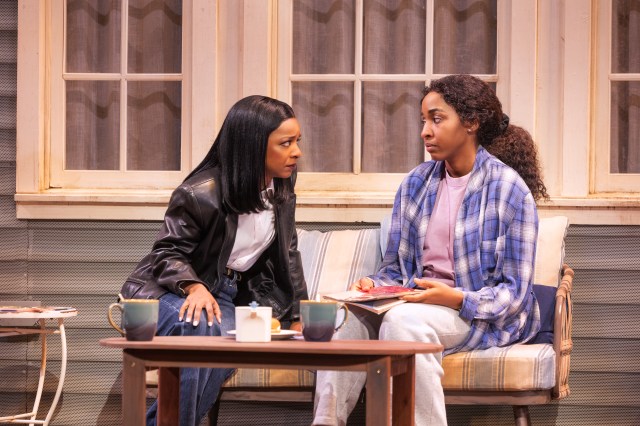
Casting Ha and Young as their counterparts heightens the imbalance: both are creatures of the stage who are operating with sharper theatrical instincts. Ha is a sweetheart as Catherine’s would-be suitor, while Young, a late replacement in the role, is effortlessly exasperated as the distant older sister. But Kail has inadvertently set up an uneven playing field, where these two performers consistently command the backyard rendered by designer Teresa L. Williams, while their more famous counterparts shrink into the overgrown grass that lines the perimeter.
Still, Kail stages the piece with a poetic elegance, if not the mystery the script deserves. Through Williams’s perspective-altering set, Amanda Zieve’s gentle lighting, and Dede Ayite’s workaday costumes, Kail’s rendering of Proof moves cleanly across time. It is underscored with mild piano melodies by Oscar-winning composer Kris Bowers (The Last Repair Shop), which fill the space and then vanish, much like Catherine’s thoughts.
In mathematics, a proof proceeds step by step, with each claim following logically from the last. By that standard, Kail’s production is sound, but soundness is not the same as revelation. Compared with more adventurous revivals like Becky Shaw, Death of a Salesman, and especially Cats: The Jellicle Ball, all of which bring a sense of risk and discovery to familiar material, this Proof feels most content to demonstrate rather than investigate. Everything adds up, but the theorem never comes alive.
(© Matthew Murphy)




source on Google
Featured In This Story
Latest Reviews
See all








Latest Videos

Watch the Trailer for Elsinore Starring Andrew Scott
The film is based on the true story of Ian Charleson, who played Hamlet at London’s National Theatre after being diagnosed with AIDS.