
Review: Hell’s Kitchen Ignites at the Pantages With Heart and Hits of Alicia Keys
A vibrant musical rises above jukebox formulas with standout performances and emotional depth.
 |
Los Angeles
|
|
Los Angeles
|
June 1, 2026

(© Marc J Franklin)
Alicia Keys’s semiautobiographical musical Hell’s Kitchen arrives at the Pantages Theatre with a compelling story, vibrant music, and a winning cast. Though relying heavily on Keys’s established catalog, the show never feels like a typical jukebox musical; the songs emerge organically, elevating both the drama and the characters.
Living in the heart of New York City, Ali (Maya Drake, in an impressive professional debut) is self-centered, pigheaded, and impulsive—in other words, a teenager. Her mother, Jersey (Kennedy Caughell), works two jobs to support them, yet Ali offers Mom little grace, meeting her with constant frustration. To be fair, Jersey—who made her own questionable choices as a teen—now overcorrects as a protective, hovering parent determined to keep her daughter from repeating those mistakes.
When Ali meets a young street drummer (Jon Avery Worrell), Jersey’s fears escalate, further straining an already fragile relationship. Ali charges ahead on adrenaline and youthful optimism, but an unexpected encounter with a piano teacher in her building (Roz White) sparks a creative awakening and reveals a talent she never knew she possessed.

(© Marc J Franklin)
Keys’s hit songs, including “Fallin’,” “Empire State of Mind,” and “Girl on Fire,” deliver the expected high-impact moments, translating seamlessly into theatrical showstoppers. Just as important are the songs written for the musical—“The River,” “Seventeen,” and “Kaleidoscope”—which ground the score in character and story, ensuring the emotional throughline never gets lost in nostalgia.
Kristoffer Diaz’s book takes a deceptively simple premise and gives it life and texture. The audience quickly invests in Ali, recognizing both her flaws and her potential, and rooting for the person she might become. There are no easy answers or divine interventions here, just complicated people, each carrying their own baggage, trying (and often failing) to guide one another.
Drake is no mere “bus and truck” discovery; she is unmistakably a star in the making. The production rests squarely on her shoulders, and she carries it with confidence, pairing a powerful voice with a vulnerability that keeps the character grounded and deeply human. Caughell matches her with an equally commanding performance, her vocals overflowing with emotional weight. In “Pawn It All,” Jersey reclaims her sense of agency in a moment that feels both personal and anthemic.

(© Marc J Franklin)
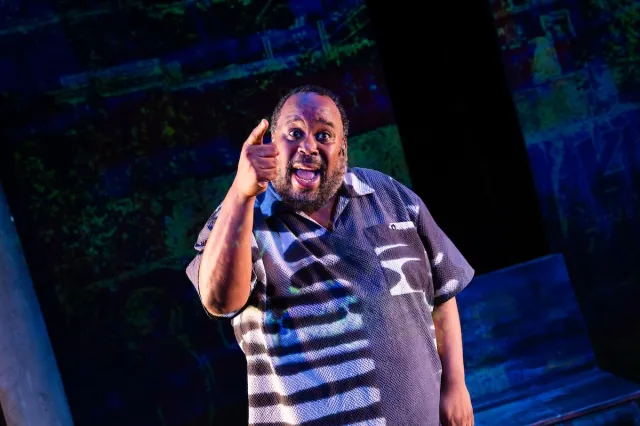
White brings warmth and gravitas as the steadying force in Ali’s life, evoking musical lineage and tradition with a sense of lived authority. It is no surprise that White is also an educator; the performance carries a richness that extends beyond the text. Desmond Sean Ellington, as Ali’s unreliable father, uses his voice with an almost hypnotic pull, drawing both mother and daughter in with ease, only to leave them behind. As Knuck, Jon Avery Worrell—a seemingly mismatched choice on paper—reveals unexpected tenderness and maturity, grounding the relationship in sincerity.
Choreographer Camille A. Brown blends freestyle movement with tight, ensemble-driven choreography, capturing the pulse of a city alive with restless, untapped talent. The cast of agile dancers fulfill those dreams. Robert Brill’s steel framework set evokes classic New York, from West Side Story’s fire escapes to the architectural language of Company. Dede Ayite’s costumes root the production firmly in mid-1990s street style—oversize jerseys, baggy jeans—reflecting young people caught between holding on to childhood and rushing toward adulthood.
Though built from familiar songs, Hell’s Kitchen transcends the limitations of the jukebox format to become something more cohesive and emotionally resonant. Director Michael Greif, who previously captured the spirit of the 1990s in Rent, brings a similar sensitivity here. He ensures that these songs remain grounded in character and circumstance, never letting the audience forget that real people with real stakes are giving voice to them.




source on Google
Featured In This Story

Latest Reviews
See all








Latest Videos

Watch the Trailer for Elsinore Starring Andrew Scott
The film is based on the true story of Ian Charleson, who played Hamlet at London’s National Theatre after being diagnosed with AIDS.