
Review: A “Problem Play”? Not This Winter’s Tale, Starring Raúl Esparza and Lily Rabe
Daniel Sullivan weaves his magic in the Public’s latest Shakespeare in the Park production.
 |
New York City
|
|
New York City
|
August 11, 2026
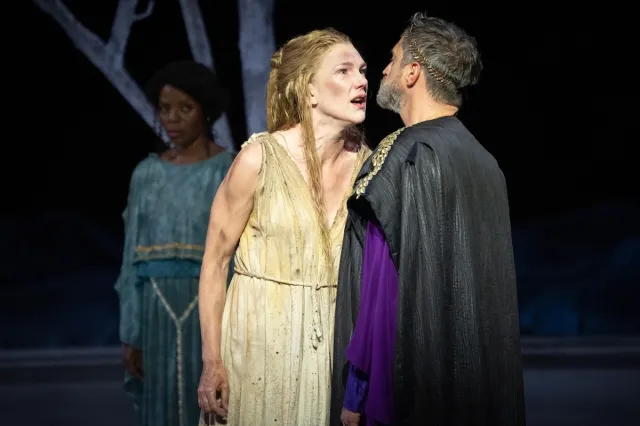
(© Joan Marcus)
A well-done revival of a less celebrated work can be even more valuable than one of a canonical classic. Such is the magic occurring at the Delacorte Theater with the Public Theater’s Free Shakespeare in the Park production of The Winter’s Tale. The narrative of this William Shakespeare play is so unwieldy that it gets produced less often than dramas like Othello and Hamlet and comedies like Much Ado About Nothing and As You Like It. Director Daniel Sullivan’s production, however, is done with enough intelligence and conviction to make a strong case for it as one of the Bard’s masterpieces.
Maruti Evans’s scenic design for the first half, characterized by doors and trees painted in rough shades of white, perfectly encapsulates its stark tragedy. Despite King Leontes (Raúl Esparza) and Polixenes (Gilbert Owuor), king of Bohemia, having been friends since childhood, Leontes becomes consumed by a jealous whim that his pregnant wife, Hermione (Lily Rabe), and Polixenes are having an affair. Among the results of Leontes’s commitment to his irrational suspicion are the imprisonment and eventual trial of Hermione; the death of their son Mamillius (Matthew Eby); and the banishment of their baby daughter Perdita to Bohemia, where a shepherd (Chuck Cooper) and his son (Michael Khalid Karadsheh) find her and raise her as their own.
Though the second half, beginning in Bohemia 16 years later, is lighter in tone—with Evans replacing the white doors with a raised platform of grass and colorful flowers—it, too, has its tensions. Polixenes discovers that his son, Florizel (Daniel Kyri), is in love with the now-grown Perdita (Isabela Ferrer) and tries to halt his plan to marry a girl he believes is a mere commoner. Camillo (Teagle F. Bougere), having once proved his moral mettle by defying Leontes’s order to poison Polixenes, does so again by helping Florizel and Perdita flee to Sicilia, where Leontes remains wracked with grief and regret. Order is eventually restored, but in The Winter’s Tale, a more profound type of redemption arrives in the form of a statue of Hermione, who collapsed at the end of her trial and has long been thought dead.
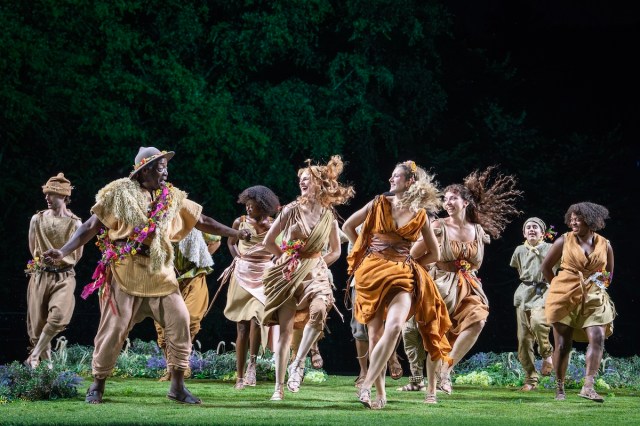
(© Joan Marcus)
With its bold mixture of tones, The Winter’s Tale is seen by some as one of Shakespeare’s “problem plays.” Sullivan’s production, however, suggests a more generous view. Considered by most scholars to be one of Shakespeare’s later works, the play feels like a summation in which he packed in just about everything that had obsessed him. From bawdy humor to the deepest horror, from jealous husbands to strong women, and with dashes of the supernatural at crucial moments, the play encompasses the full range of human experience (and beyond) in ways that feel singular even amid Shakespeare’s oeuvre.
Keen attention to psychological detail, allied with a willingness to embrace its emotional oscillations, is needed for such a vision to come off. In his long history with the Public Theater, Sullivan has proved himself to be one of Shakespeare’s finest interpreters, his productions marked by a trust in the text that feels refreshing amid a spate of half-baked high-concept Shakespeare interpretations (like Shakespeare in the Park’s recent Romeo and Juliet). Linda Cho’s judiciously designed costumes aid in comprehensibility, with the most noble characters, like Camillo and Antigonus (Steven Skybell), clad in blue, and some of the youngest in lighter, more translucent colors. Tom Kitt has composed effective interstitial music, performed by a live offstage quartet, that bridges scenes and enhances moods.
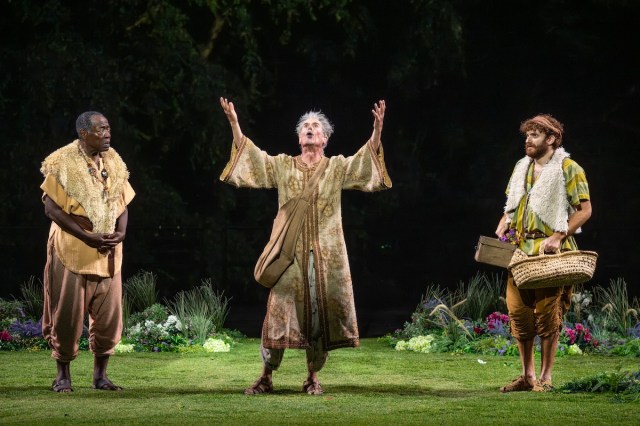
(© Joan Marcus)
Of course, it all comes down to the actors to make Shakespeare’s meaning clear to the audience, however ornate the language. Esparza’s rage in the first half is white-hot, his regret in the second half palpable. To some degree, Owuor channels Esparza’s anger when he chews out Florizel after discovering his dalliance with Perdita, suggesting that Leontes and Polixenes may not be so different. On the lighter end of the spectrum, Cooper and Karadsheh make for an enjoyable comic team, while Bougere radiates nobility mixed with pragmatism.
Two performers especially stand out, though. Skybell plays both the aforementioned Antigonus and the roguish comic-relief beggar Autolycus; as the latter, he shows a scene-stealing brio wholly unexpected based on his previous performances in Fiddler on the Roof and the recent Cabaret Broadway revival.
But Rabe reigns supreme as Hermione. The alternately shell-shocked and defiant way she delivers her trial monologue is searing. Even more memorable, though, is the radiance she exudes in its magical final scene. Her seraphic gaze alone is enough to embody Shakespeare’s dramatization of art as a tool for empathy and forgiveness. It also puts a transcendent finishing touch on a production that demonstrates the power of a great revival to shine the best possible light on a “problematic” work.




source on Google
Featured In This Story

Latest Reviews
See all








Latest Videos

Jocelyn Bioh, Whitney White, Jasmine Amy Rogers, and Patina Miller Talk School Girls
The playwright, director, and stars of School Girls; Or, the African Mean Girls Play discuss the comedy, sisterhood, and themes behind the new Broadway production.