
Review: Free Shakespeare in the Park's Romeo and Juliet, on ICE!
Saheem Ali directs a heavy-handed production that will probably provoke some eye-rolls.
 |
Off-Broadway
|
|
Off-Broadway
|
June 11, 2026

(© Joan Marcus)
In 2017, the Public Theater detonated a polarizing Julius Caesar at the Delacorte Theater, featuring a Caesar dressed as Donald Trump. When word got out, sponsors jumped ship and protesters, including right wing activist Laura Loomer, stormed the stage to protest the character’s stabbing.
Director Saheem Ali might be trying to repeat that kind of charged political theatermaking with his free Shakespeare in the Park staging of Romeo and Juliet, set in a desert cemetery in the shadow of the border wall in “Nueva Verona.” The Montagues are immigrants, and the Capulets are border patrol agents. But the production, which uncomfortably grafts this highly specific contemporary gloss onto the now-bilingual text, is both heavy-handed and incoherent, and more likely to provoke eye-rolls than demonstrations.
Ali, who movingly wove some Swahili into last summer’s similarly underwhelming Twelfth Night, goes further here, with large swaths of the play translated by Alfredo Michel Modenessi into Spanish. The Montagues sometimes speak Spanish together, and Juliet (Ra’Mya Latiah Aikens), rebelling against her father’s anti-immigrant sentiment, is especially excited to play out her love scenes in her new boyfriend’s native tongue. Daniel Bravo Hernández’s goofily suave Romeo especially thrives in persuasively navigating the code-switching between English and Spanish, and there’s extra heft when ICE agent Tybalt (Ariyan Kassam) exclaims, overhearing Romeo soliloquizing in Spanish, that “this, by his voice, should be a Montague.”
The couple’s bilingual communication lacks linguistically star-crossed stakes. There’s no dramatic demand for Juliet to keep guiding Romeo into Spanish since they both could be speaking fluent English. Sure, it’s sweet that she wants to show her cultural openness, but this production also emphasizes how Juliet’s obsession with Romeo is also an act of parental defiance: since Español is a no-go in the Capulet household, there’s a whiff of fetishization in how eagerly Juliet relishes staging her passion in a forbidden language. Her fluency also seems to accelerate fantastically quickly.
(© Joan Marcus)
But Ali knows how to direct actors to communicate meaning through gesture and vibes even when some audiences won’t understand the language. For audiences with partial fluency or less, the Spanish passages may work best since there’s no expectation of understanding everything word for word. But good luck following the English sections: Mercutio’s Queen Mab speech is reduced to playful thrusting with no sense that the character knows why he’s saying those specific words. Instead of discovering character through the text, Ali’s cast more often superimposes broad-strokes emotion or physical caricature on top of it.
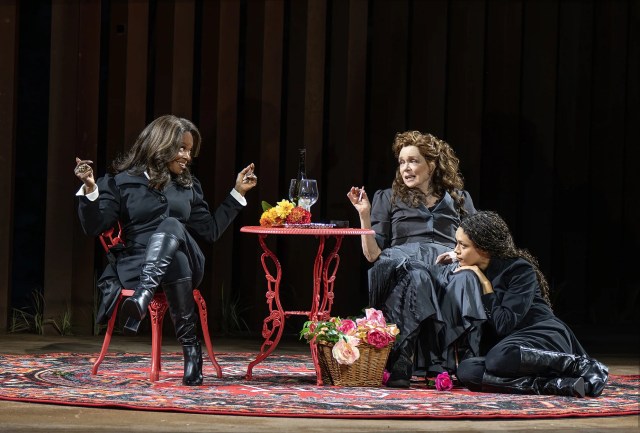
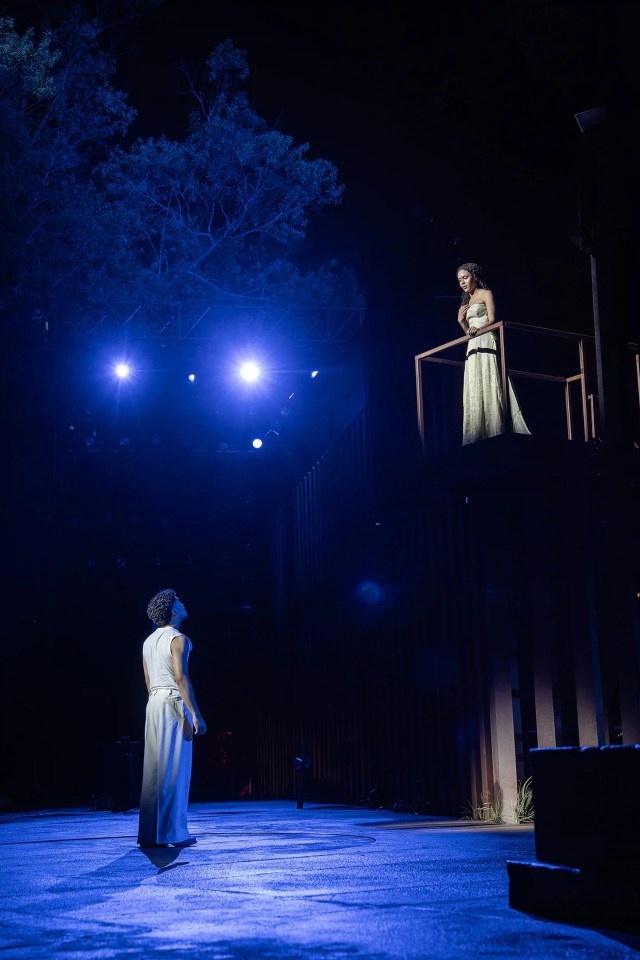
As a result, Aikens misses most of the adolescent snark and rebellious humor in Juliet’s banter with her mother (an underutilized LaChanze) and the Nurse (Deirdre O’Connell); she’s best when she leans into Juliet’s edginess. And though she and Hernández are cute together in the balcony scene, their chances at reaching more dramatic heights are swallowed by the muddy resetting.
O’Connell gives a compelling salt-of-the-earth performance as the Nurse, speaking in an unplaceable accent with a clipped delivery that earns some awkward, unintended laughs. Francis Jue charms as a particularly gossipy Friar Laurence whose long-standing affectionate mentorship of Romeo seems believable here. The real scene-stealer is Rachel Crowl in the cameo role of the apothecary who sells Romeo fatal drugs. For just a couple minutes, Crowl slows things down to focus the audience on a suddenly complex character caught between desperation for money and pained conscience in selling Romeo the poison: “My poverty, but not my will, consents,” she eventually accedes, the culmination of a riveting teensy playlet.
The whole point of Romeo and Juliet is that the feuding Capulets and Montagues are equally to blame for their rootless “ancient grudge.” “A plague o’ both your houses,” curses a dying Mercutio (Caleb Joshua Eberhardt), now a leading anti-ICE protester, suggesting (incomprehensibly given the character’s newfound politics) that there are good (or equally bad) people on both sides. But that’s not the case, this production otherwise argues, making it clear that the Capulets are the villains, driven by xenophobic hatred, while the Montagues merely defend themselves from state-sanctioned violence.
That imbalance also collapses the play’s hopeful ending since a resolution between one immigrant border community and one racist family cannot topple a systemic threat. It’s nice that Montague (Jason Manuel Olazábal) and Capulet (Glenn Fleshler) hug it out, but that feels like a hollow resolution. Won’t DHS just send new agents who don’t care about suicidal teens? In the face of a major humanitarian crisis, skimming the surface like this isn’t the sort of response to ICE the real world can afford.
(© Joan Marcus)




source on Google
Featured In This Story

Latest Reviews
See all









Latest Videos
Watch: Ellen Greene Reflects on the Enduring Legacy of Little Shop of Horrors
Frank Oz’s cult classic movie-musical has gotten a new 4K restoration in celebration of its 40th anniversary.